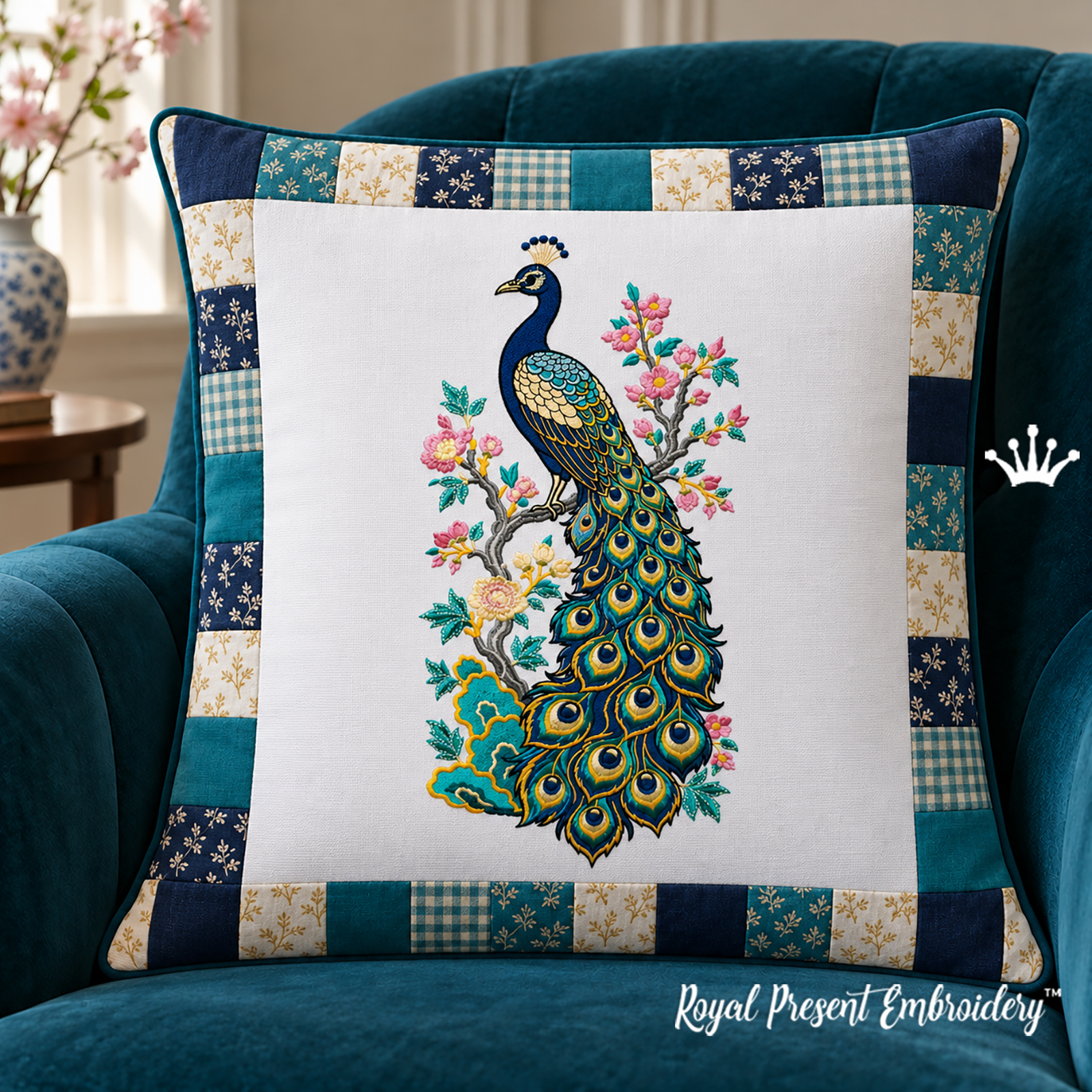
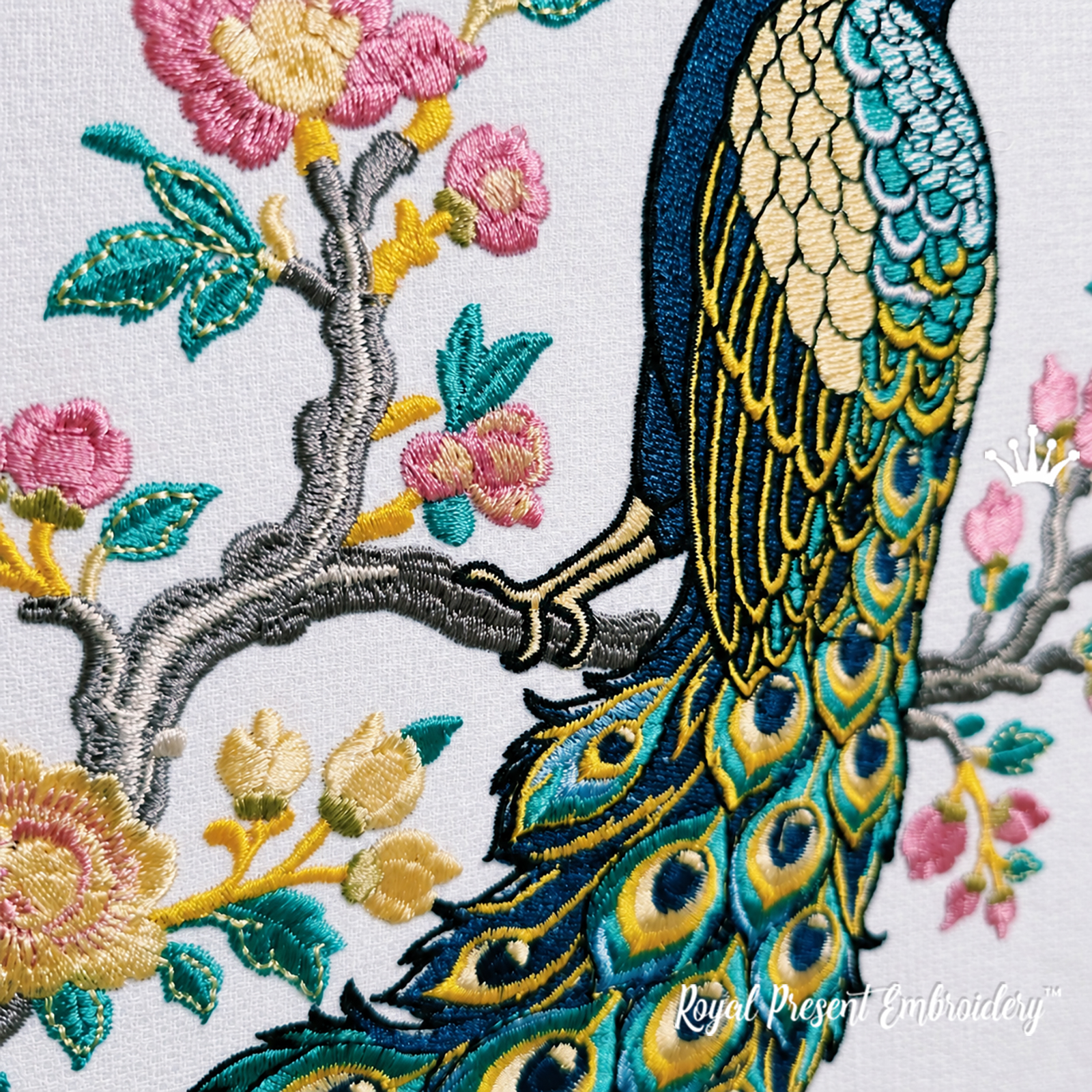
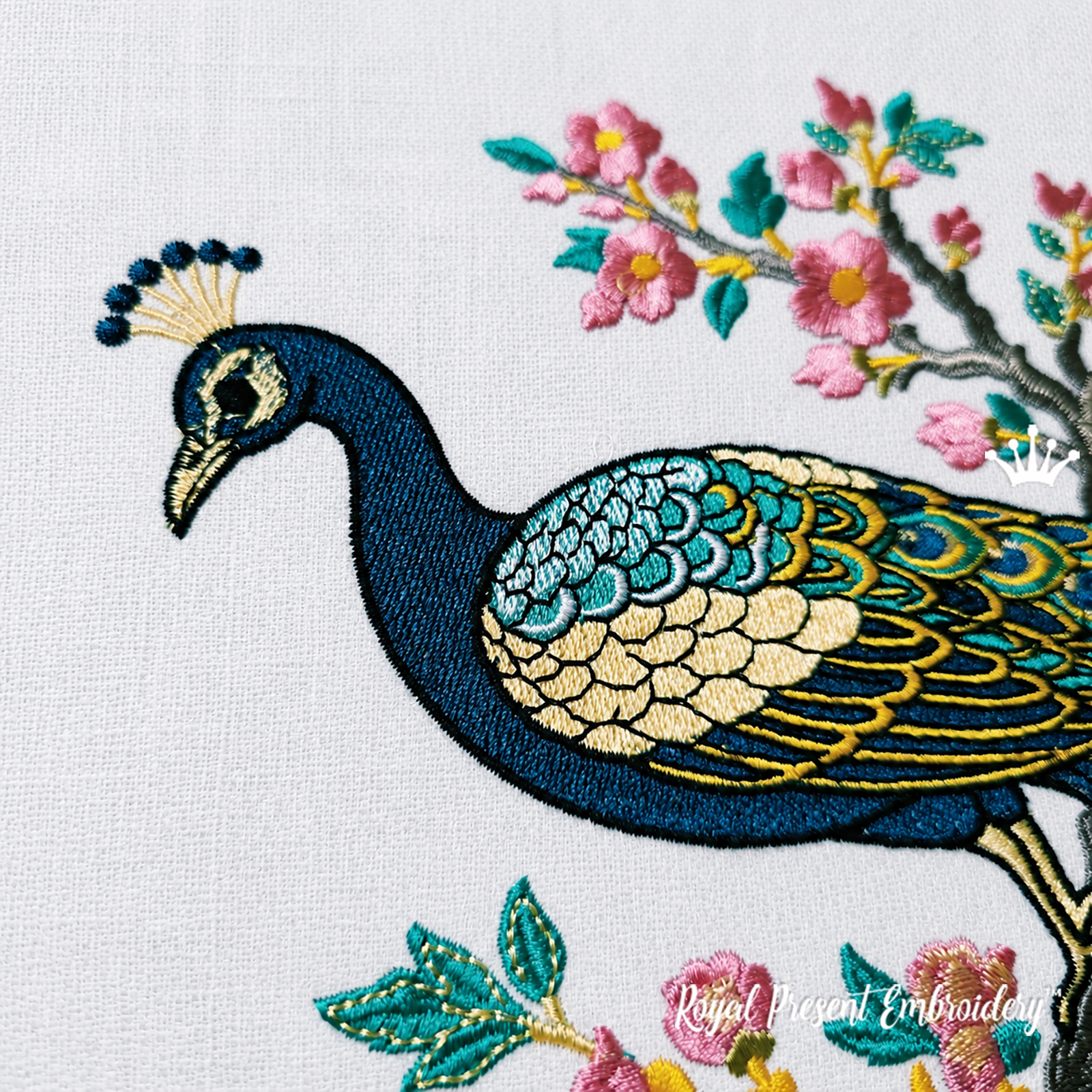
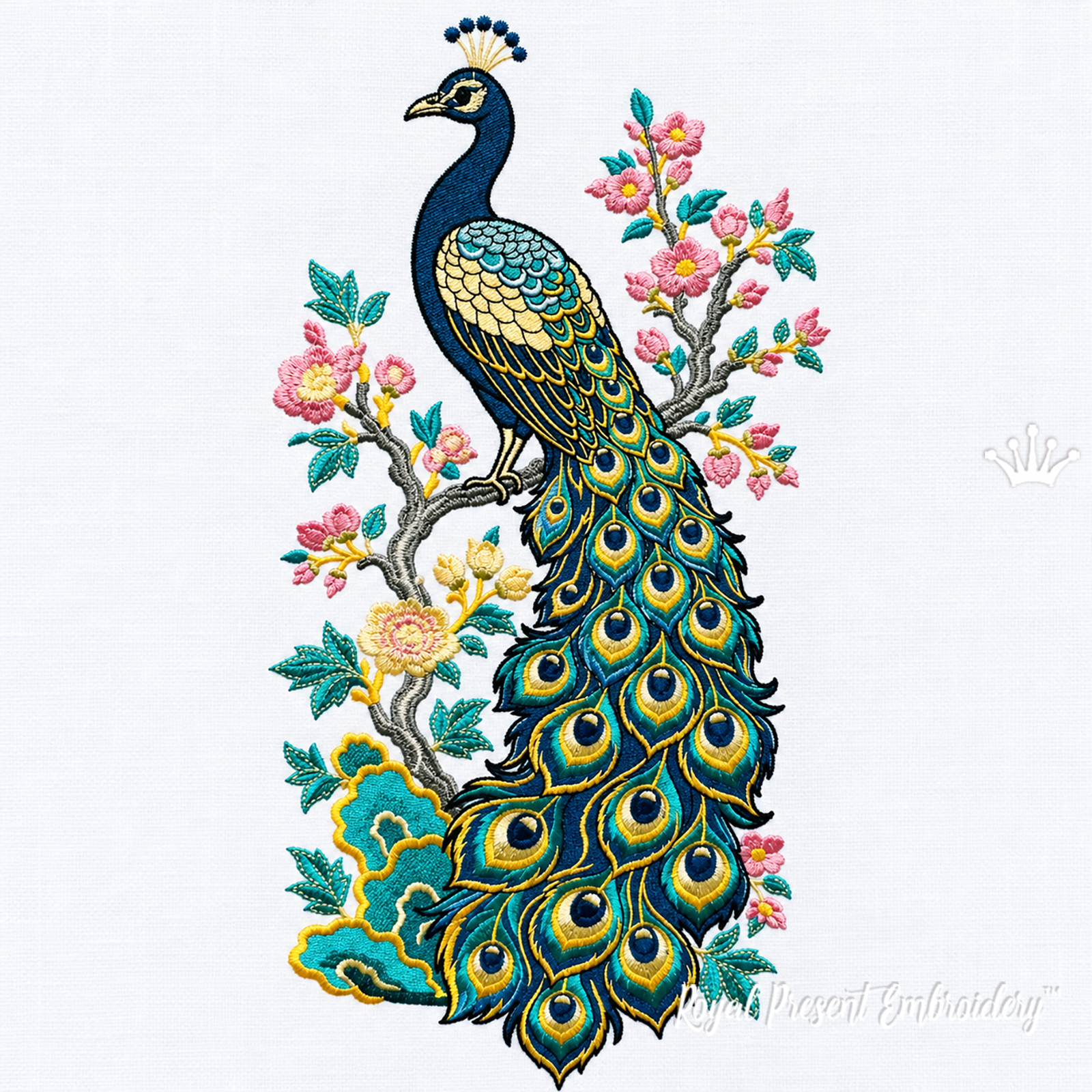
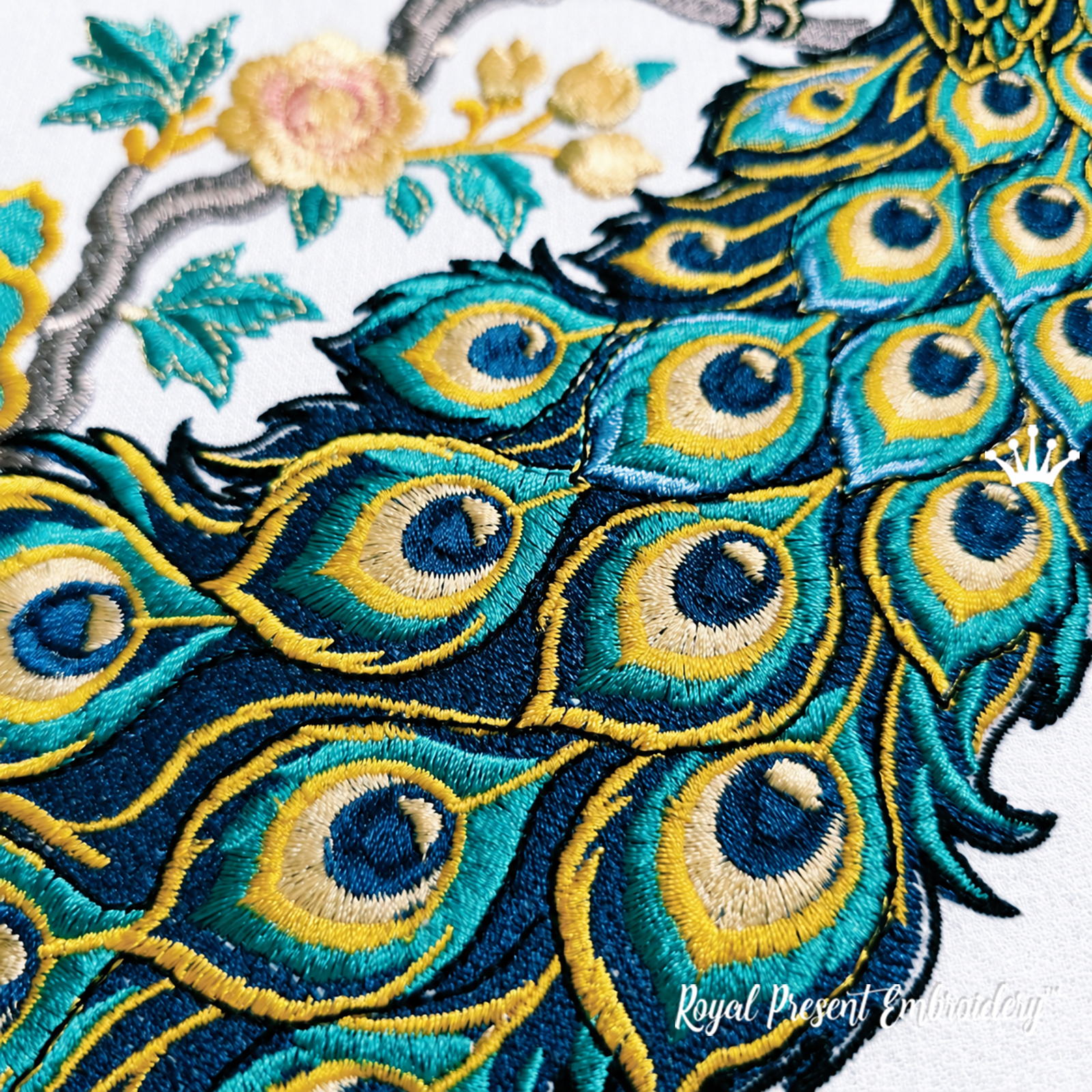
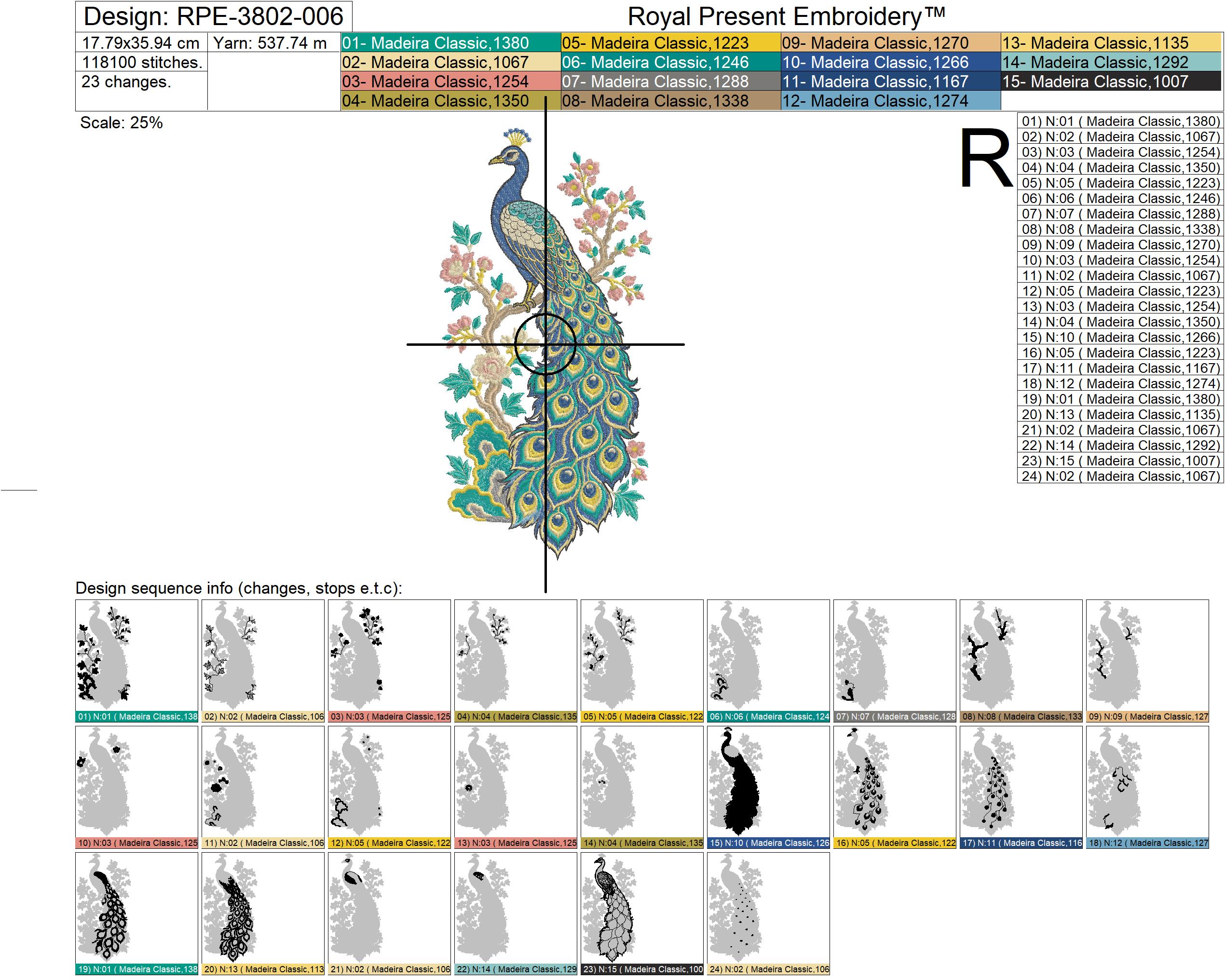
Large Peacock with Long Tail for Mega Hoops is a vertical design with a side-profile bird among flowering branches. The cascading tail with eyespot feathers, deep-blue and turquoise plumage, gold accents, pink flowers and leaves form a complete decorative composition for a large cushion front, textile wall panel, jacket back, bag panel or quilt.
The download contains four original machine embroidery files in all formats listed below. This is a digital product: no finished item, fabric, thread, stabilizer or hoop is included. Because of the density and length of the composition, always run the machine trace before starting the final project.
Technical sizes and hoops
Large Peacock with Long Tail for Mega Hoops
Size: 177.9x359.4 mm (7.00x14.15 "), Stitches: 118100
Hoop: 200x360 mm (8x14")
Size: 197.2x398.3 mm (7.76x15.68 "), Stitches: 134500
Hoop: 200x400 mm (8x16")
Size: 218.3x441.4 mm (8.59x17.38 "), Stitches: 155700
Hoop: 240x450 mm (9.5x18")
Size: 238.4x481.8 mm (9.39x18.97 "), Stitches: 175700
Hoop: 360x500 mm (14x20")
Formats: .dst, .jef, .pec, .vip, .hus, .pes, .exp, .sew, .dat, .vp3, .xxx
Recommended products
 Peacock for Mega Hoop |
 Set of Peacock Feathers |
 Circle Shaped Peacock |
 Beautiful Peacock Corner |
Madeira Classic thread chart
Thread numbers and visible shades are taken from the supplied colour charts. Match thread by Madeira number rather than by a screen colour.
| Colour | Madeira number | Stitched element |
|---|---|---|
|
|
Madeira Classic 1380 | Turquoise leaves and plumage details. |
|
|
Madeira Classic 1067 | Light feathers, flower and tail details. |
|
|
Madeira Classic 1254 | Pink flower petals. |
|
|
Madeira Classic 1350 | Olive shades in branches and decorative details. |
|
|
Madeira Classic 1223 | Gold outlines, crown and flower centres. |
|
|
Madeira Classic 1246 | Dark turquoise leaves and plumage. |
|
|
Madeira Classic 1288 | Grey shading in branches and flowers. |
|
|
Madeira Classic 1338 | Brown-beige branches. |
|
|
Madeira Classic 1270 | Warm light details in branches and flowers. |
|
|
Madeira Classic 1266 | Blue areas of the body and tail. |
|
|
Madeira Classic 1167 | Dark blue peacock outlines and plumage. |
|
|
Madeira Classic 1274 | Blue accents in feathers and crest. |
|
|
Madeira Classic 1135 | Light-gold feathers and accents. |
|
|
Madeira Classic 1292 | Light-turquoise feather and leaf accents. |
|
|
Madeira Classic 1007 | Dark outlines and fine composition details. |
FAQ
What stabilizer is suitable for this dense peacock on a large cushion or wall panel?
Choose a stable non-stretch ground such as cotton twill, firm linen, furnishing cotton or canvas. Use sufficient tear-away or cut-away backing; on soft or open-weave fabric, add a second layer. Stitch a test on the same fabric, thread and backing first: the large filled areas must lie flat without drawing the ground inward or creating ripples around the tail.
How should I hoop a long vertical file?
Compare the file measurements with your machine’s true embroidery field, not only with the hoop name. Mark the vertical centre line, secure backing and fabric without diagonal tension, then run the trace. It is especially important for the long tail: the needle must not reach the frame, a cushion seam, a zip or the back layer of a finished cover.
Can I embroider the peacock on a ready-made cushion cover?
Yes, if only the front panel enters the hoop freely and all bulky seams stay outside the stitch field. For a cover that cannot be conventionally hooped, hoop self-adhesive tear-away backing, score only its release paper and fix the front panel onto the adhesive. Use a basting stitch around the design if your machine provides one, then run the trace.
How can I reduce thread breaks in a file with a high stitch count?
Install a new 75/11 or 80/12 embroidery needle, wind an even bobbin and clean the hook area before starting. Use quality 40-weight thread, test tension on a sample and do not raise the speed through dense tail sections. Stop at the first sign of loops or thread abrasion: continuing with damaged thread can spoil a large section that is difficult to repair.

 Get Sign-In Link
 Login with Google
 Login with Facebook
 Login with Amazon
 Login with Paypal