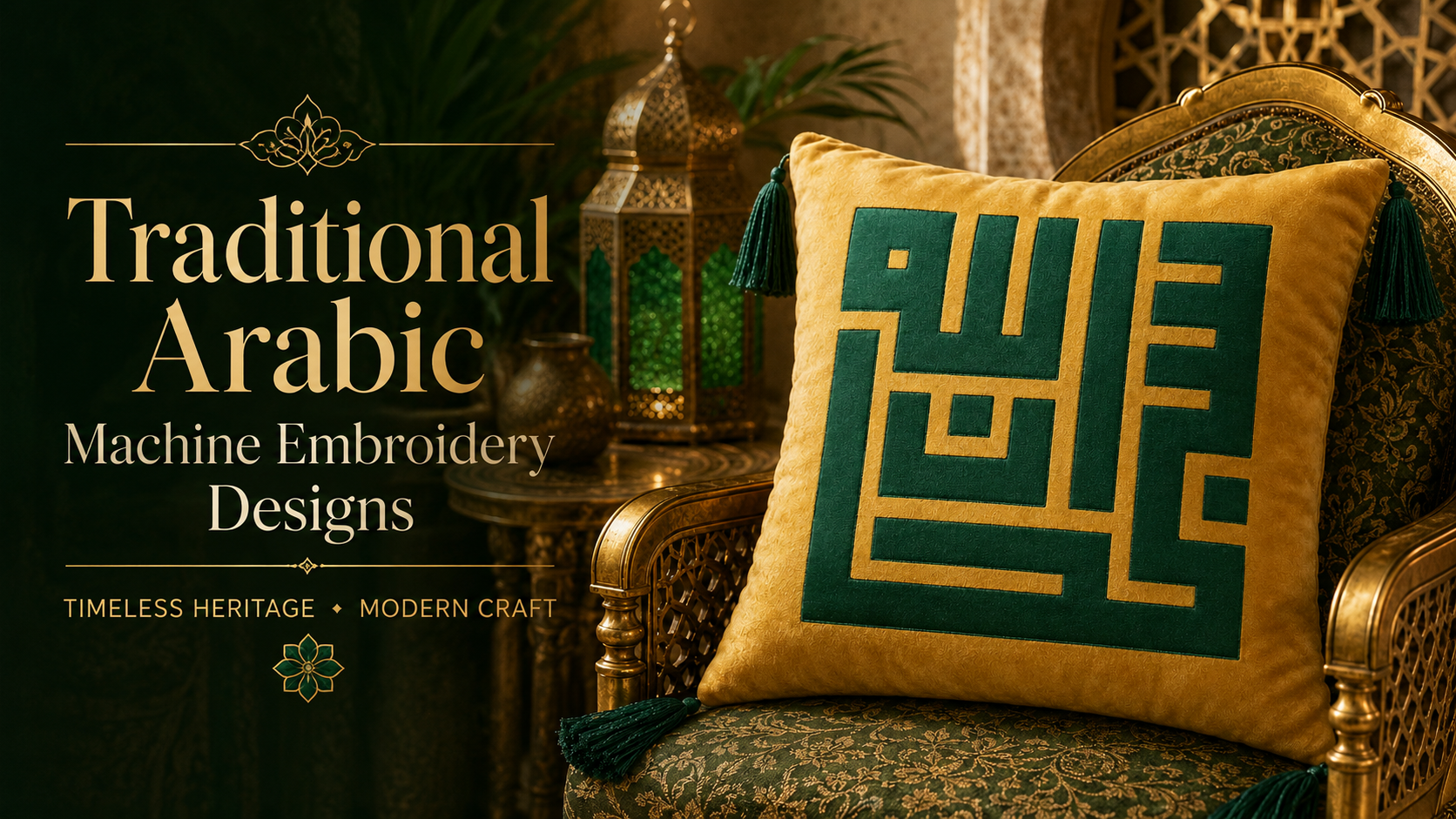
Traditional Arabic machine embroidery designs include several distinct visual languages: Arabic calligraphy, Islamic religious motifs, Moroccan arabesques, Moorish and Andalusian geometry, and related Ottoman, Persian and Central Asian floral ornament. They can be used on Ramadan and Eid textiles, monogrammed linens, cushions, table runners, wall panels, book covers and decorative gifts.
This guide helps you choose an appropriate design, thread, fabric and stabilizer. Every item shown below is a downloadable digital file for an embroidery machine, not a finished embroidered product.
Arabic, Islamic, Moroccan and Oriental: what is the difference?
These terms overlap in online searches, but they are not interchangeable. Choosing the more precise term makes the finished textile feel intentional and helps avoid treating several different traditions as one generic style.
| Style | Typical visual language | Best uses | Important note |
|---|---|---|---|
| Arabic | Arabic lettering, calligraphic curves, arabesques and regional ornament | Textile panels, cushions, book covers and festive gifts | Never mirror readable Arabic writing. |
| Islamic | Religious calligraphy, Ramadan greetings, crescents, stars and geometric ornament | Ramadan and Eid décor, prayer-room textiles and respectful gifts | Religious wording should be placed where it stays clean and is treated respectfully. |
| Moroccan and Moorish | Interlacing geometry, arabesques, floral frames and zellige-inspired rhythm | Monograms, borders, table linens and interior textiles | These designs may be decorative rather than religious. |
| Andalusian | Bold geometry and floral ornament associated with southern Spain's layered decorative heritage | Quilt blocks, placemats, runners and cushions | Strong repeated modules work especially well in coordinated table settings. |
| Ottoman, Persian and Central Asian | Formal flowers, medallions, vines, palace-style borders and saturated jewel colours | Statement borders, monogram frames and decorative panels | These are related navigation styles, not synonyms for Arabic embroidery. |
Arabic calligraphy and Islamic machine embroidery designs
Choose calligraphy for a clear verbal message and crescent, star or geometric motifs when you want a symbolic or decorative result. Check the wording, orientation and final placement before stitching.
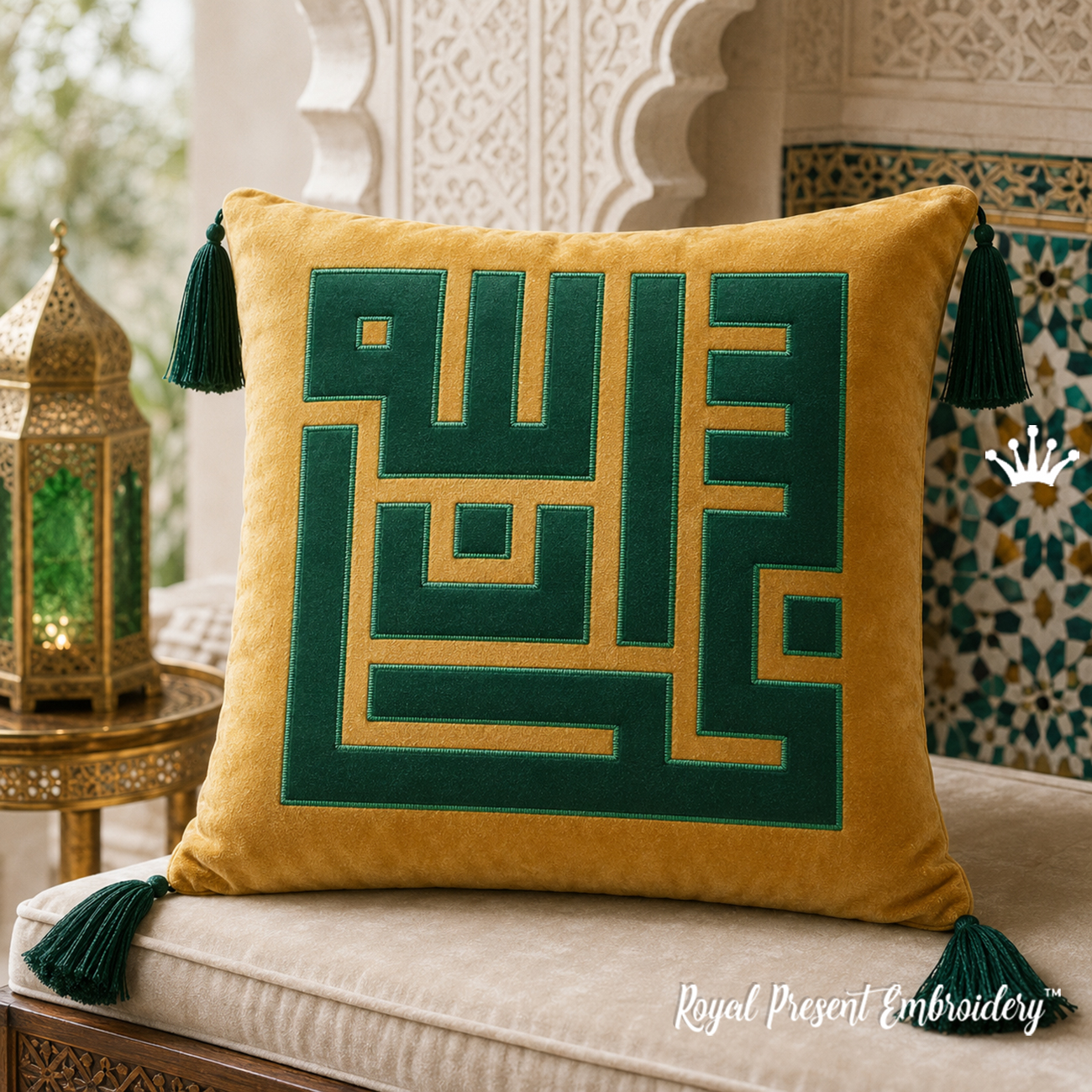
Arabic Calligraphy Applique – 3 Sizes
A complete unsplit appliqué composition for large cushions and textile wall panels.
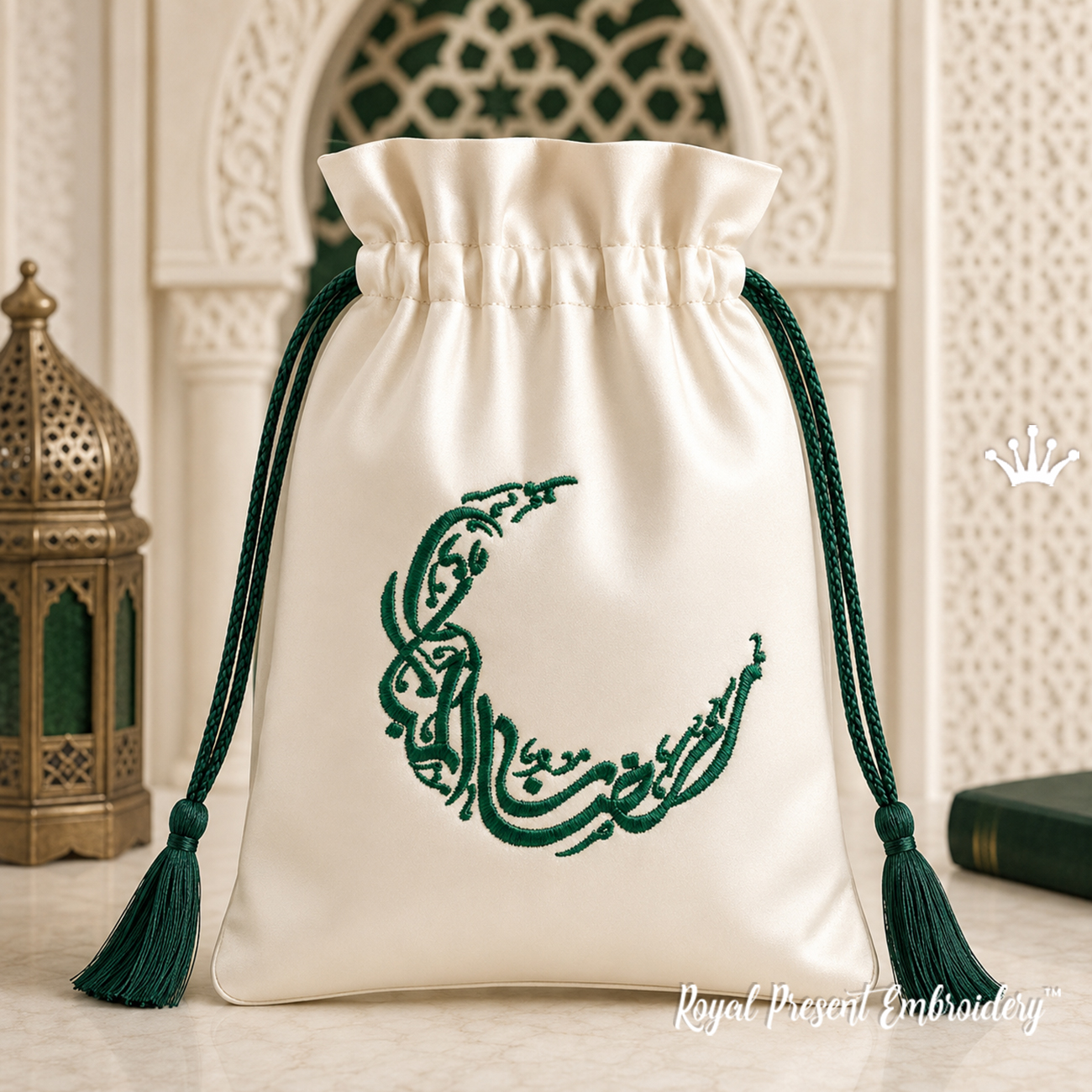
Ramadan Kareem Crescent – 6 Sizes
A one-colour Arabic greeting shaped as a crescent for linens, cushions and festive gifts.
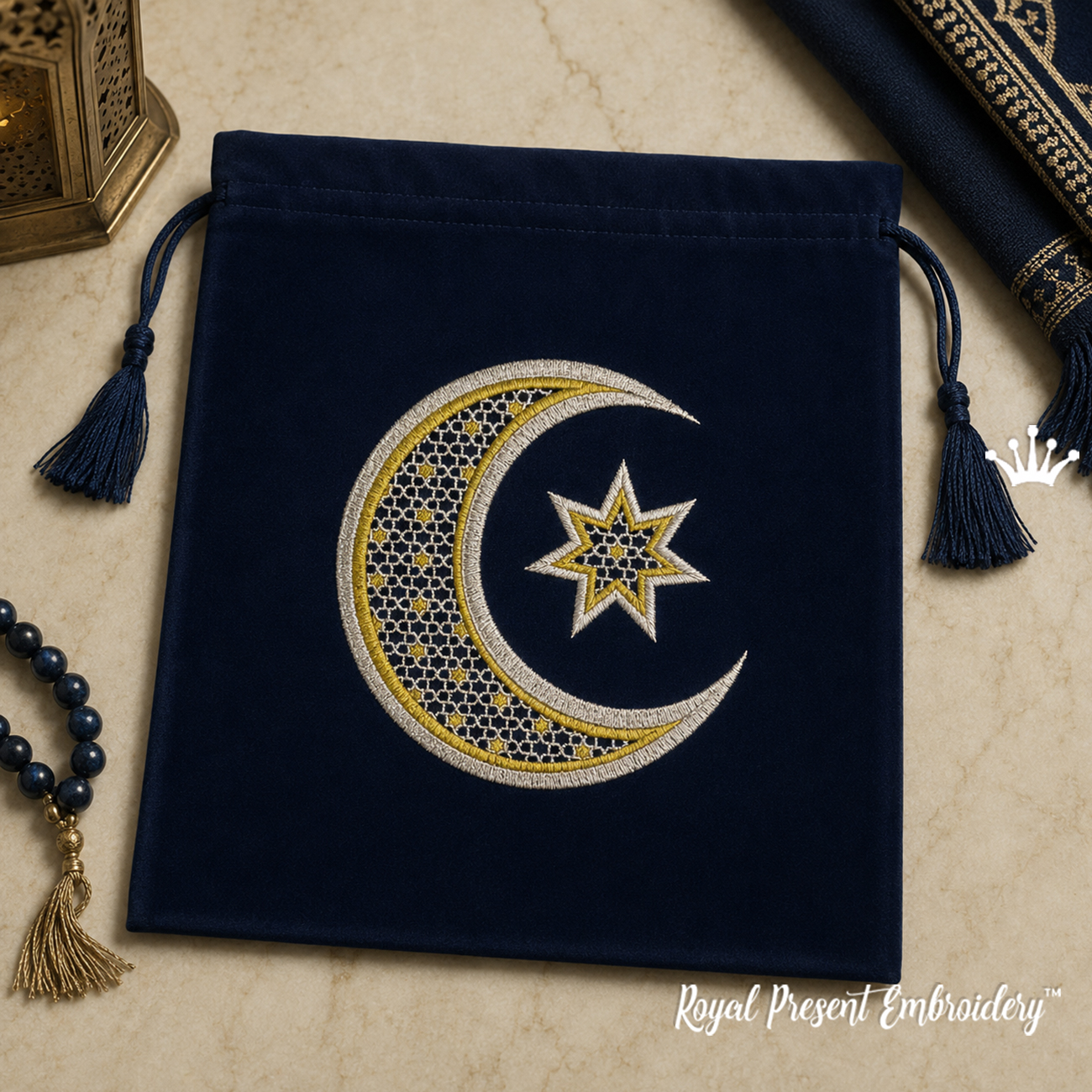
Islamic Crescent Moon and Star – 3 Sizes
An ornamental symbol for ceremonial accessories, home décor and textile panels.
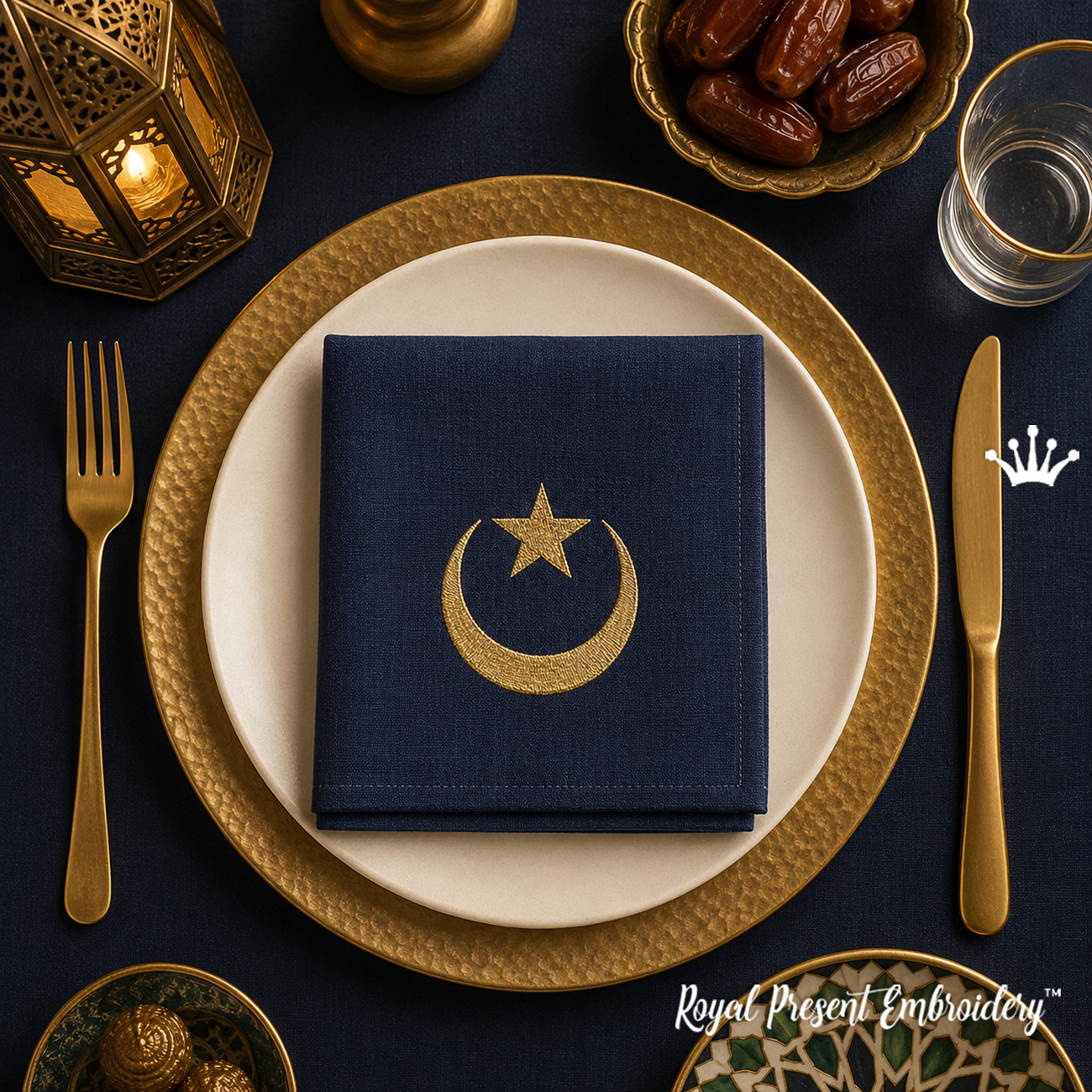
Gold Islamic Crescent and Star for 4x4 Hoop
A compact motif for napkins, gift bags, small panels and book covers.
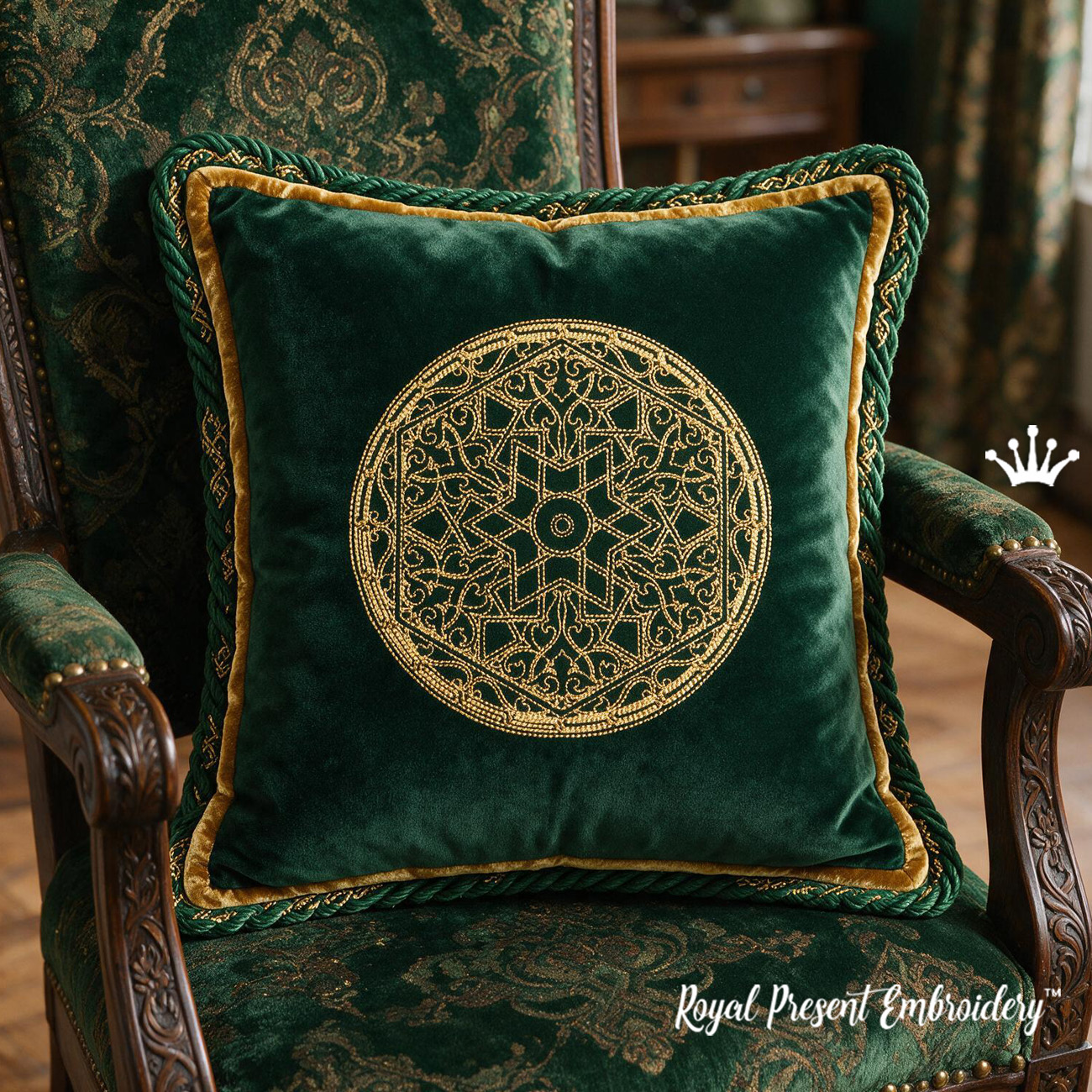
A large one-colour geometric line design for cushions and decorative panels.
Moroccan machine embroidery designs
Moroccan-style embroidery becomes most convincing through controlled repetition and a limited palette. Use one dominant jewel colour, one lighter companion and a small metallic accent rather than assigning a different colour to every element.
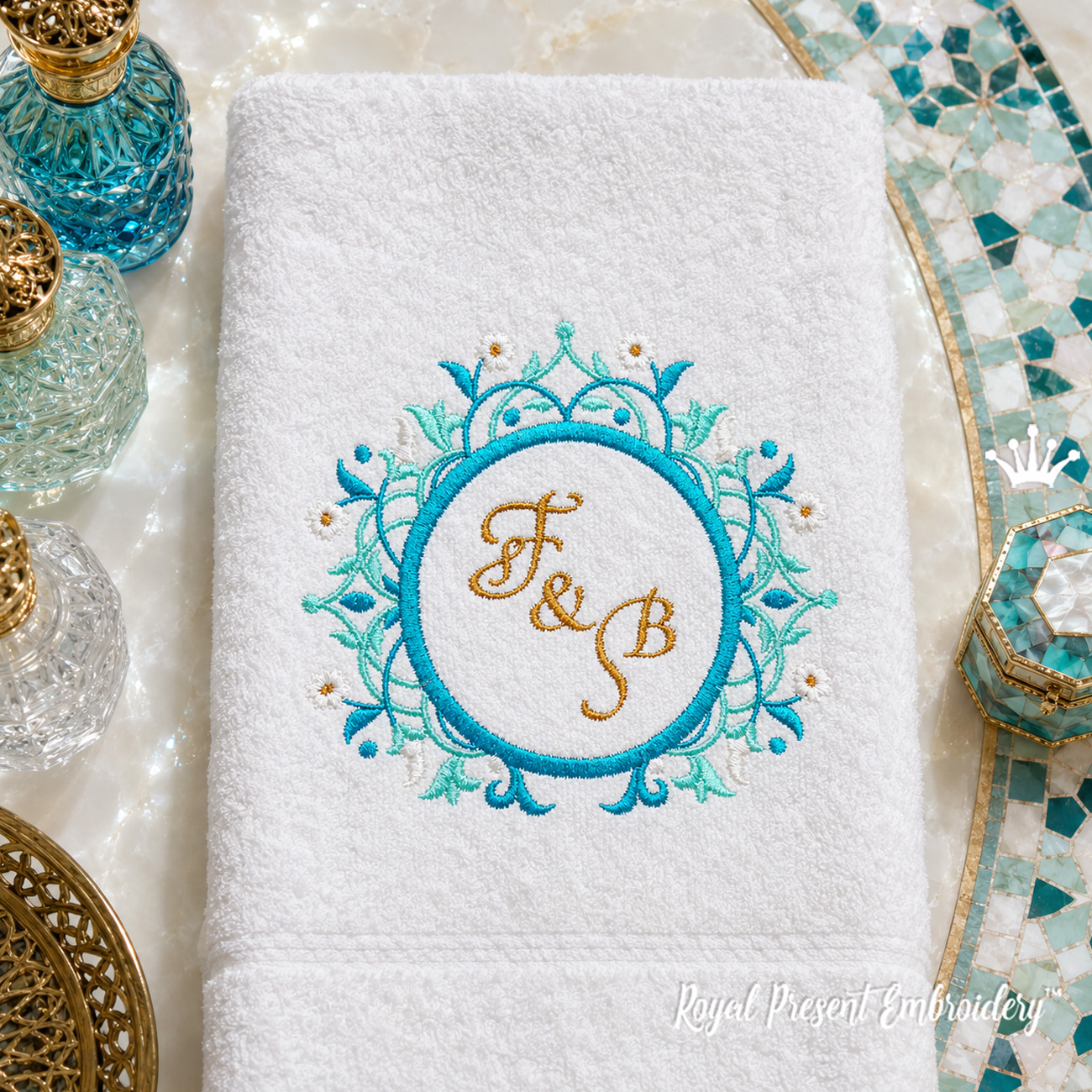
Moroccan Floral Monogram Frame
A decorative open frame for initials on towels, napkins and personalized gifts.
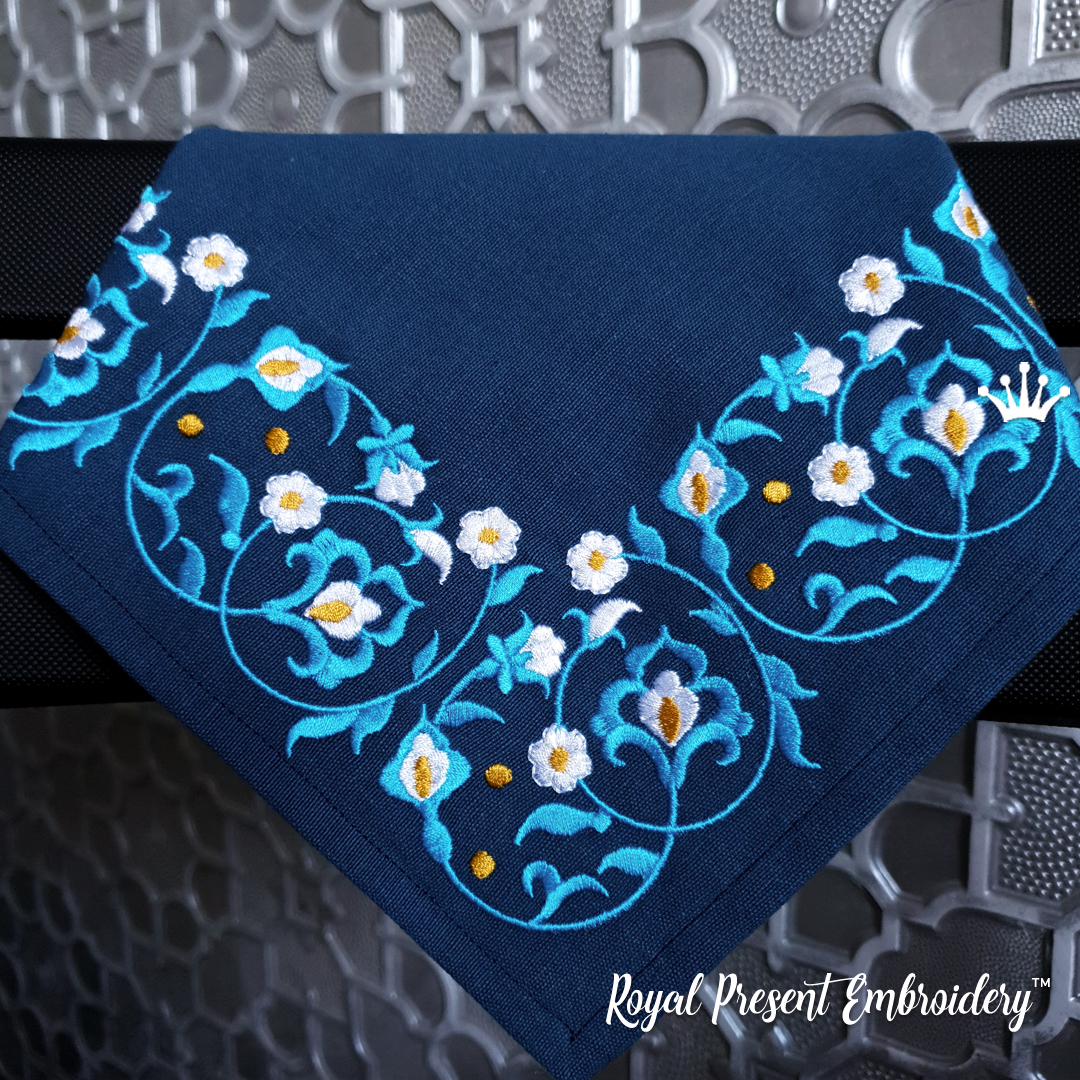
A compact ornamental border for cuffs, runners, towels and coordinated linen sets.
Andalusian and Moorish embroidery projects
Square Andalusian modules can be used individually or repeated as a controlled textile rhythm. Before making a full set, embroider one block and check whether adjacent edges align visually at the spacing you plan to use.
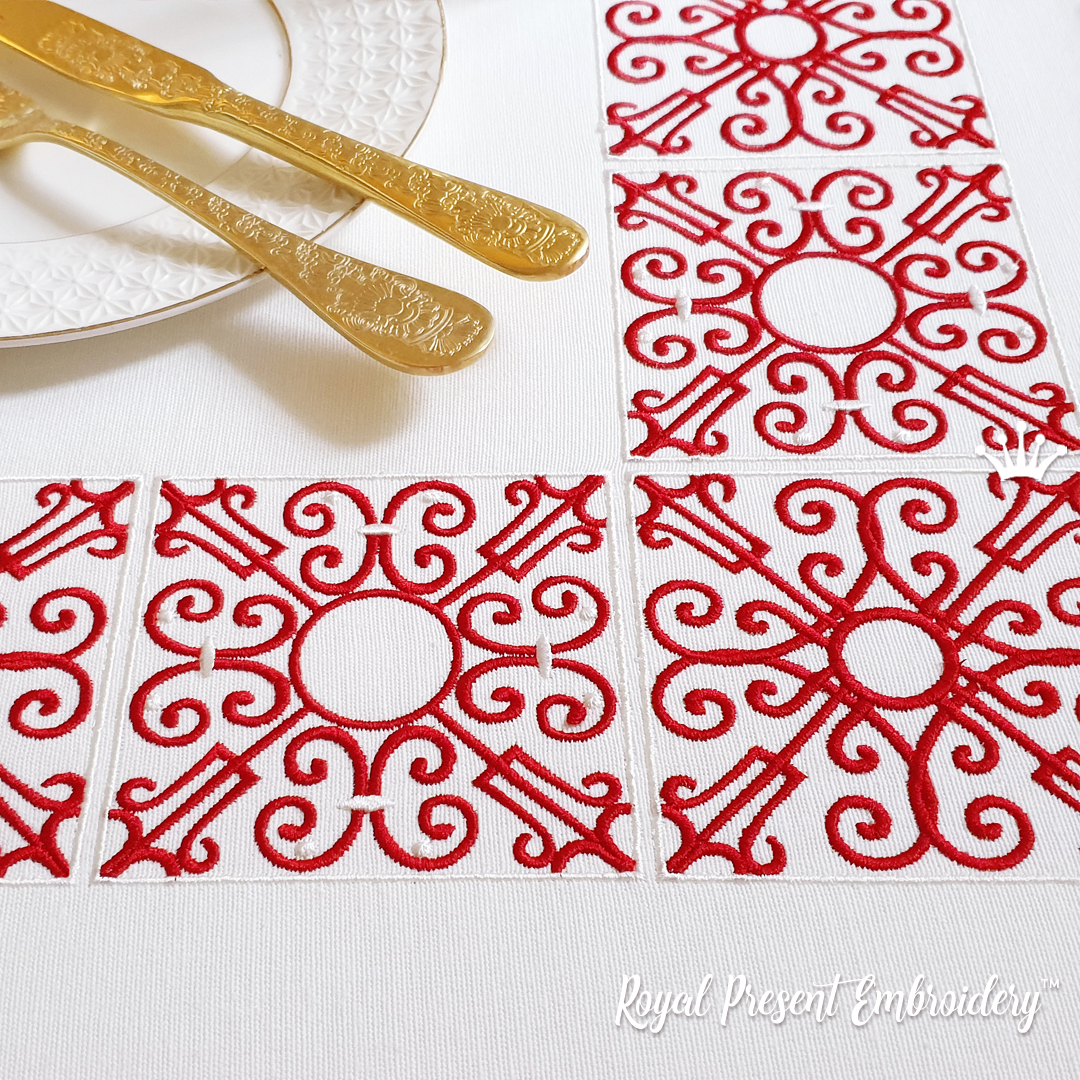
Andalusian Ornaments Set – 4 Sizes
Square modules for patchwork, cushions, borders and repeating textile compositions.
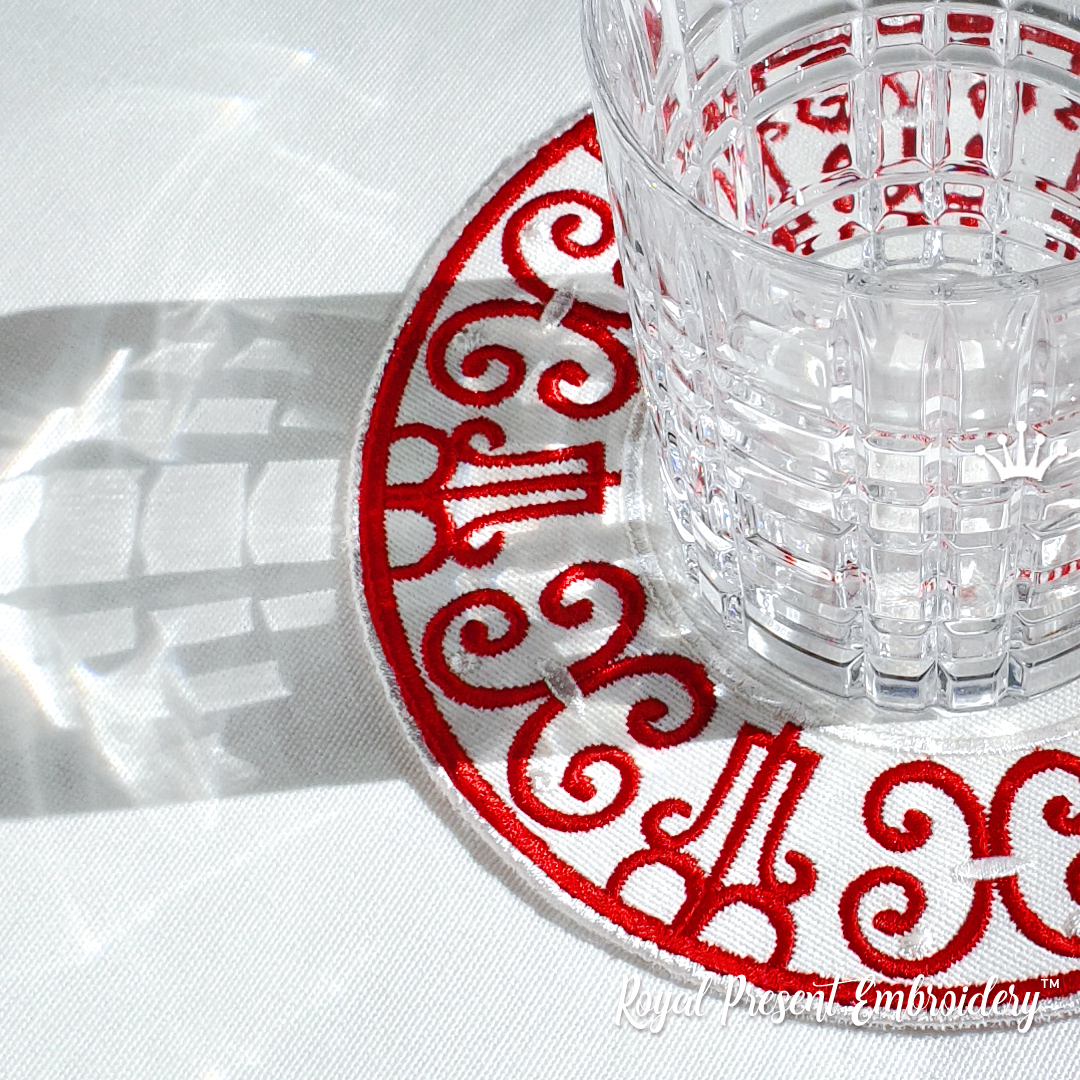
ITH Andalusian Table Placemat – 7 Sizes
An in-the-hoop project for coordinated Mediterranean and Moorish-style table settings.
Eastern, Ottoman and Persian-inspired ornament
This group expands the visual range beyond Arabic and Moroccan design. It includes formal palace florals, medallions and borders inspired by several neighboring traditions. Use these labels precisely; Oriental is a broad decorative catalog term, not the name of one country or one embroidery tradition.
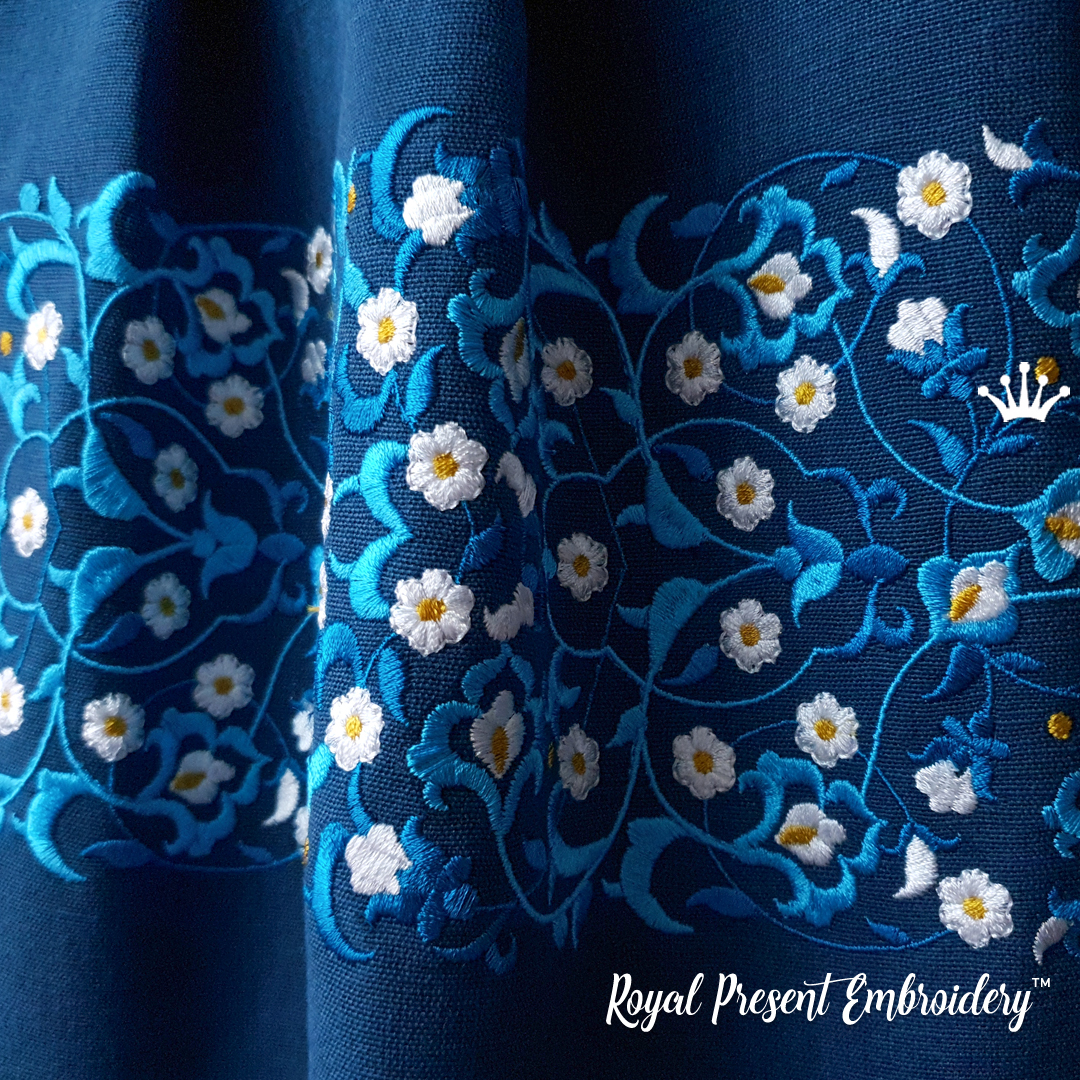
A richly coloured architectural floral border inspired by Central Asian decoration.
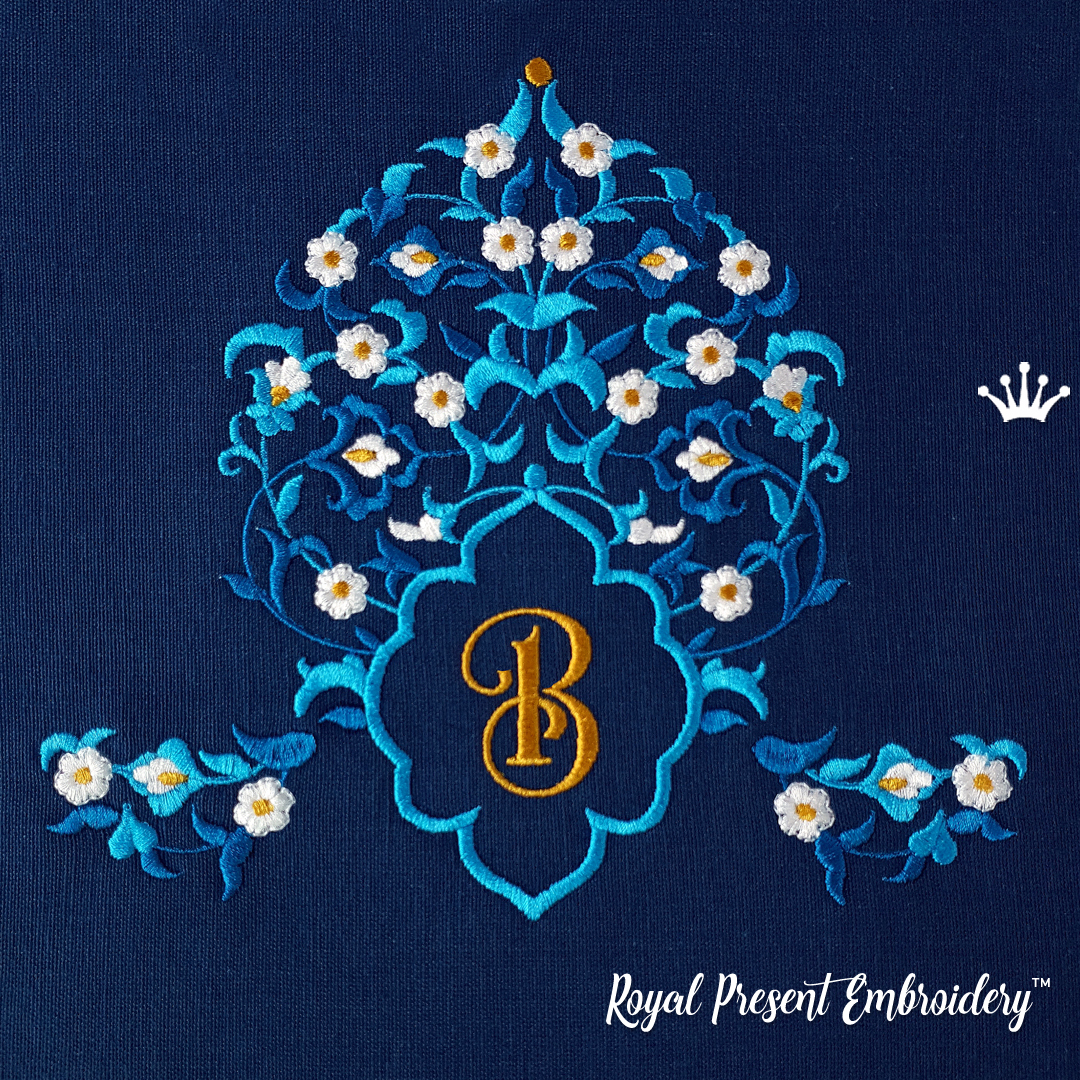
Eastern Blank Monogram – 4 Sizes
A formal floral frame plus separate décor elements; the embroidery font is not included.
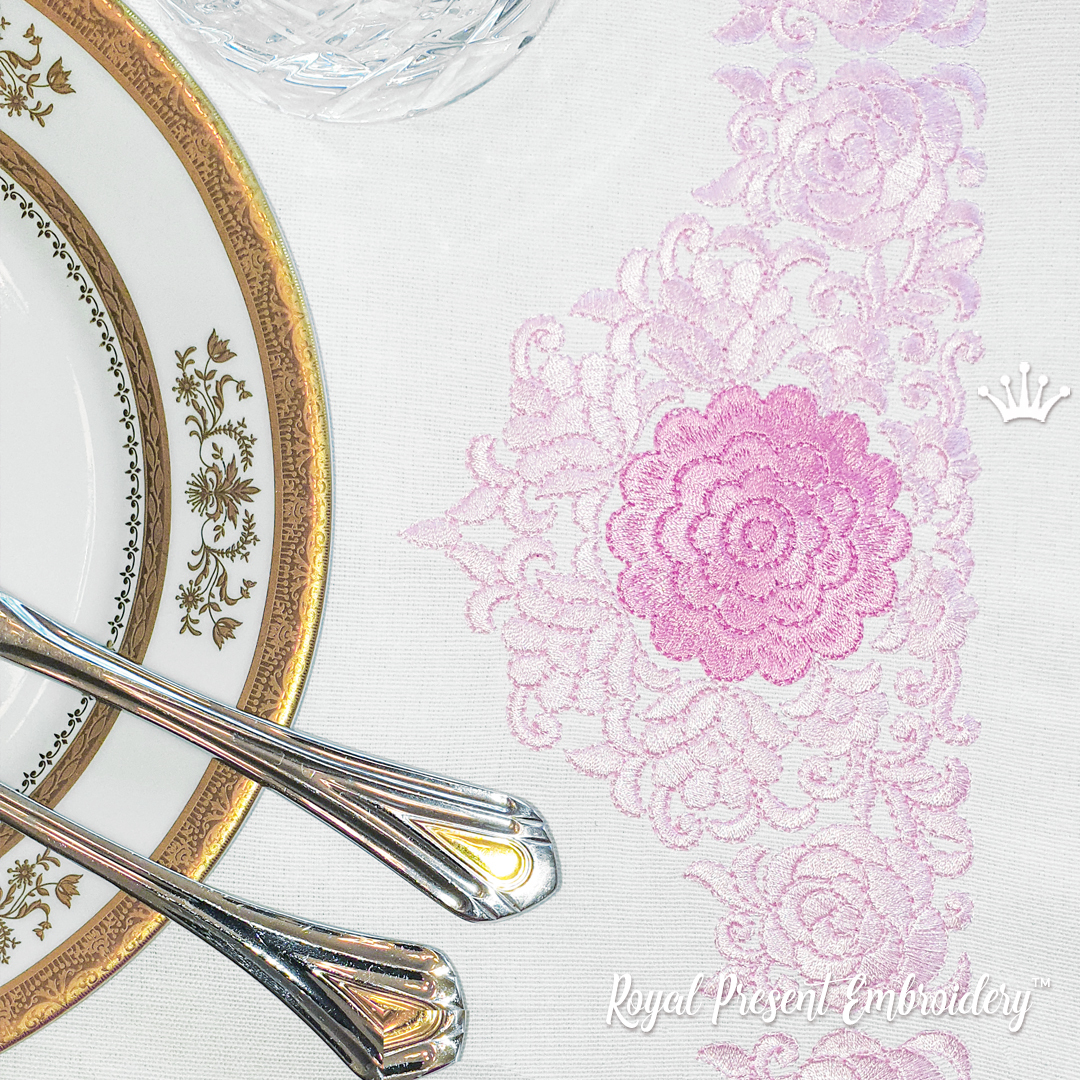
Oriental Floral Border – 6 Sizes
A versatile decorative border for towels, runners, garments and cushion panels.
A balanced floral square for quilt blocks, cushions and centered textile decoration.
A circular floral composition for formal linens, medallion layouts and statement panels.
Which embroidery thread gives the best result?
Rayon or viscose 40 wt: the best first choice for decorative shine
For cushions, wall panels, formal table linens and richly coloured ornamental embroidery, rayon or viscose 40 wt is usually the strongest visual choice. Its soft, silk-like lustre changes with stitch direction, so arabesques, leaves and satin borders gain depth without looking harsh. Madeira Classic 40 is suitable for standard 40 wt digitizing and is normally used with a 65/9 to 75/11 needle selected for the fabric.
Polyester 40 wt: better for hard use and frequent washing
Choose polyester for towels, children's items, hospitality linens, outdoor textiles or anything that will be washed often. It is more resistant to abrasion, chemicals and demanding care. Its shine is usually crisper and less fluid than viscose, which can be an advantage in geometric designs.
Metallic thread: use it as controlled light, not automatic coverage
Metallic thread is ideal for a narrow border, flower centers, selected calligraphic strokes or one small focal element. A ready-made design digitized for ordinary 40 wt thread may contain dense overlaps or sharp direction changes that are unfriendly to metallic thread. Test the exact file before replacing a complete colour block, and do not assume that every full-fill area can be stitched in metallic without adjustment.
Madeira metallic colours for a refined Arabic or Moroccan palette
These Madeira FS 40 shades create a quieter, more architectural effect than bright yellow gold. Pair one metallic with two or three non-metallic colours rather than using several competing metallics in one design.
Use with ivory, turquoise and deep petrol blue.
Use with midnight blue, emerald and warm white.
Use with burgundy, aubergine, dusty rose and cream.
Use with terracotta, dark teal and natural linen.
Use with black, peacock blue and muted olive.
Use with charcoal, sapphire and cool white.
How to embroider with metallic thread without constant breaks
- Start with a clean thread path, clean bobbin area and a new, undamaged needle. A rough guide or worn needle eye can strip the metallic wrap.
- For FS 40, begin with a 75/11 embroidery or metallic needle unless the thread or fabric manufacturer specifies otherwise. The enlarged eye reduces friction.
- Use a conservative home-machine speed of about 650–750 stitches per minute for the first test. Slow further if the design contains short stitches, tight curves or frequent direction changes.
- Reduce upper tension only slightly and only if the test shows shredding or excessive pull. Tension set too low creates loops and poor registration.
- Arrange the spool, net or external thread stand so the thread unwinds smoothly without twisting or catching.
- Test the same design, fabric, stabilizer and needle combination that will be used for the final project. A test on plain cotton does not predict performance on velvet or dense upholstery fabric.
- If a dense section still breaks metallic thread, stitch that section in rayon and reserve metallic for open satin, outlines or isolated highlights.
Fabric and stabilizer guide
| Fabric or project | Recommended support | Practical technique |
|---|---|---|
| Stable cotton or linen | Medium tear-away for open designs; cut-away for dense or large motifs | Hoop fabric and stabilizer together. Keep the fabric firm and flat, not drum-tight. |
| Silk, satin or slippery woven fabric | Lightweight cut-away or no-show mesh, secured with temporary adhesive | Test for hoop marks. If necessary, hoop the stabilizer and float the fabric with secure basting. |
| Velvet, velour or terry cloth | Cut-away below plus water-soluble topping above | The topping prevents fine stitches from sinking into the pile. Avoid crushing the nap in the hoop. |
| Cushions and upholstery panels | Firm cut-away matched to the design density | Embroider the flat panel before construction and support the weight of a large hoop. |
| In-the-hoop placemats | Use the stabilizer and layer sequence specified in the product instruction | Do not replace an ITH construction sequence with a general embroidery sandwich. |
Placement and colour planning
- Do not mirror Arabic calligraphy. Mirroring reverses the writing and may change or destroy its meaning.
- Keep sacred wording away from footwear, seating surfaces, floor-level decoration and items likely to be soiled or casually discarded.
- On monogram frames, check whether the lettering shown in the sample is included. A blank frame normally does not include a font unless the product page says so.
- For a coordinated room or table, repeat one metallic and two main rayon colours across several designs; vary the motif, not the entire palette.
- Print the supplied template and check the complete design boundary, center and orientation on the real project before hooping.
- Compare both design dimensions with the usable embroidery field of your machine. The commercial hoop name alone is not enough.
Common problems and fast corrections
| Problem | Most likely cause | Correction |
|---|---|---|
| Puckering around a geometric motif | Insufficient permanent support, fabric stretched in the hoop or excessive top tension | Use a firmer stabilizer, re-hoop without stretching and test tension. |
| Metallic thread shreds repeatedly | Worn needle, rough thread path, excessive speed or dense overlapping stitches | Fit a new metallic needle, clean the path, slow the machine and reserve metallic for a lighter section. |
| Fine lines disappear on velvet | Stitches are sinking into the pile | Add water-soluble topping and use permanent support below. |
| Border elements no longer register | Fabric movement, hoop drag or unstable re-hooping | Support the hoop, stabilize permanently and use printed templates or alignment marks. |
| Colour looks flat despite a rich palette | Too many similar shiny colours or no contrast in value | Use one metallic focal shade, one dark anchor, one saturated jewel colour and one light neutral. |
Before downloading a design
- Open the individual product page and confirm its exact dimensions, hoop requirement, stitch count and included machine formats.
- Choose one of the supplied sizes whenever possible. If another size is essential, read the design resizing service instructions; resizing can affect density, satin width and appliqué registration.
- Read the guide to embroidery hoop sizes and actual stitching fields before buying a file close to your machine's maximum field.
- Extract the ZIP archive before transferring a design to the machine. If your device cannot open the archive, use the Royal Present online ZIP extractor.
Frequently asked questions
Are all Arabic-style embroidery designs religious?No. Moroccan borders, Moorish geometry, arabesques and many floral frames are decorative. Islamic calligraphy, Ramadan greetings and explicitly religious symbols should be identified and placed more carefully.
Can I mirror an Arabic calligraphy design?No. Mirroring reverses Arabic writing. Use the orientation shown in the product preview and confirm it again with the printed template.
Is rayon better than polyester for Arabic and Moroccan embroidery?Rayon or viscose 40 wt gives the softest, most luxurious lustre for decorative textiles. Polyester 40 wt is the better practical choice for frequently washed, heavily used or chemically cleaned items.
Can I embroider a complete design in metallic thread?Sometimes, but only after a full test. Metallic thread performs best in stitch structures that are not excessively dense and do not contain heavy overlaps or very sharp direction changes. For a ready-made file, accents are safer than replacing every colour block.
What stabilizer should I use on velvet or towels?Use a suitable cut-away stabilizer below and water-soluble topping above. The backing supports the design after embroidery, while the topping keeps fine stitches from sinking into the pile.
Are letters included with blank Moroccan or Eastern monogram frames?Not unless the individual product page explicitly says that a font or alphabet is included. A blank monogram frame normally provides open space for your own compatible embroidery lettering.
Do all designs come in the same machine formats?No. Format sets vary by product. Open the chosen listing and verify that the required format and a size compatible with your machine are included before purchasing.

Author: Ludmila Konovalova
My name is Ludmila Konovalova, and I lead Royal Present Embroidery. Embroidery for me is more than a profession; it is a legacy of my Ukrainian and Bulgarian heritage, where every woman in my family was a virtuoso in cross-stitch and smooth stitching. This art, passed down through generations, is part of my soul and a symbol of national pride.
Date: 01.02.2025

 Get Sign-In Link
 Login with Google
 Login with Facebook
 Login with Amazon
 Login with Paypal