Christmas Bunny Decorating a Fir Garland with Carrot Ornaments Machine Embroidery Design - 4 Sizes
By knowing the speed of your embroidery machine, you can find out how long it will take to embroider a design.
To use the embroidery calculator, click on the number of stitches in the product description.
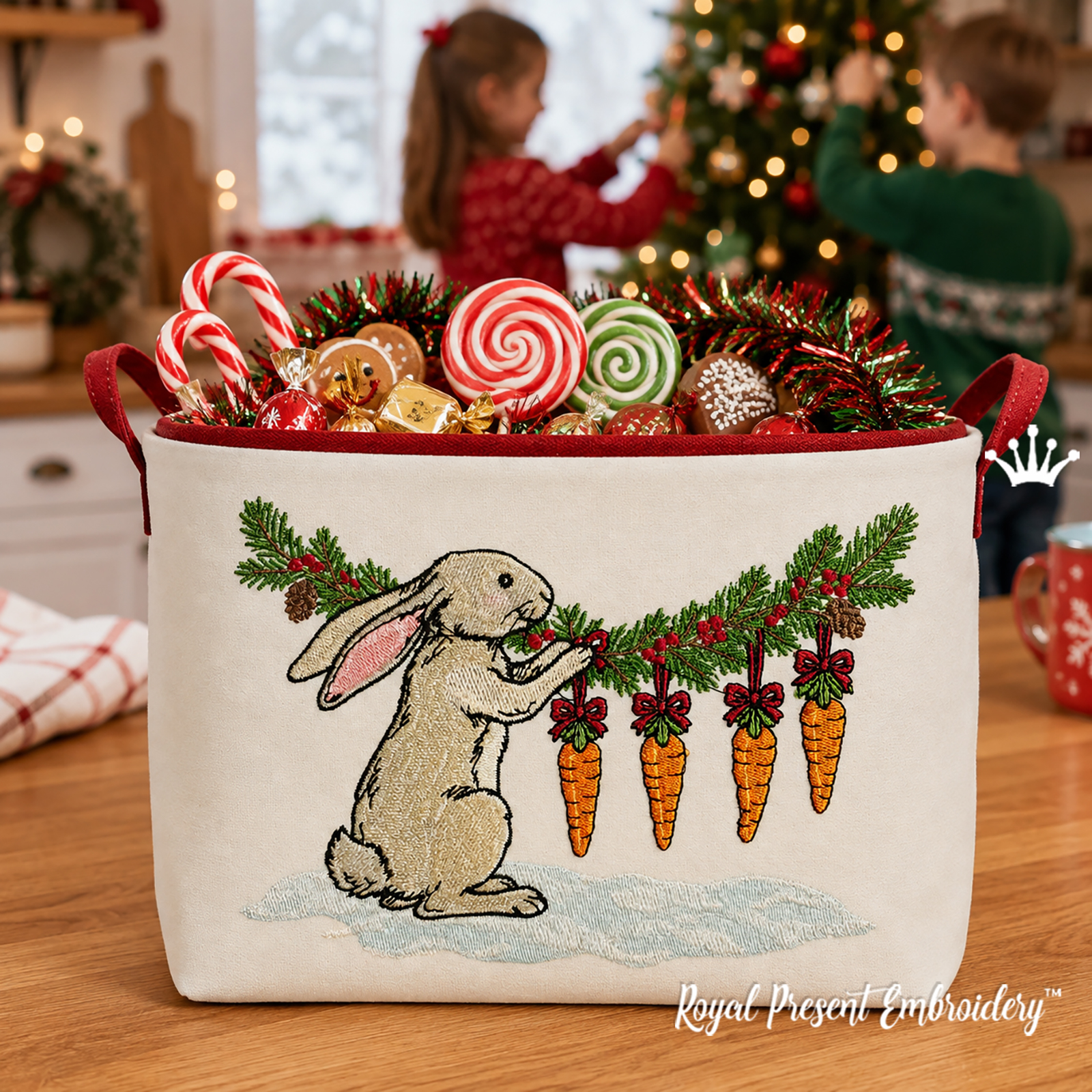
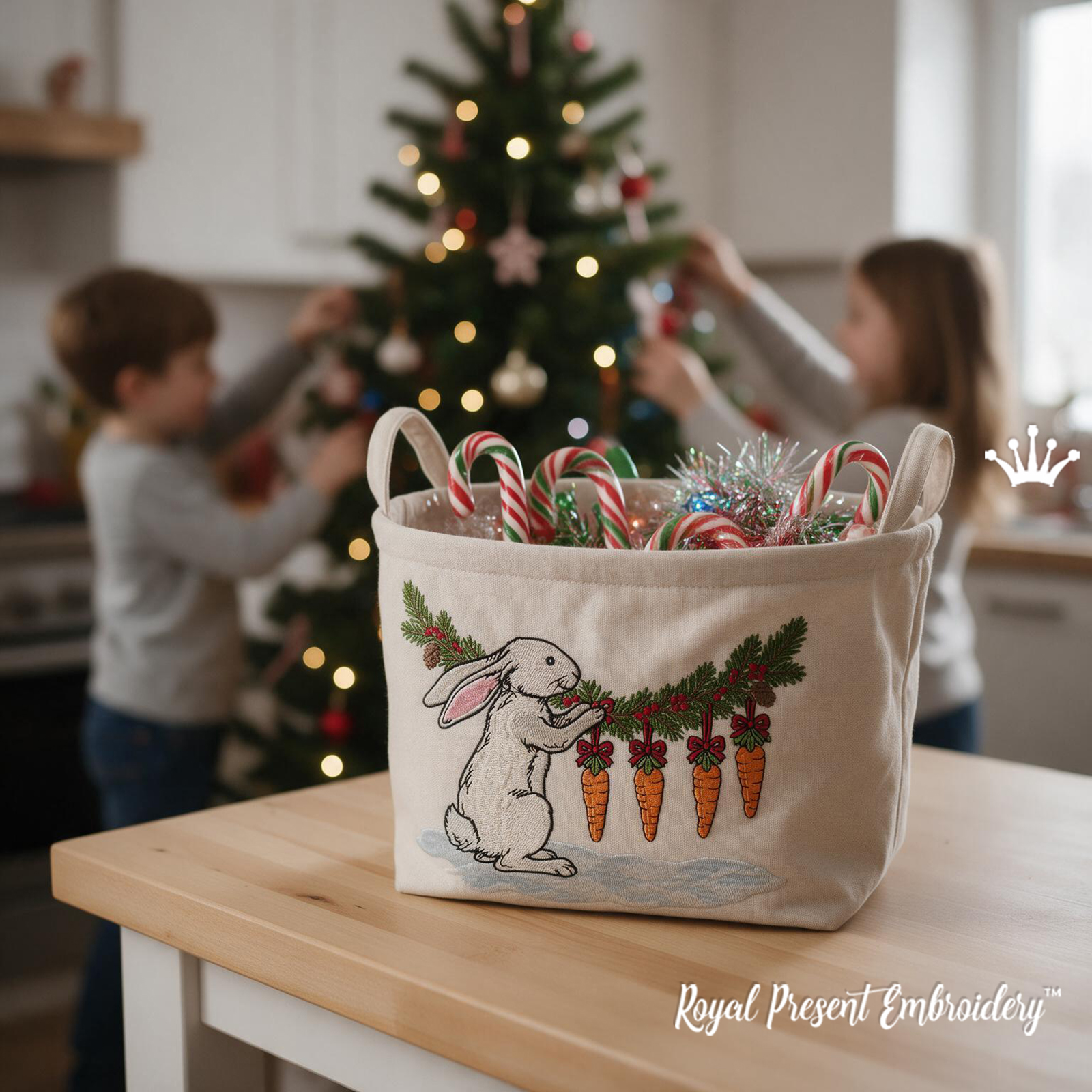
Christmas Bunny Decorating a Fir Garland with Carrot Ornaments is a digital machine embroidery design featuring a soft storybook-style rabbit holding a long evergreen garland decorated with hanging carrots, red bows, red berries and pinecones. A light stitched snow shadow grounds the bunny below the garland. The four prepared sizes work well for Christmas basket liners, decorative pillows, table runners, large napkins and framed textile panels. You receive digital files for an embroidery machine, not a finished embroidered item.
Sizes and stitch counts
Size: 127.9x171.1 mm (5.04x6.74"), Stitches: 38300
Size: 185.0x138.3 mm (7.28x5.44"), Stitches: 42300
Size: 158.3x211.8 mm (6.23x8.34"), Stitches: 50700
Size: 178.2x238.6 mm (7.02x9.39"), Stitches: 59600
Formats: .dst, .jef, .pec, .vip, .hus, .pes, .exp, .sew, .dat, .vp3, .xxx
What is included
The ZIP archive includes all four prepared sizes in the listed machine formats, the design image, and JPG production color charts. After downloading, unzip the archive and select the file format supported by your embroidery machine.
This is a digital product. The basket, fabric, thread, stabilizer, hoops and finished embroidery shown in project images are not included.
Hoop sizes
Design size 127.9x171.1 mm — hoop 130x180 mm (5x7")
Design size 185.0x138.3 mm — hoop 140x200 mm (5.5x8")
Design size 158.3x211.8 mm — hoop 160x240 mm (6.3x9.45")
Design size 178.2x238.6 mm — hoop 200x260 mm (8x10.24")
Madeira Classic Rayon 40 color chart
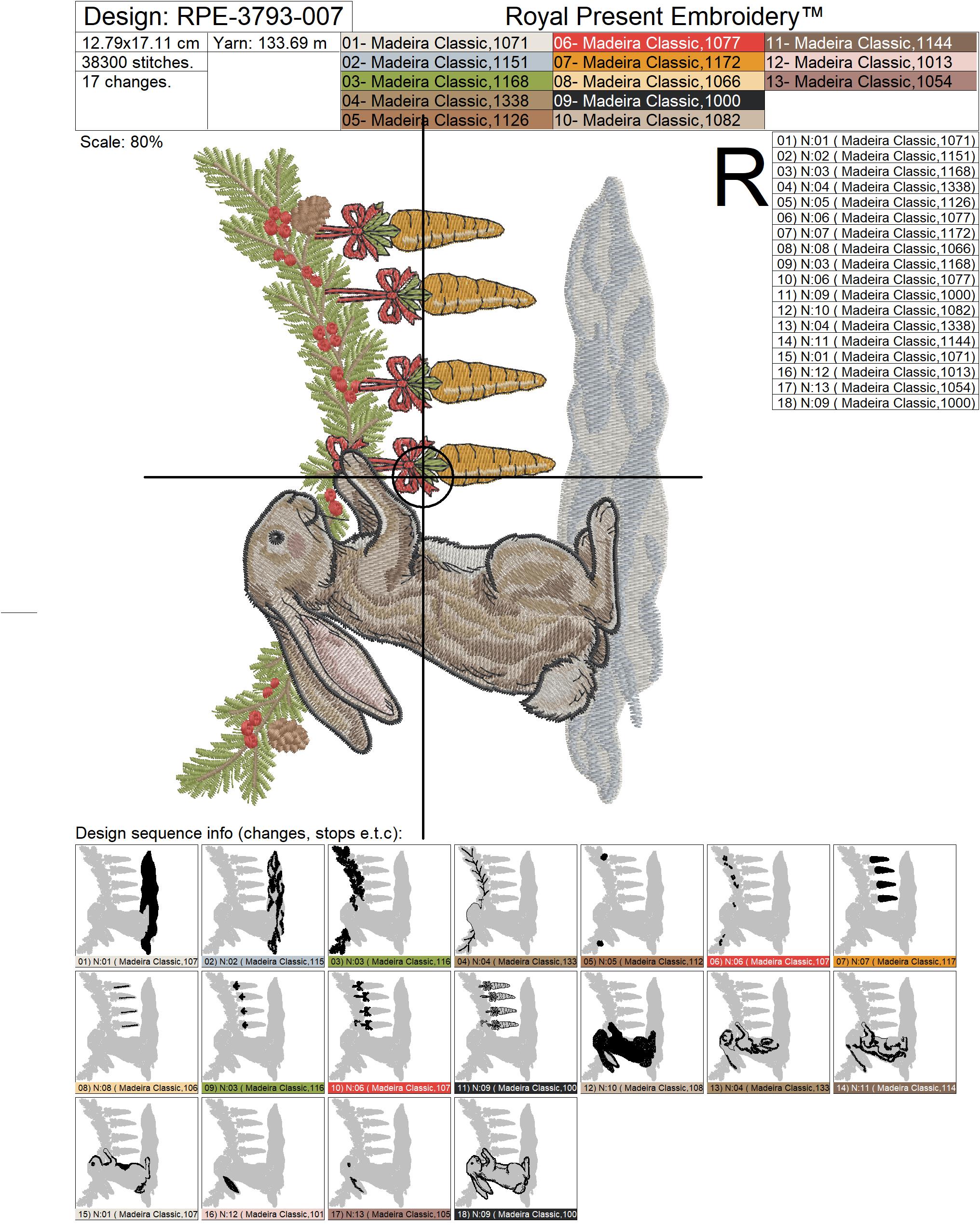
The original production chart uses 13 unique Madeira Classic Rayon 40 colors. The color squares below are screen guides only; use the Madeira number as the primary reference when selecting thread.
|
Madeira Classic 1071 | Light base of the snow shadow and pale highlights in the bunny fur. | |
|
Madeira Classic 1151 | Blue-gray texture and shading in the stitched snow. | |
|
Madeira Classic 1168 | Fir needles and green carrot tops. | |
|
Madeira Classic 1338 | Woody stems in the garland and part of the shaded fur detail. | |
|
Madeira Classic 1126 | Pinecones on the evergreen garland. | |
|
Madeira Classic 1077 | Red berries and bows above the carrot ornaments. | |
|
Madeira Classic 1172 | Main orange fill of the hanging carrots. | |
|
Madeira Classic 1066 | Light highlights and lengthwise accents on the carrots. | |
|
Madeira Classic 1000 | Dark carrot detail, the eye, and final outline work on the bunny. | |
|
Madeira Classic 1082 | Main fill of the bunny fur. | |
|
Madeira Classic 1144 | Darker shading and texture in the bunny fur. | |
|
Madeira Classic 1013 | Pink inner ear areas. | |
|
Madeira Classic 1054 | Warm pink-beige facial accents and blush on the bunny. |
If you use another thread brand, use the free Madeira Thread Exchange converter to find the closest available matches. Screen colors are not an exact substitute for a physical thread chart.
Design construction
This multicolor composition combines filled areas in the bunny, carrots and stitched snow with lighter open areas between the fir needles. The two larger files contain 50700 and 59600 stitches, so a loose or soft fabric needs stronger support than a small decorative motif. Accurate stabilization is especially important because the final dark outlines must stay registered with the shaded fur and small facial details.
Fabric, stabilizer, needle and thread
For firm linen, cotton or gabardine, start with a strong tear-away backing for the first two sizes and complete a full test stitch. For the third and fourth sizes, loose linen, soft bag panels or basket liners, cut-away support is often the safer choice because it remains under the larger stitched area and can be hidden by a lining.
For knits and sweatshirt fabrics, use a soft cut-away stabilizer and do not stretch the item while hooping. On terry cloth, fleece or velvet, add a thin water-soluble topping above the surface so the facial lines, fir needles and other narrow details do not sink into the pile.
The original chart is prepared for Madeira Classic Rayon 40. With standard 40-weight embroidery thread, start with a new 75/11 embroidery needle. On firm canvas or a layered basket panel, an 80/12 needle may work better after a test stitch.
Before embroidering the finished item, stitch the complete selected size using the same fabric, stabilizer, needle and thread combination planned for the project.
Project idea: Christmas basket liner
The horizontal 185.0x138.3 mm version is especially useful on the front panel of a fabric basket liner: the bunny and four carrot ornaments read clearly across a wide composition. Embroider the outer panel before assembly and mark the finished top fold, side seams and handle positions before hooping. For a larger basket, the 158.3x211.8 mm or 178.2x238.6 mm versions can create a stronger focal panel when enough clear fabric remains around the design.
For more help choosing backing for the project fabric, see Choosing stabilizers for machine embroidery. Part 2.
Related machine embroidery designs
Questions and answers
How can I prevent the black bunny outline from shifting away from the fur shading?
Outline shift is usually caused by fabric movement during a long multicolor stitch-out. Hoop the fabric without stretching it, support the complete embroidery field with backing, and keep the loose part of a basket liner or large panel from pulling against the carriage. On loose linen or soft project panels, use permanent cut-away support. If registration is already drifting on the test sample, check stabilization and thread tension before editing the embroidery file.
Can I use 40-weight polyester instead of Madeira Classic Rayon 40?
Yes. Good-quality 40-weight polyester embroidery thread works well for this design and is practical for basket liners, pillows and holiday textiles that may be handled or washed frequently. Rayon gives a softer characteristic sheen. When changing thread brands, keep visible separation between the close beige and brown bunny shades because those colors create the fur depth.
Can I change the carrot, bow and berry colors?
Yes. The original red, orange and green palette can be adapted to the project. Burgundy, muted red, gold or softer holiday tones can replace the bows. Keep enough contrast between the carrots, their green tops and the fir needles, and avoid collapsing all bunny fur shades into one color if you want to preserve the original dimensional effect.
Can I embroider this design on an already assembled basket liner?
Only if the finished liner can lie completely clear of the embroidery arm and carriage. In most cases it is safer to embroider the flat outer panel before assembly. This makes the long garland easier to position, keeps the design away from seams and handle openings, and allows cut-away stabilizer to remain hidden between the outer fabric and lining.
Can I resize the design beyond the four included sizes?
It is better to use one of the four prepared files. The bunny contains closely spaced texture stitches and final outlines, so simple scaling can change stitch density, stitch length and registration. If another size is required, use the Royal Present design resizing service so the embroidery parameters can be recalculated instead of simply stretching the finished file.
Why can the DST file display different colors on my machine?
DST does not preserve the original Madeira thread numbers in the same way as the supplied production chart. Your embroidery machine or software may display its own placeholder colors. This does not mean the file is damaged. Use the JPG color chart and the Madeira numbers supplied with the design when choosing thread.
Do I need water-soluble topping on smooth linen?
Usually not. Water-soluble topping is mainly useful on terry cloth, fleece, velvet and other raised or textured surfaces where narrow fir needles, facial lines and small details can sink into the pile. On smooth, firm linen, concentrate on choosing the correct backing underneath the fabric.

 Get Sign-In Link
 Login with Google
 Login with Facebook
 Login with Amazon
 Login with Paypal