MADEIRA SIDED BOBBIN L
When it comes to sewing machines, bobbins play a crucial role in holding the lower thread. They are available in different materials and types, and it's important to weigh their advantages and disadvan...
By knowing the speed of your embroidery machine, you can find out how long it will take to embroider a design.
To use the embroidery calculator, click on the number of stitches in the product description.
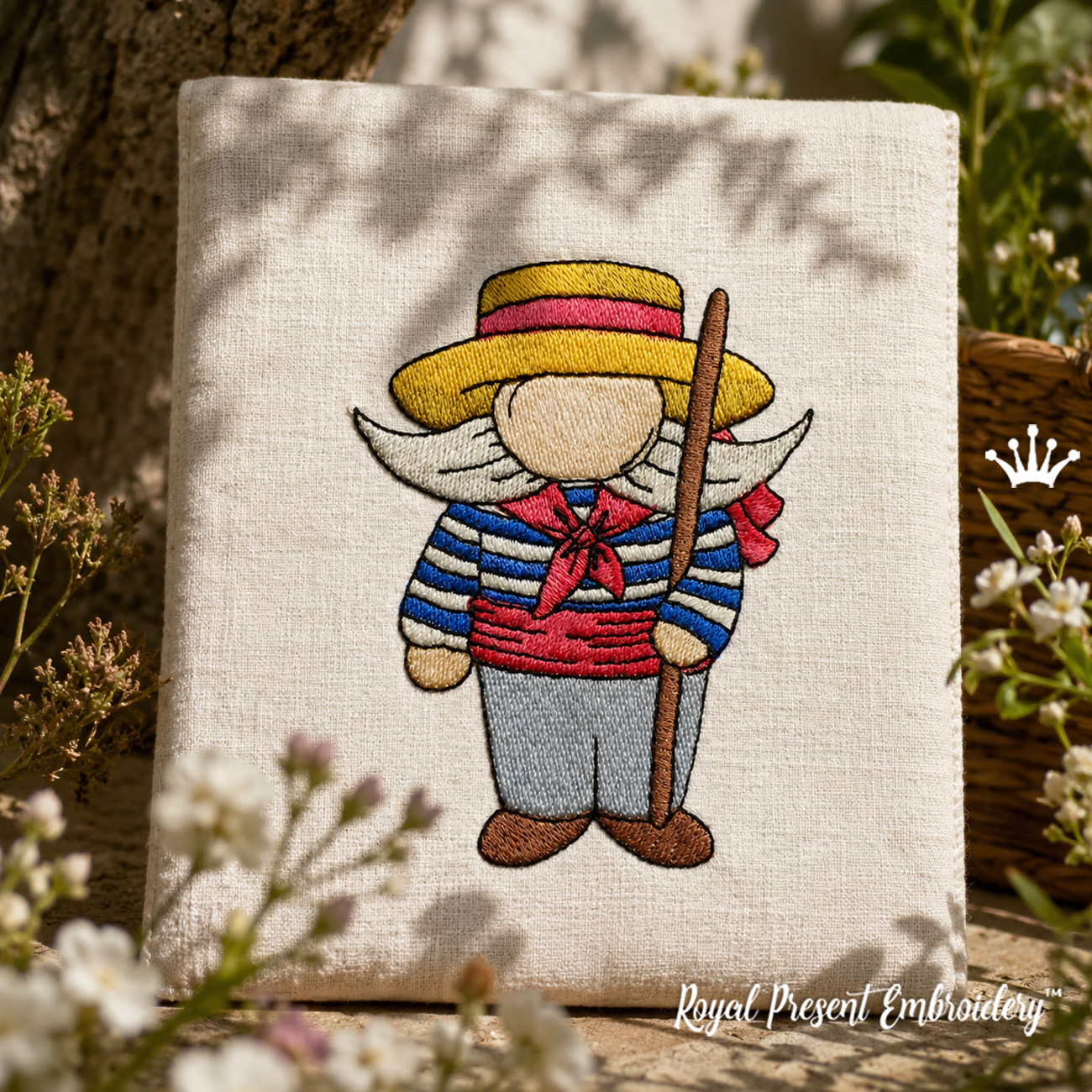
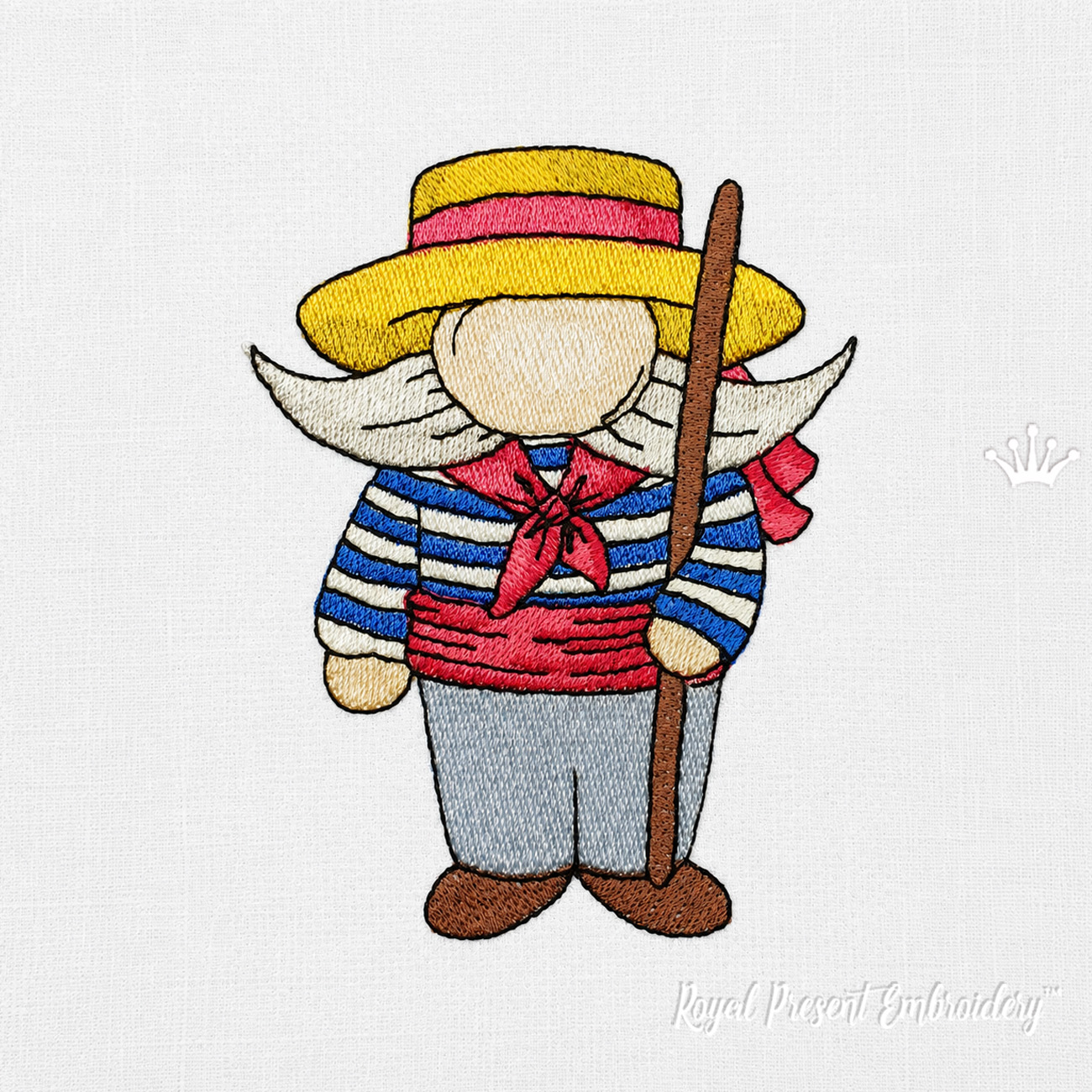
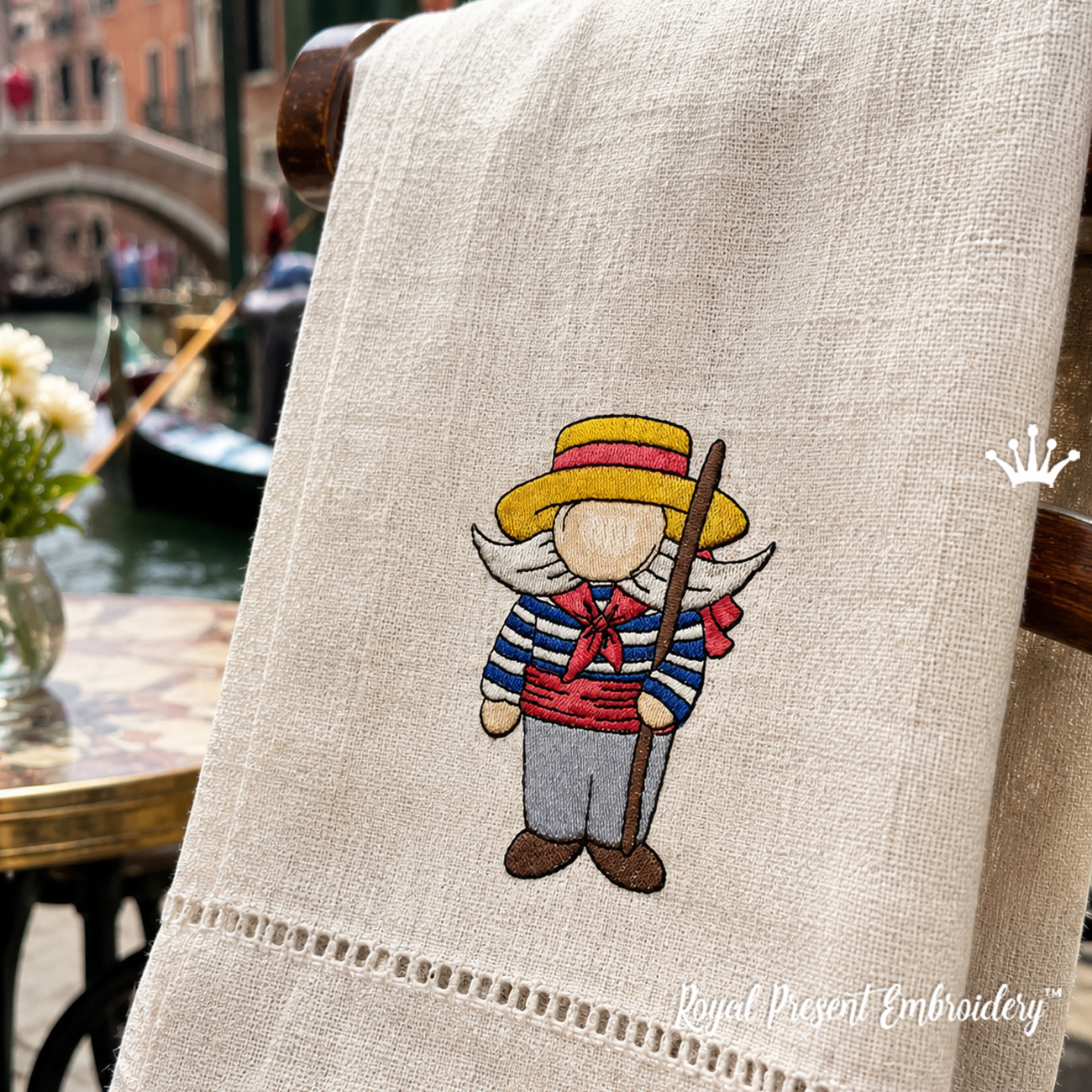
Venice Gondolier Gnome Machine Embroidery Design depicts a cheerful Venetian gondolier wearing a striped shirt, red sash and straw boater while holding a long wooden oar. The digital product includes one design in four prepared sizes. The smallest file fits a true 100x100 mm (4x4") embroidery field, while the largest requires a 130x180 mm (5x7") hoop or larger. No finished embroidery, towel, fabric, thread or physical product is included.
Sizes, stitch counts and formats
Size: 76.0x98.0 mm (2.99x3.86"), Stitches: 15353
Size: 83.6x107.8 mm (3.29x4.24"), Stitches: 17774
Size: 92.0x118.5 mm (3.62x4.67"), Stitches: 20412
Size: 101.2x130.3 mm (3.98x5.13"), Stitches: 23734Formats: .dat, .dst, .exp, .hus, .jef, .jef+, .jpx, .pec, .pes, .sew, .vip, .vp3, .vp4, .xxx
| Designs included | 1 independent Venice gondolier gnome design |
|---|---|
| Prepared sizes | 4 |
| Character details | Striped shirt, red neck scarf and sash, straw boater, trousers, moustache and wooden oar |
| Embroidery technique | Filled, satin and outline machine embroidery; not appliqué, a patch or an in-the-hoop project |
| Product type | Digital files for computerized embroidery machines |
| Design size | Suitable embroidery hoop |
|---|---|
| 76.0x98.0 mm (2.99x3.86") | 100x100 mm (4x4") hoop |
| 83.6x107.8 mm (3.29x4.24") | 100x130 mm (3.94x5.12"), 100x140 mm (3.94x5.51") or larger hoop |
| 92.0x118.5 mm (3.62x4.67") | 100x130 mm (3.94x5.12"), 100x140 mm (3.94x5.51") or larger hoop |
| 101.2x130.3 mm (3.98x5.13") | 130x180 mm (5x7") or larger hoop |
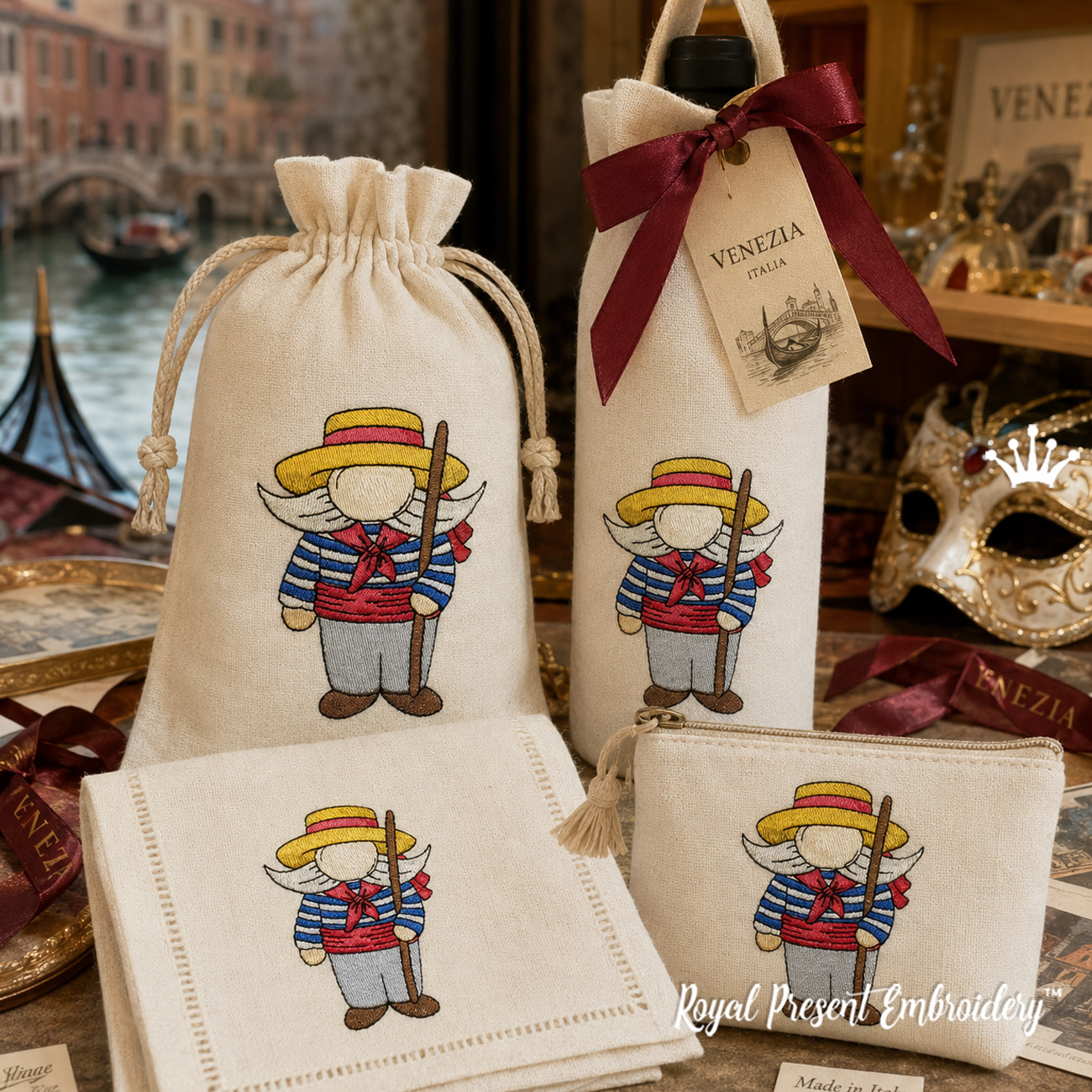
The narrow vertical composition works well on projects where a wide design would be difficult to position:
On a towel, place the gondolier in the lower decorative area while avoiding thick hems and woven bands. On a wine-bottle sleeve or bag, embroider the design while the fabric panel is still flat and keep the oar away from seam allowances, zippers and drawstring channels.
More characters are available in the Gnome Machine Embroidery Designs collection.
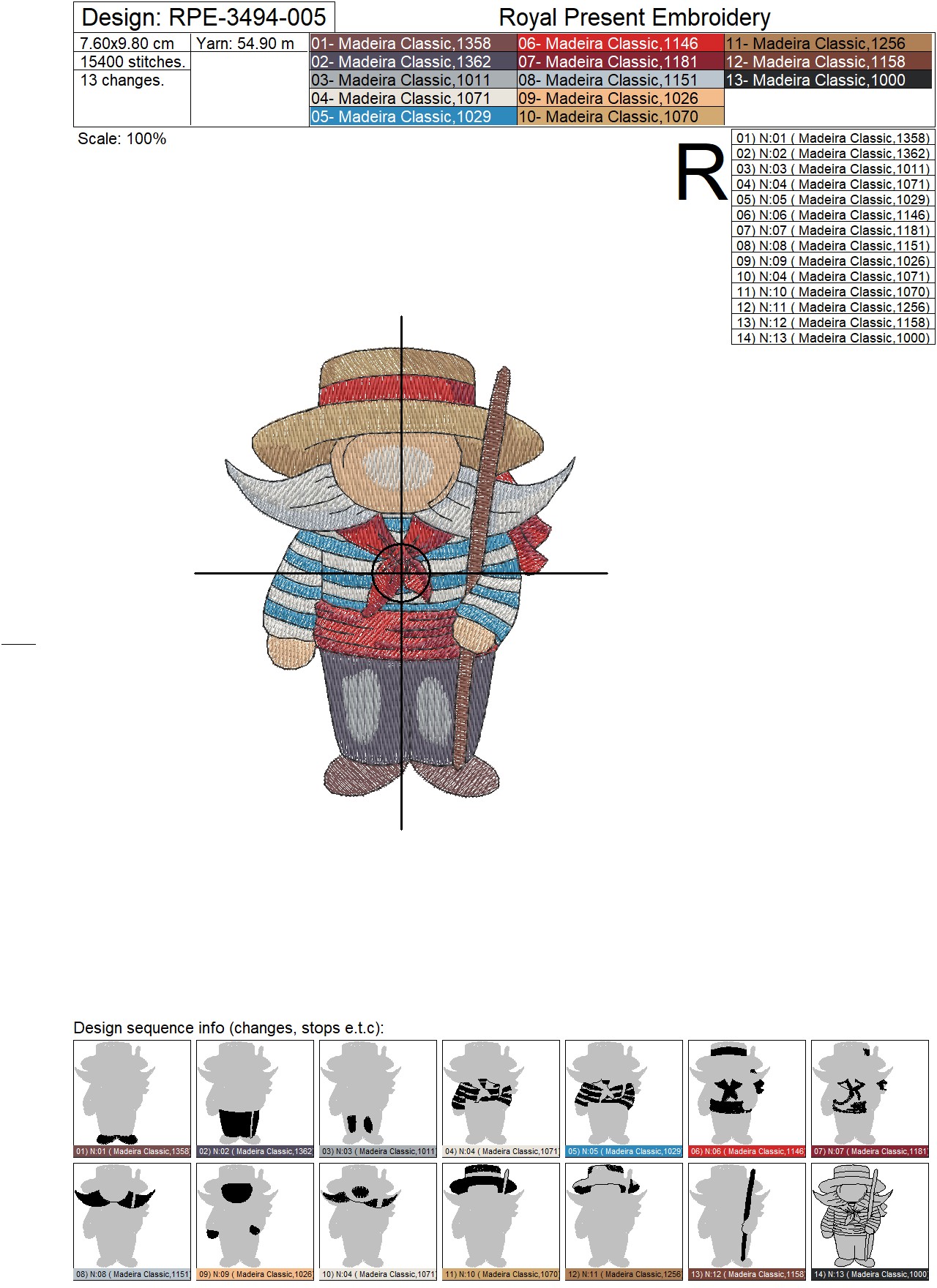
The chart for the smallest file contains 13 thread colors arranged in 14 programmed color blocks. Madeira Classic 1071 appears twice because the same shade returns at a later stage. The names below describe the visible colors; follow the worksheet included with the selected file for the exact embroidery order.
| Color | Madeira Classic | Descriptive name | Visible embroidery area | |
|---|---|---|---|---|
|
|
1358 | Dark reddish brown | First dark brown sections and character shading | |
|
|
1362 | Dark slate | Dark sections of the trousers and clothing | |
|
|
1011 | Medium gray | Lighter trouser and clothing sections | |
|
|
1071 | Off-white | Light shirt stripes and pale details; repeated later in the sequence | |
|
|
1029 | Venetian blue | Blue shirt stripes | |
|
|
1146 | Bright red | Hat ribbon, neck scarf and sash highlights | |
|
|
1181 | Dark red | Shadows in the scarf, sash and red hat details | |
|
|
1151 | Light silver gray | Moustache and light gray details | |
|
|
1026 | Peach | Face, nose and hands | |
|
|
1070 | Straw beige | Straw boater and warm beige details | |
|
|
1256 | Warm brown | Wooden oar and shaded straw details | |
|
|
1158 | Deep brown | Shoes, moustache shadows and dark wooden details | |
|
|
1000 | Charcoal black | Final outlines and small facial and clothing details |
Programmed sequence shown for the smallest file:
1358 → 1362 → 1011 → 1071 → 1029 → 1146 → 1181 → 1151 → 1026 → 1071 → 1070 → 1256 → 1158 → 1000
Do not automatically sort or combine the two off-white blocks. Their separate positions are part of the programmed construction order.
| Project material | Stabilizer | Needle and thread | Gondolier-specific point |
|---|---|---|---|
| Medium-weight linen or cotton | Medium tear-away such as OESD Medium Weight TearAway or AllStitch RipStitch #15, 1.5 oz/yd², approximately 51 g/m² | Sharp embroidery needle 75/11; 40-weight polyester or rayon | Hoop the fabric on grain so the vertical body and long oar do not lean after release |
| Loose linen, canvas or the largest size | Firm tear-away such as AllStitch RipStitch #20, 2.0 oz/yd², approximately 68 g/m²; use light cut-away when permanent support is preferable | Embroidery needle 75/11 or 80/12; 40-weight polyester | Support the complete oar and character area, not only the dense body |
| Terry kitchen or guest towel | Medium tear-away underneath and thin water-soluble topping over the loops | Embroidery needle 75/11 or 80/12; 40-weight polyester | Topping keeps the shirt stripes, moustache and final outlines above the pile |
| Sweatshirt or knit fabric | Medium cut-away or no-show mesh; do not use tear-away as the only permanent support | Ballpoint embroidery needle 75/11; 40-weight polyester | Do not stretch the knit while hooping because contraction can move the final outline away from the stripes |
The long oar is the part most sensitive to fabric movement. Use the smallest hoop that fits the selected file and stabilize the complete design area. A backing cut only to the character’s body may leave the outer section of the oar unsupported.
Run a complete test on the same fabric and stabilizer intended for the finished project. Watch the blue-and-white shirt stripes, moustache and final black outline. If these elements begin to shift consistently in one direction, check hooping and fabric movement before changing thread tension.
When substituting colors, retain strong contrast between the blue and off-white shirt stripes and between the red highlights and shadows. The striped shirt is the main visual feature that identifies the character as a Venetian gondolier.
Use one of the four prepared files whenever possible. Automatic reduction can overload the narrow stripes and facial details, while excessive enlargement can make satin sections too loose.
This is a digital machine embroidery product. Download the ZIP archive, extract the files and transfer only the format supported by your embroidery machine. If necessary, use the Royal Present ZIP extraction tool.
Finished physical items embroidered with this design may be sold according to the Royal Present license. The digital files may not be copied, shared, exchanged, uploaded or resold. Review the current license and terms of use before commercial production.
Yes. The 76.0x98.0 mm (2.99x3.86") file fits a true 100x100 mm (4x4") embroidery field.
No. The largest file measures 101.2x130.3 mm (3.98x5.13"), so it requires a 130x180 mm (5x7") embroidery field or larger.
Yes. Use suitable backing underneath and lightweight water-soluble topping over the pile so the shirt stripes, moustache and narrow outlines remain visible.
The oar is long and narrow and extends away from the denser body. Insufficient backing or fabric movement can shift its later details, so stabilize the entire embroidery area and use the smallest compatible hoop.
Yes. Keep clear contrast between the two stripe colors and preserve the original color-block order. The repeated off-white blocks should not be merged automatically.
When it comes to sewing machines, bobbins play a crucial role in holding the lower thread. They are available in different materials and types, and it's important to weigh their advantages and disadvan...
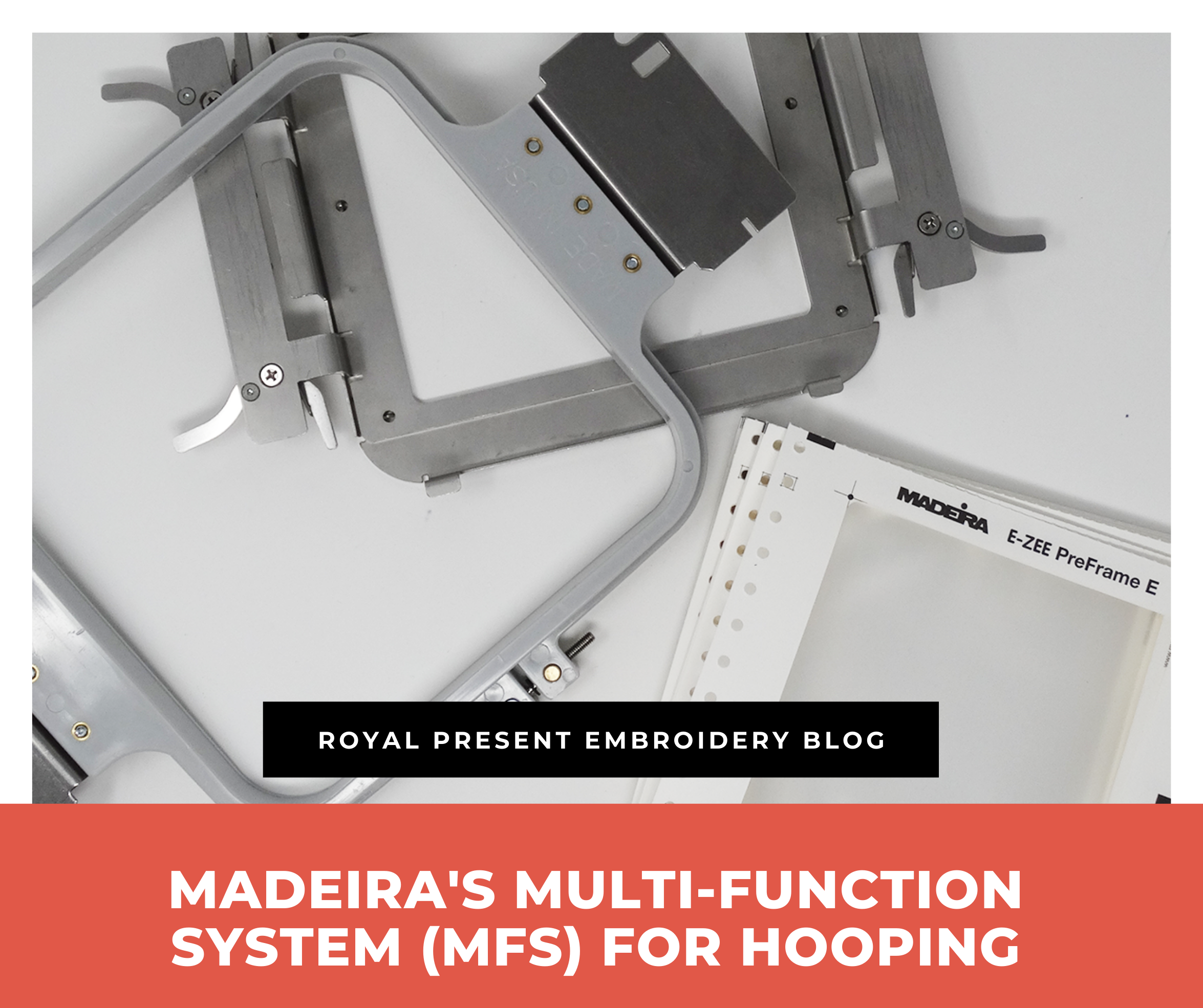
Enhance Your Embroidery Projects with the Madeira MFS System: A Comprehensive Review Embroidery enthusiasts, whether beginners or seasoned professionals, are always on the lookout for tools that can...
Choosing machine embroidery threads Today I would like to talk about threads for machine embroidery projects. This information will be interesting and informative for both beginners who h...
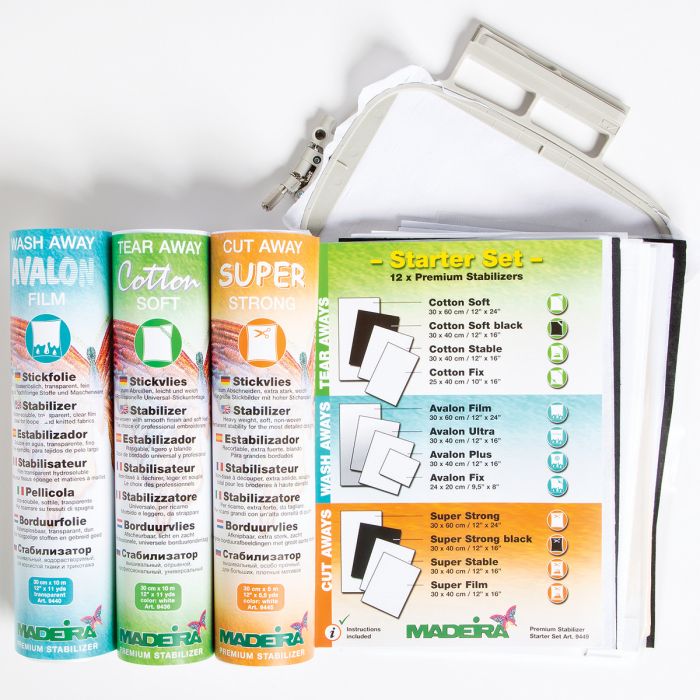
Correctly chosen stabilizers make your embroidery design look better on any kind of textile, due to their bracing qualities, preventing the fabric from shifting during the embroidery process. This supp...

 Get Sign-In Link
 Login with Google
 Login with Facebook
 Login with Amazon
 Login with Paypal