Andalusian Ornaments Set Machine Embroidery Designs – 4 Sizes
By knowing the speed of your embroidery machine, you can find out how long it will take to embroider a design.
To use the embroidery calculator, click on the number of stitches in the product description.
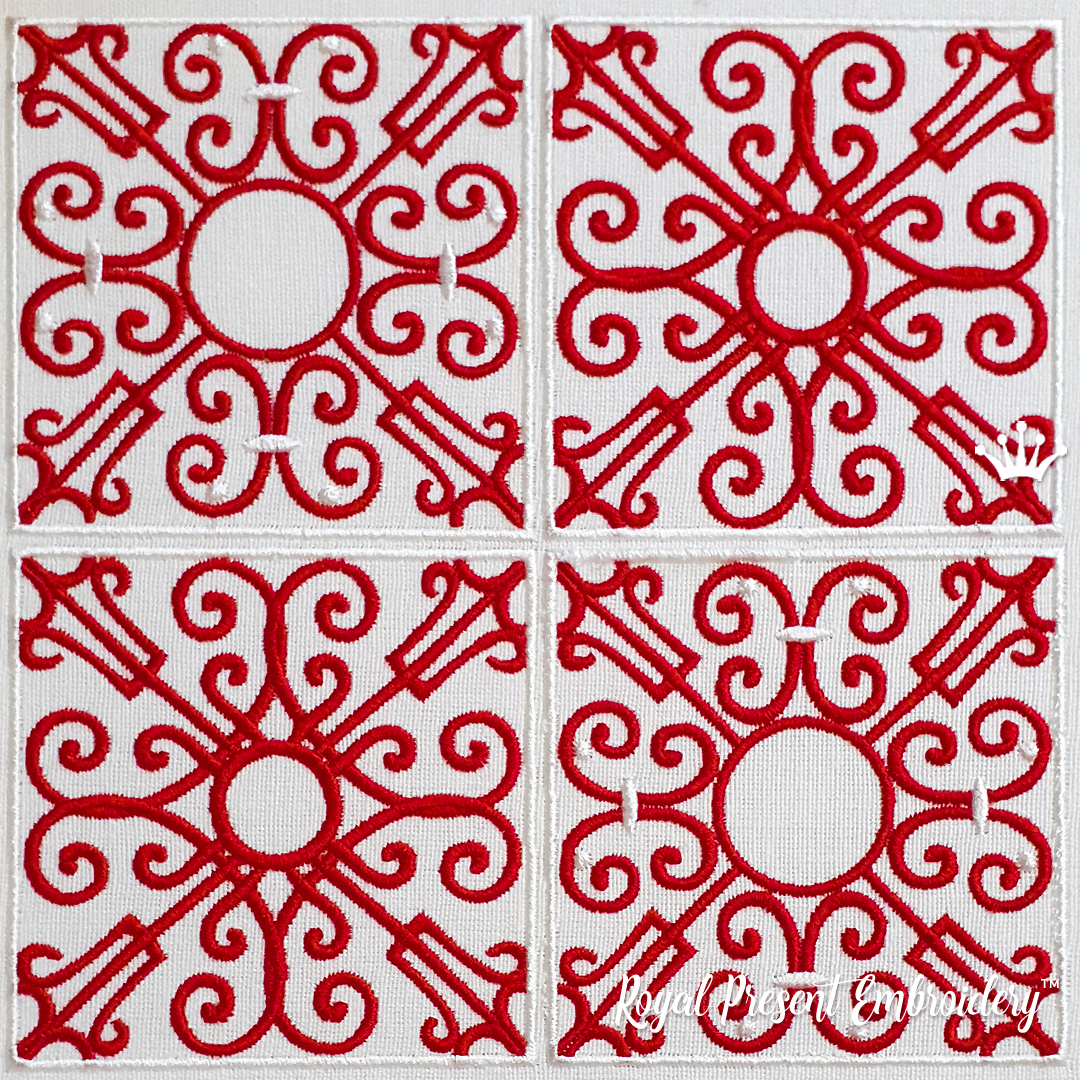
The Andalusian Ornaments Set digital download contains two coordinated square machine embroidery designs, each supplied in 4 exact sizes. These are files for an embroidery machine; finished embroidery, fabric, thread and the photographed projects are not included.
Sizes, stitches and file formats
Size: 98.0x98.0 mm (3.86x3.86"), Stitches: 16498
Size: 107.8x107.8mm (4.24x4.24"), Stitches: 18124
Size: 118.6x118.6mm (4.67x4.67"), Stitches: 20308
Size: 128.0x128.0 mm (5.04x5.04 "), Stitches: 21532
Formats: .dst, .jef, .pec, .vip, .hus, .pes, .exp, .sew, .dat, xxx, vp3
| Feature | Exact product data |
|---|---|
| Product type | Digital machine embroidery design set |
| Included | 2 coordinated square ornaments, each in 4 sizes |
| Technique | Satin lines and outlines stitched on the base fabric; no appliqué and no ITH assembly |
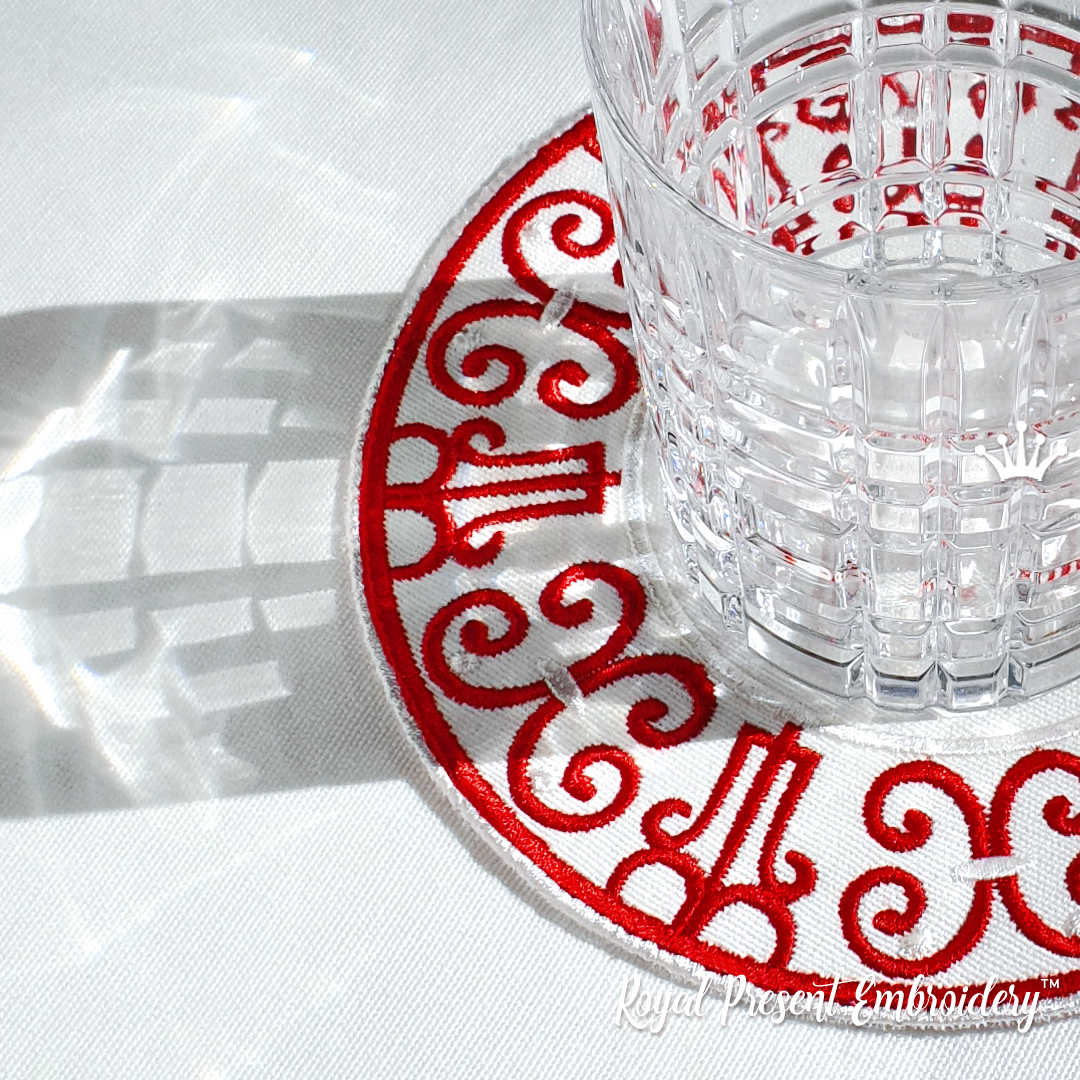
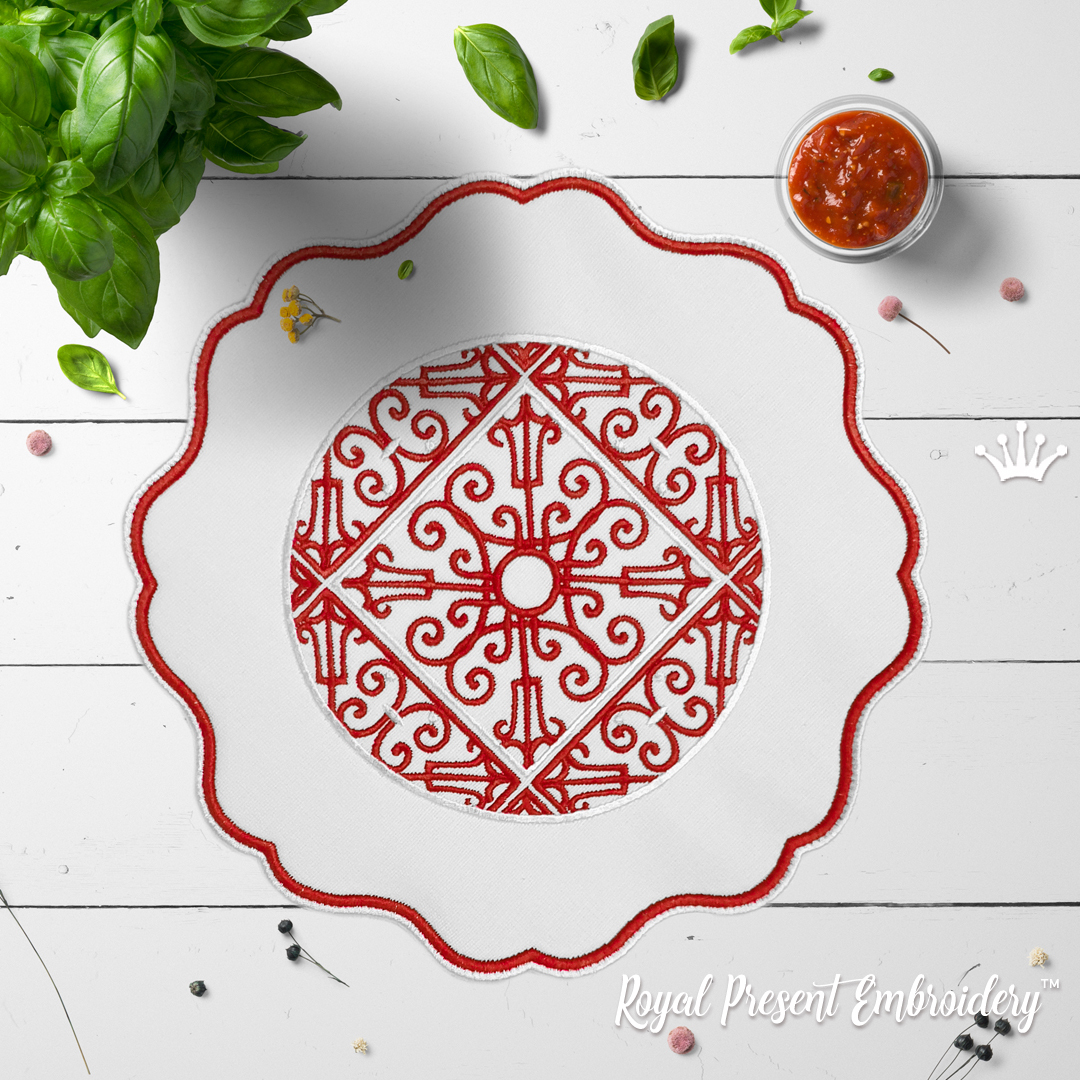
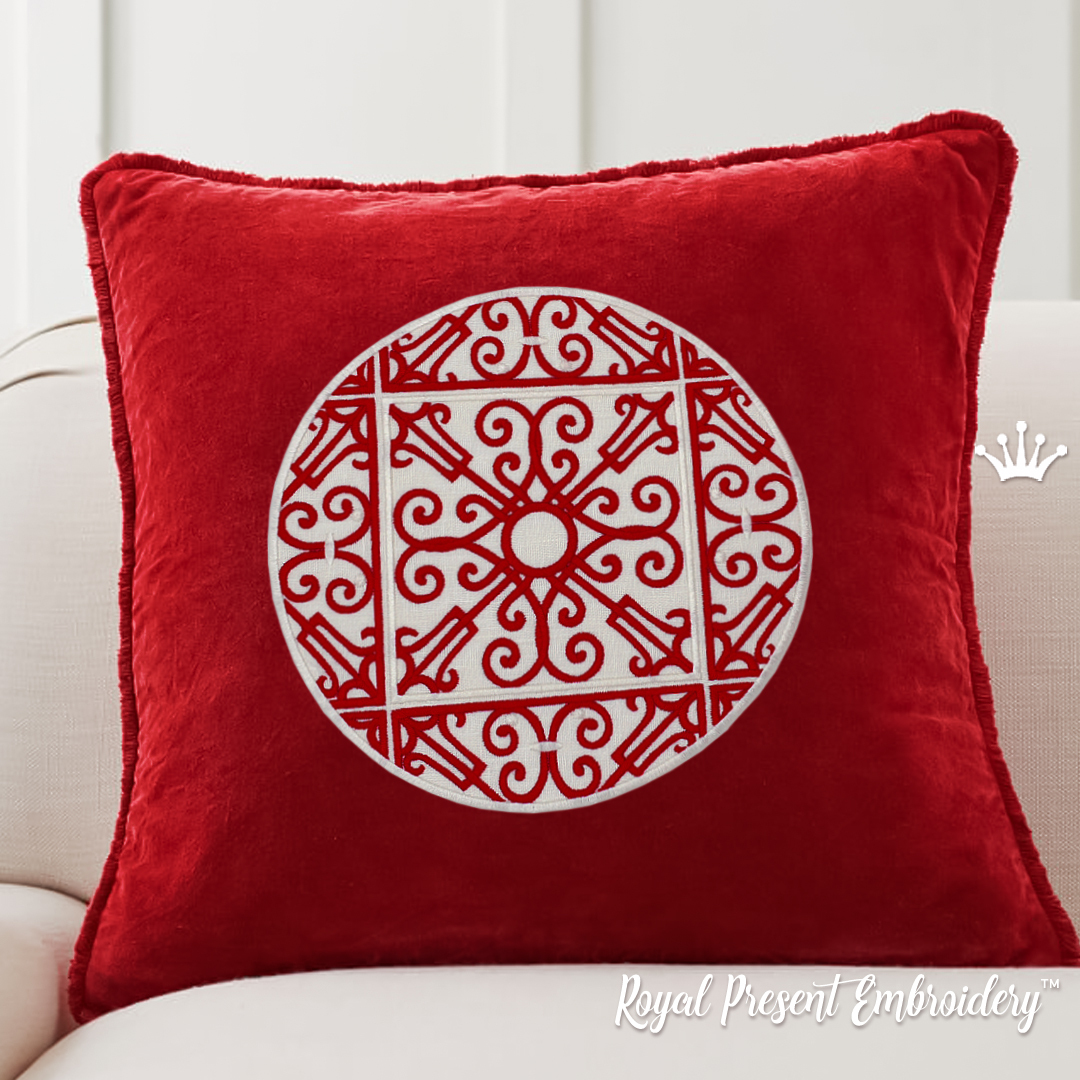
| Suitable projects | Quilt blocks, decorative pillows, table runners, borders and textile panels |
| Published stitch count | 16498–21532 stitches, depending on size |
| Thread chart | 2 Madeira Classic 40 colors |
Two square designs for a varied repeat
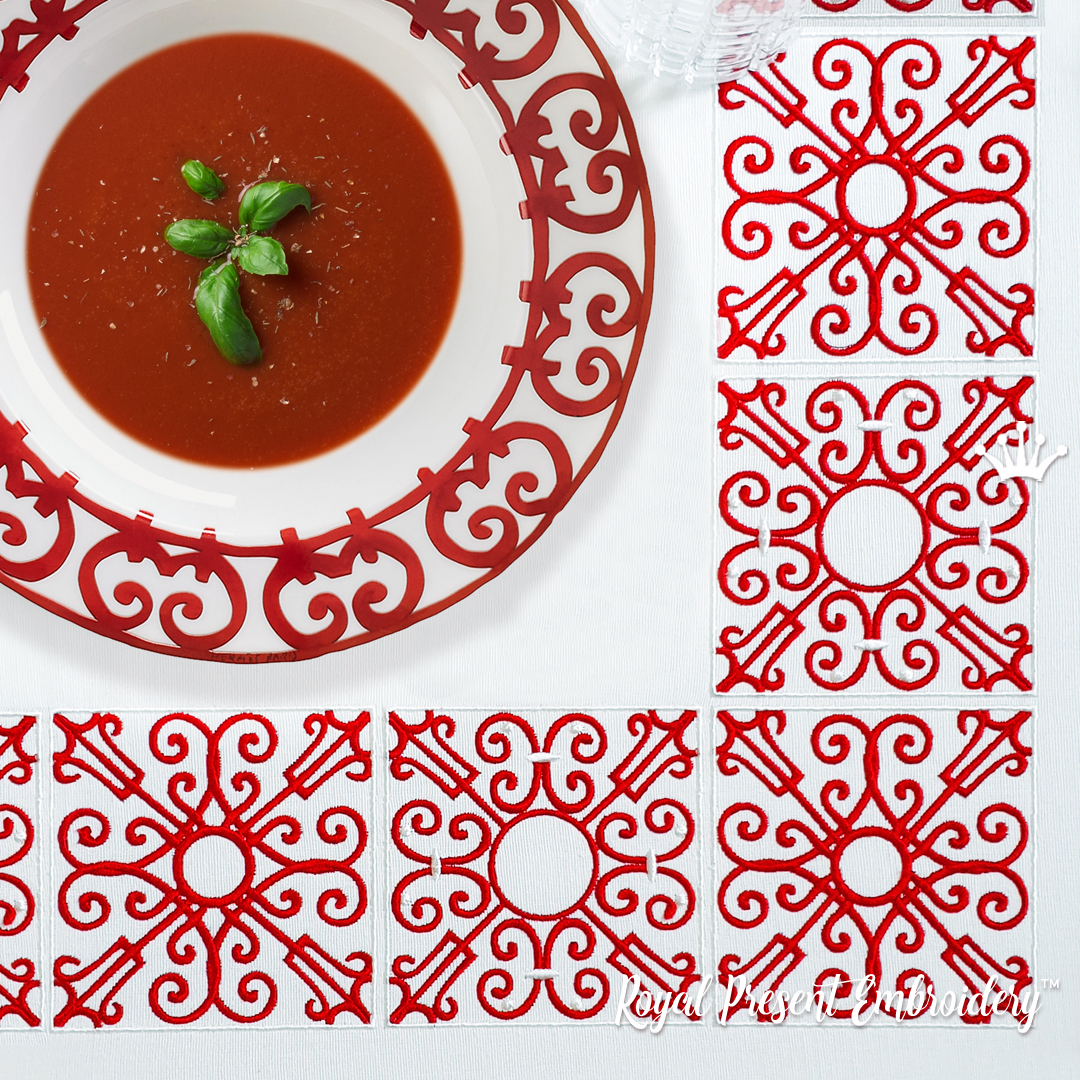
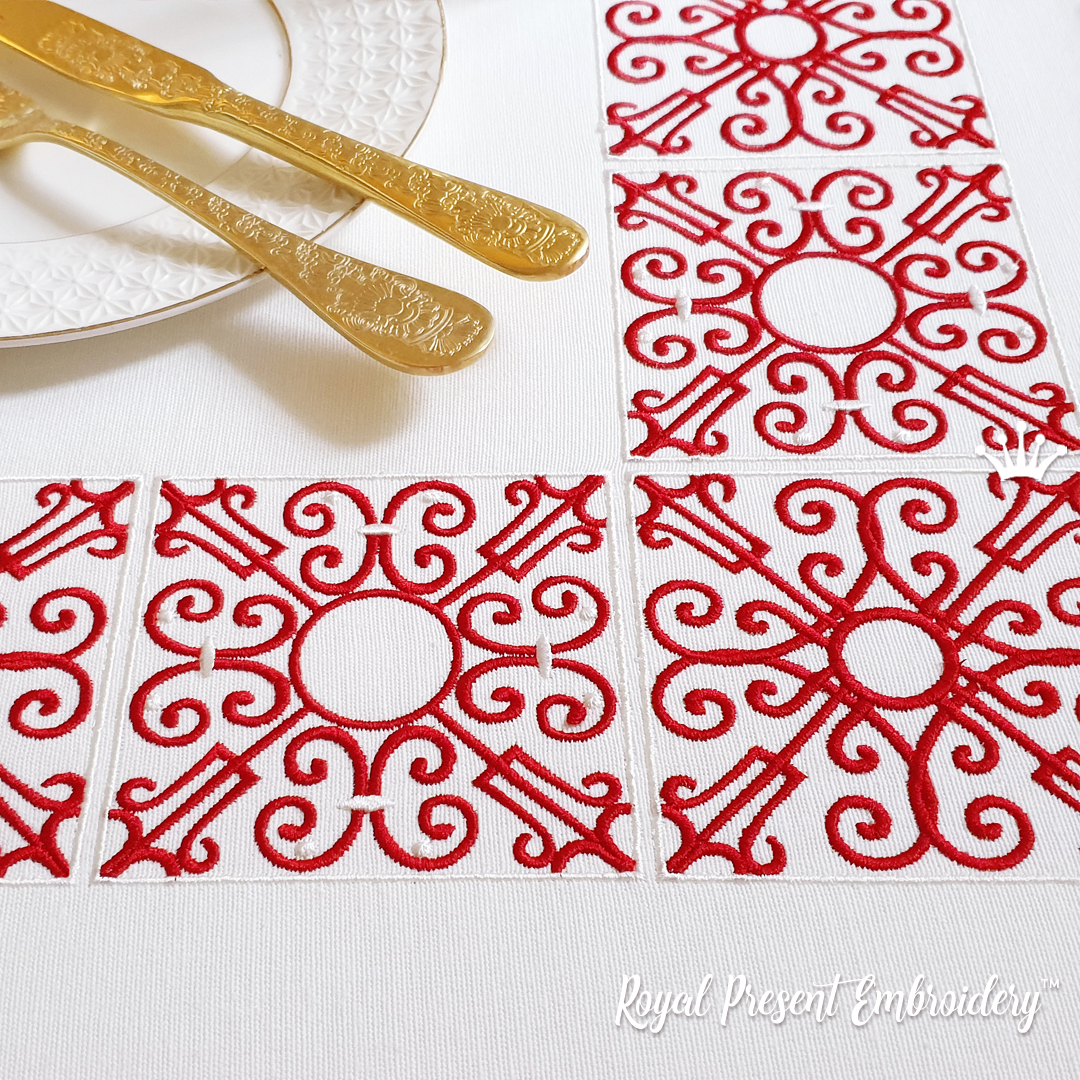
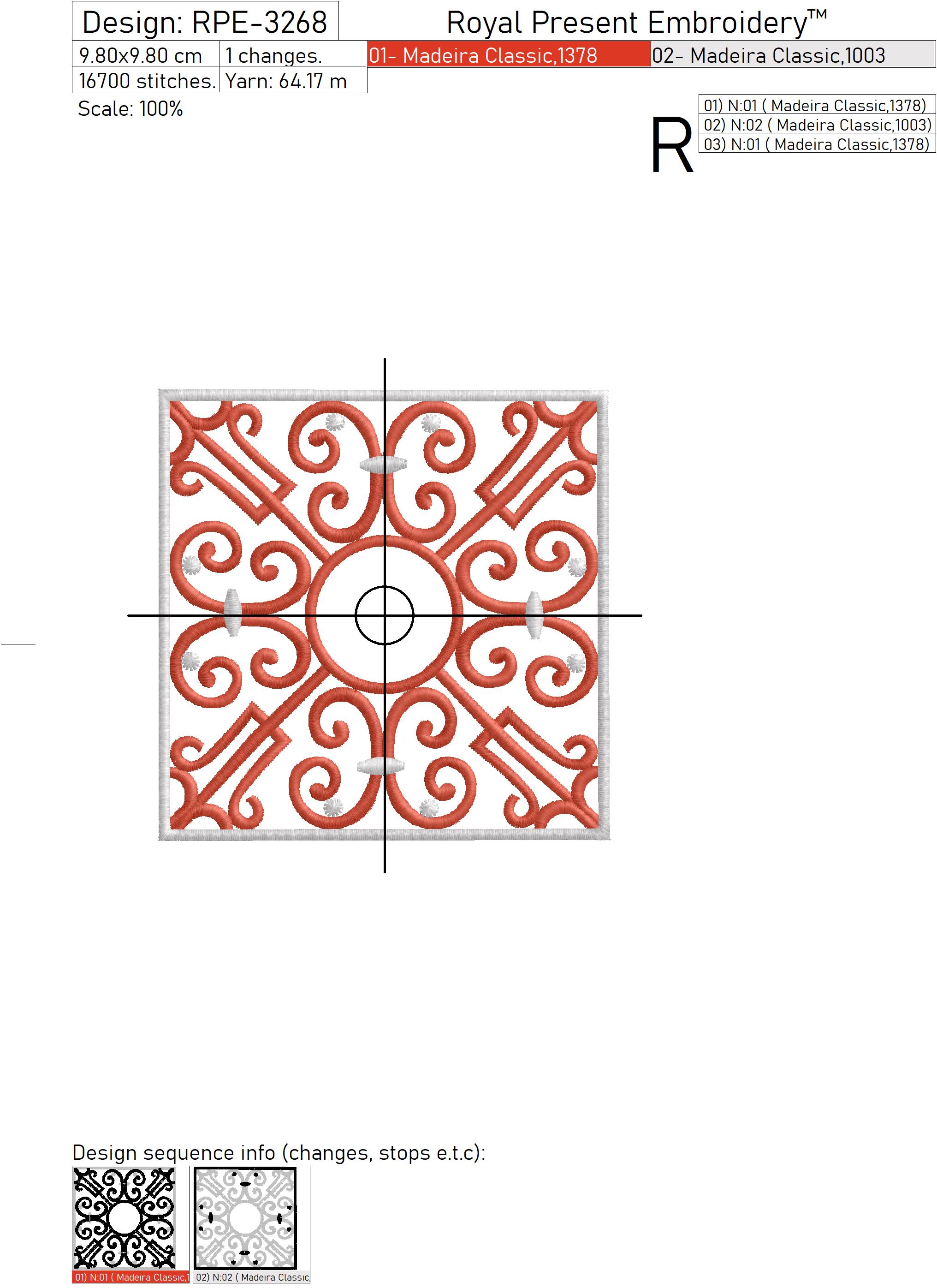
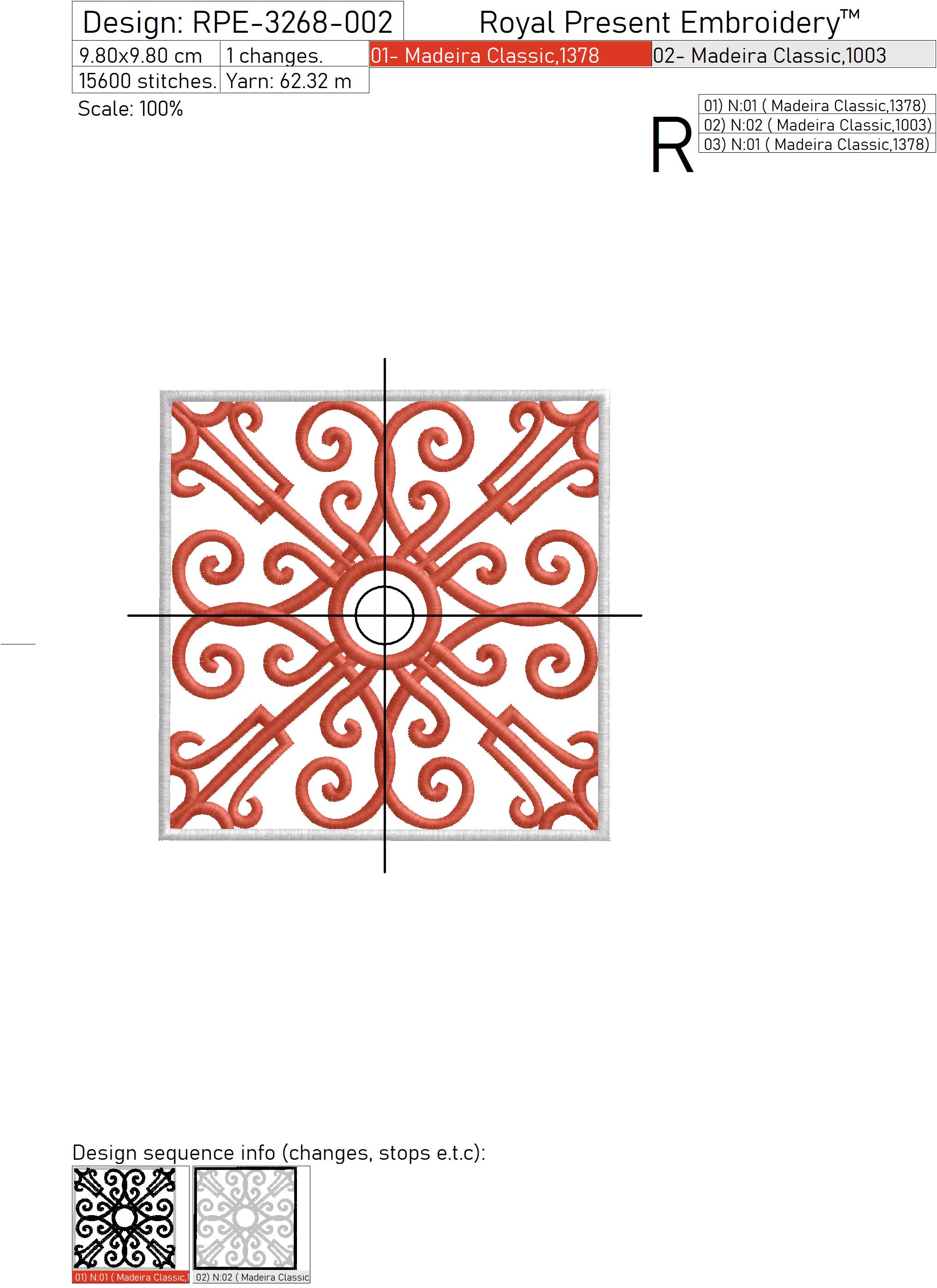
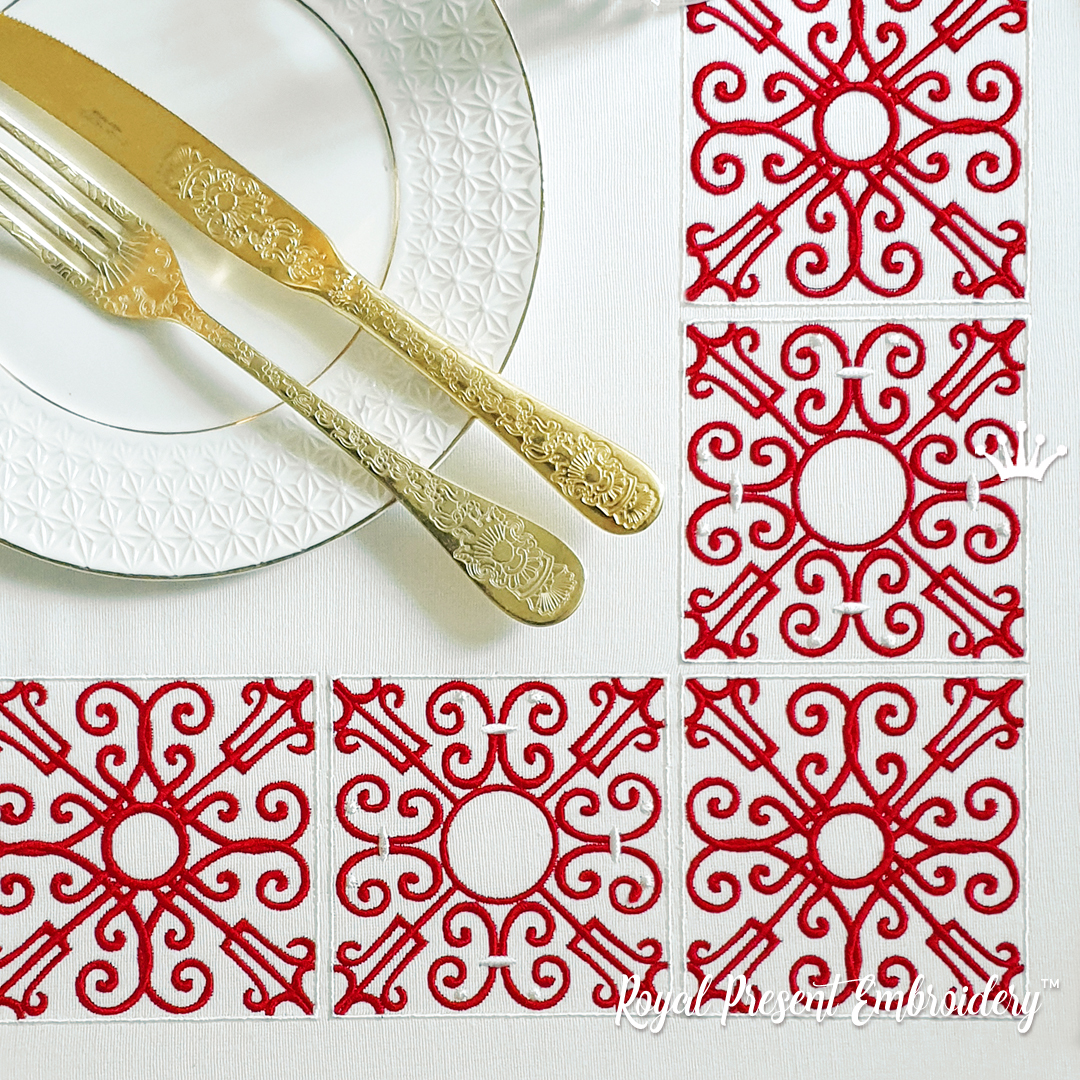
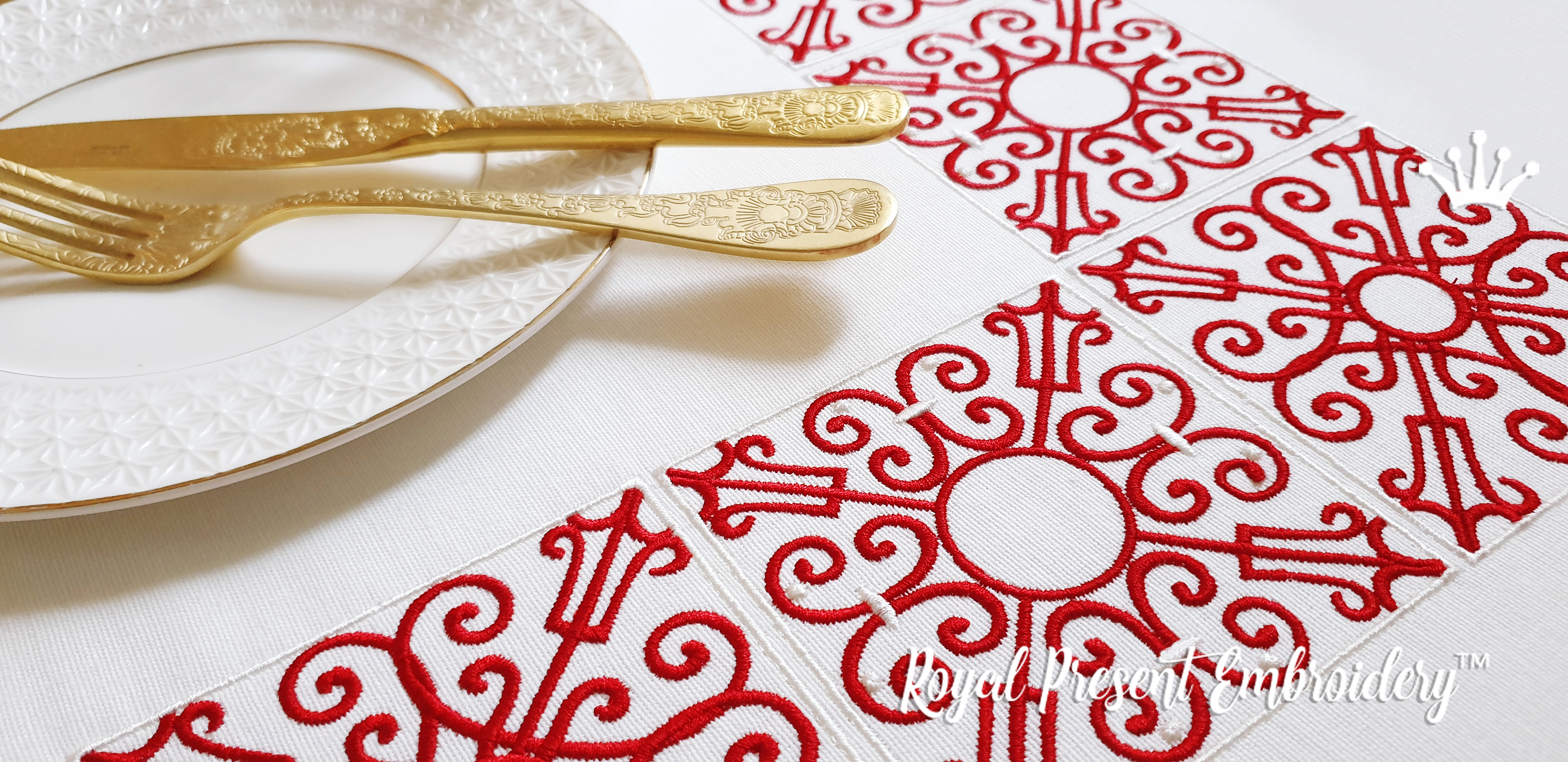
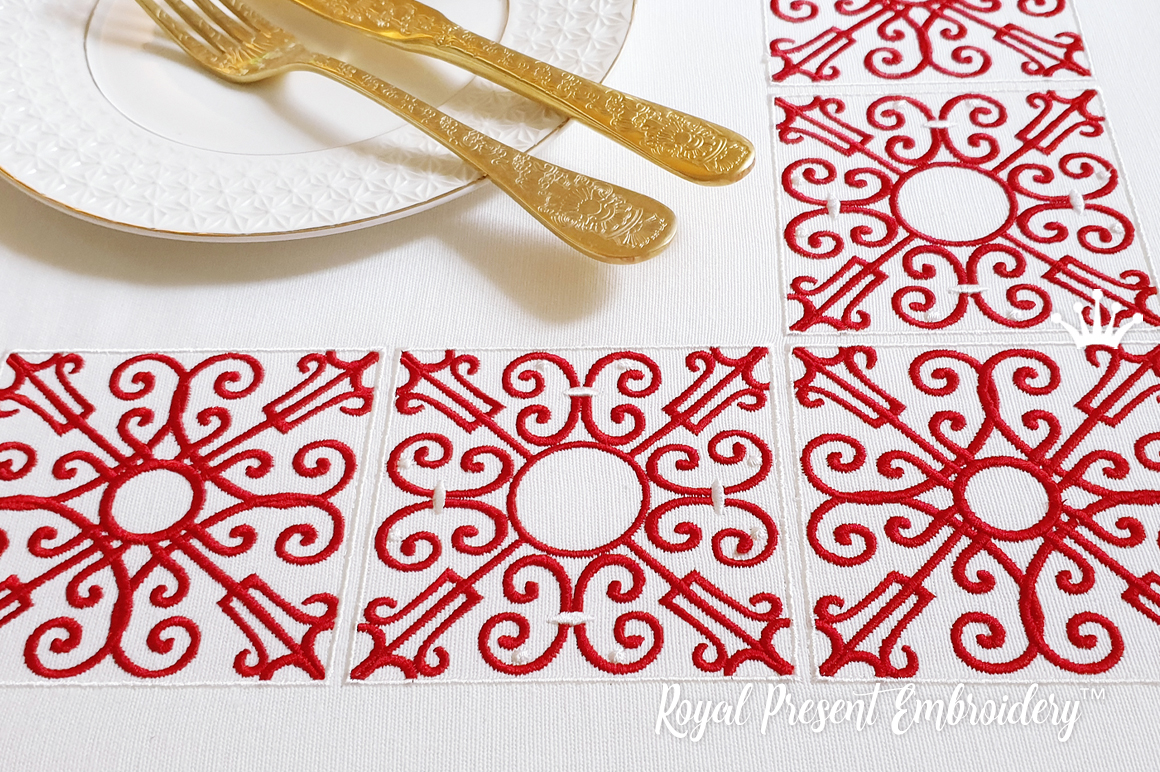
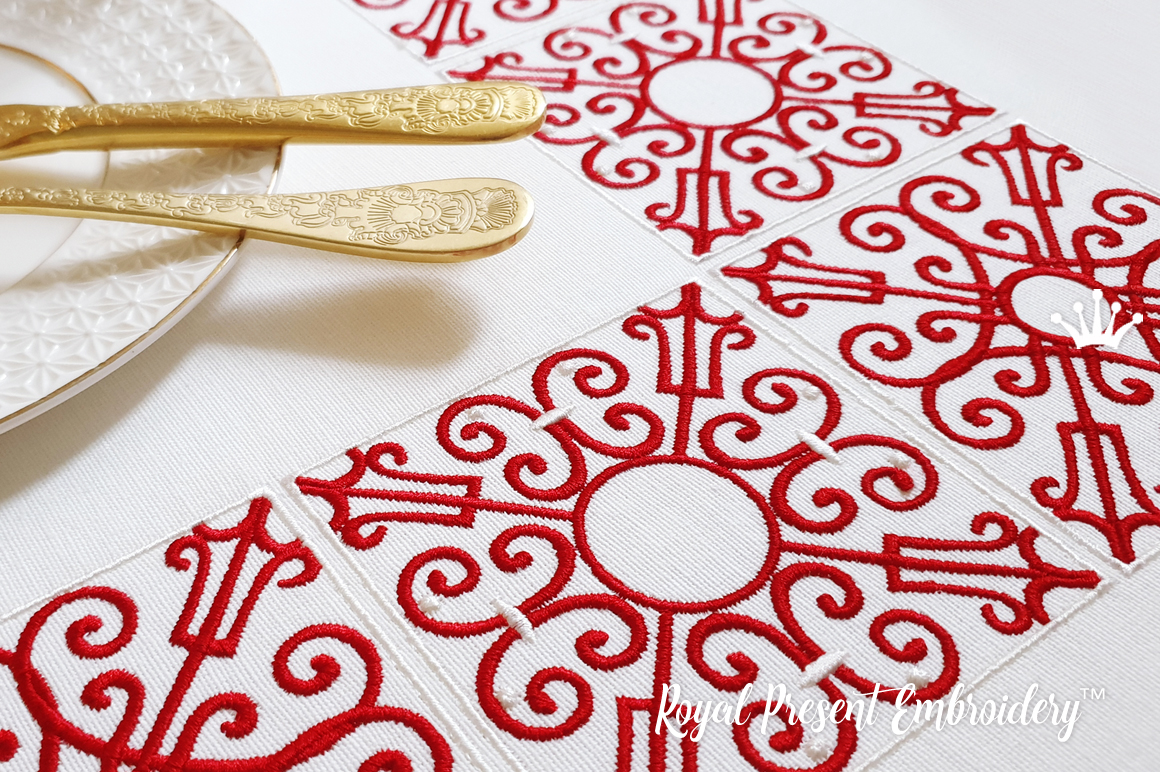
The source color charts identify the files as RPE-3268 and RPE-3268-002. One square uses a broad open circle in the center with light connecting accents. The second has a smaller, denser central medallion and a more continuous red scroll. Because both designs share the same square boundary, they can alternate in a checkerboard layout, form a straight border or build a central panel without looking like one block copied mechanically.
The set draws on the geometry of Andalusian ironwork and Moorish arabesques. Its red-and-white palette coordinates especially well with Hermès Balcon du Guadalquivir tableware, while the stitch artwork remains an independent Royal Present Embroidery creation. The files do not reproduce the porcelain decoration and are not an official Hermès product, collaboration or licensed design.
Complete the Andalusian embroidery collection

Madeira Classic 40 thread chart for Andalusian Ornaments Set
The original product charts specify these two Madeira numbers. Screen color is approximate; use the thread number and a physical Madeira color card when purchasing thread.
| ■ | Madeira Classic 40 No. 1378 – Paprika Red Main arabesques, scrolls, diagonal elements and central medallion |
| ■ | Madeira Classic 40 No. 1003 – Creme White Outer square frame and small light connecting accents |
Useful detail: No. 1003 reads mainly through rayon luster on smooth white cotton. Use warm ivory or natural linen when you want the pale square to remain clearly visible; use white fabric for a quieter tone-on-tone relief.
How to calculate a 3×3 repeat panel
For a continuous layout without gaps, multiply one side of the chosen motif by the number of blocks. A 3×3 panel of nine stitch-outs produces the following embroidery field before seam allowances and any outer fabric border:
| One embroidered block | 3×3 field without gaps | Practical use |
|---|---|---|
| 98.0x98.0 mm (3.86x3.86") | 294.0x294.0 mm (11.58x11.58") | Small pillow center or wall panel |
| 107.8x107.8 mm (4.24x4.24") | 323.4x323.4 mm (12.72x12.72") | Medium cushion panel |
| 118.6x118.6 mm (4.67x4.67") | 355.8x355.8 mm (14.01x14.01") | Large decorative panel |
| 128.0x128.0 mm (5.04x5.04") | 384.0x384.0 mm (15.12x15.12") | Large pillow or quilt center |
If each ornament is embroidered on a separate patch, add the same seam allowance to every block. Stitch first, square the patch from the outer satin frame, and trim only after embroidery; this makes the repeated units far more consistent than cutting all fabric squares in advance.
Materials for clean satin geometry
- Fabric: stable prewashed cotton, linen or linen blend around 180–240 g/m² (5.3–7.1 oz/yd²).
- Stabilizer: a practical starting point is about one third of the fabric weight, or 60–80 g/m² for the linen above. Use soft cut-away when the back will be enclosed inside a pillow; test one or two layers of firm tear-away when the reverse of a runner will remain visible.
- Needle: a new sharp embroidery needle, 75/11 for ordinary woven cotton or 80/12 for medium-weight linen.
- Top thread: Madeira Classic 40 for rayon luster, or 40-weight embroidery polyester for table linens that will be washed frequently.
- Topping: none on smooth cotton; test a thin water-soluble film such as Madeira Avalon Film or Sulky Solvy on loose, textured linen if the satin edges sink into the weave.
Six practical tips for straight repeats and a cleaner back
- Print the template at 100%. Mark the center and all four sides of the outer square. For the next repeat, measure from the stitched frame on the test sample rather than relying only on the nominal design width.
- Test both ornaments on the project fabric. Their red and light elements are distributed differently, so the two squares may relax by slightly different amounts after pressing. Compare them before deciding the final gap.
- Keep the stabilizer firm and the fabric neutral. Smooth both layers in the hoop, but do not stretch the fabric. Stretched cloth contracts after release and bends the straight square border.
- Run the long satin scrolls at about 550–650 stitches per minute. The lower speed reduces abrupt frame movement at diagonals and helps the line width remain consistent.
- Change the bobbin before Creme White. A pale bobbin thread reduces red specks at the needle penetrations and gives a table runner a cleaner reverse.
- Use one rigid squaring template for separate quilt blocks. Add an identical allowance outside the satin square and keep the raised satin frame out of the sewing seam.
Royal Present technical guides: how to prevent puckering in machine embroidery, how fabric, stabilizer and stitch density work together, and how to choose a stabilizer.
Washing and pressing
Prewash the project fabric at the temperature planned for the finished item. Wash an embroidered runner or cushion cover on a gentle cycle up to 30 °C (86 °F), without chlorine bleach. Reshape it promptly and press from the reverse through a cotton cloth on a padded surface so the satin scrolls keep their relief.
For frequently washed table linens, 40-weight polyester is the more practical choice because it is stronger and more colorfast; Madeira Classic 40 rayon is chosen for its softer, high-luster finish. Test after changing thread type: the same color number in a different thread family does not guarantee the same shade or sheen.
Browse more compatible files in machine embroidery designs for quilt blocks and patterns and arabesque machine embroidery designs.
Frequently asked questions
Does the download contain one ornament or two?
It contains two coordinated square machine embroidery designs: one with a broad open central circle and one with a smaller, denser medallion. Each design is supplied in 4 sizes.
Are these appliqué or in-the-hoop designs?
No. Both files stitch directly onto the base fabric with satin lines and outlines. No fabric pieces are placed during stitching, and a finished item is not assembled in the hoop.
Can I make a 3×3 pillow panel?
Yes. Nine 98.0x98.0 mm blocks create a 294.0x294.0 mm field without gaps or allowances; nine 128.0x128.0 mm blocks create a 384.0x384.0 mm field. Add the outer fabric border and seam allowances required for the finished pillow size.
Which stabilizer should I use on linen?
For stable linen around 180–240 g/m², start by testing 60–80 g/m² of stabilizer. A soft cut-away gives stronger support when the reverse will be enclosed; for a visible table-linen back, test one or two layers of firm tear-away on the exact fabric.
Do the designs coordinate with Hermès Balcon du Guadalquivir?
Yes. The red-and-white palette, square architecture and scrolling rhythm work naturally in the same table setting without copying the porcelain decoration. These are independent Royal Present Embroidery designs with no official Hermès affiliation or collaboration.

 Get Sign-In Link
 Login with Google
 Login with Facebook
 Login with Amazon
 Login with Paypal