Andalusian Applique Machine Embroidery Design – 8 Sizes
By knowing the speed of your embroidery machine, you can find out how long it will take to embroider a design.
To use the embroidery calculator, click on the number of stitches in the product description.
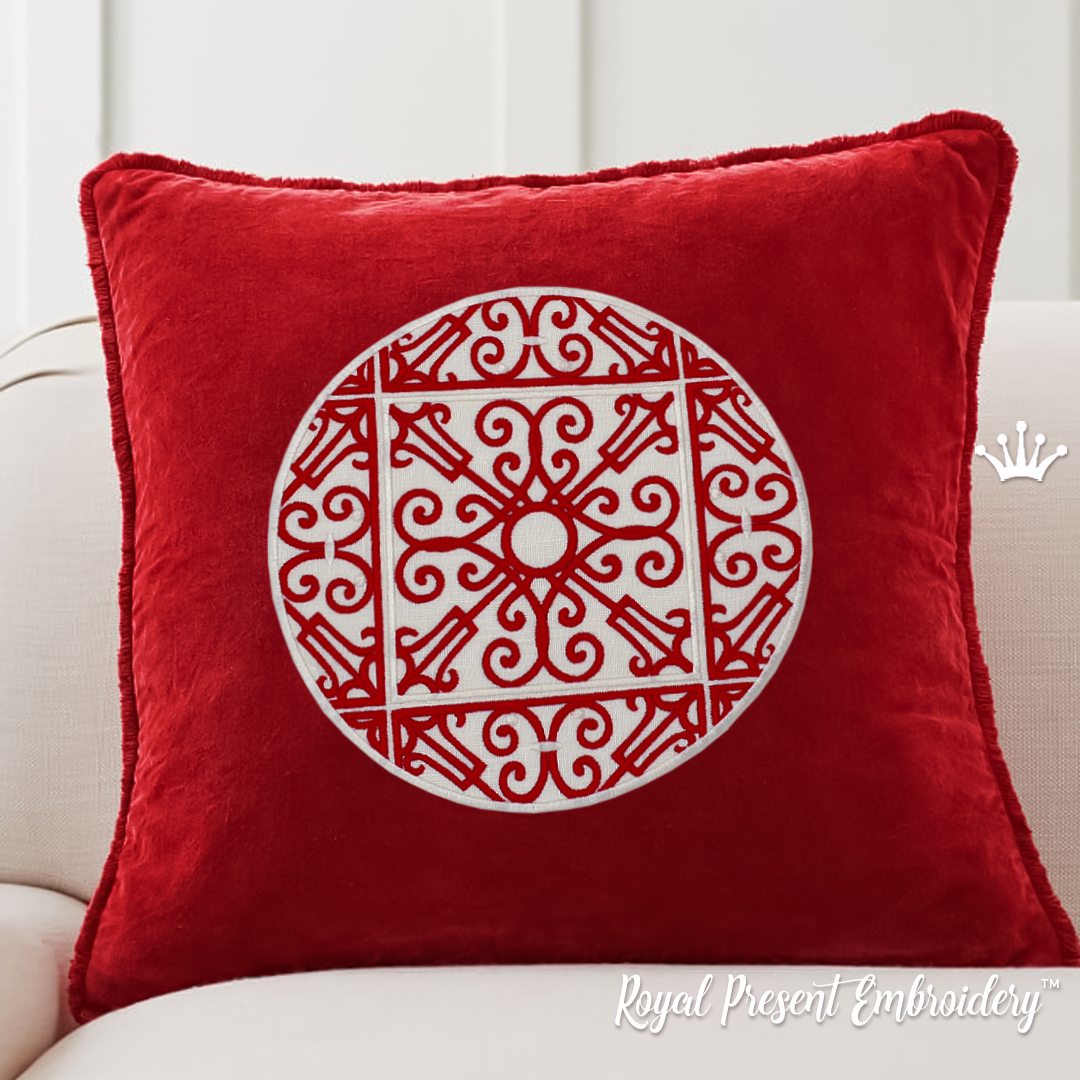
This digital Andalusian applique machine embroidery design contains one round ornament in 8 exact sizes. The download includes 11 machine formats and a color chart; fabric, thread and a finished item are not included.
Exact sizes, stitches and file formats
Size: 128.0x126.6mm (5.04x4.98"), Stitches: 31177
Size: 138.0x136.4mm (5.43x5.37"), Stitches: 33613
Size: 148.0x146.3mm (5.83x5.76"), Stitches: 36082
Size: 158.0x156.3mm (6.22x6.15"), Stitches: 38554
Size: 178.0x176.0 mm (7.01x6.93"), Stitches: 43529
Size: 198.0x195.8mm (7.80x7.71"), Stitches: 48682
Size: 217.9x215.5mm (8.58x8.48"), Stitches: 54220
Size: 240.7x238.0 mm (9.48x9.37"), Stitches: 60815
Formats: .dst, .jef, .pec, .vip, .hus, .pes, .exp, .sew, .dat, xxx, vp3
| Specification | Exact product data |
|---|---|
| Product type | Digital applique machine embroidery design |
| Included | One ornament in 8 sizes, 11 machine formats and a color chart |
| Stitch count | 31,177–60,815 stitches, depending on size |
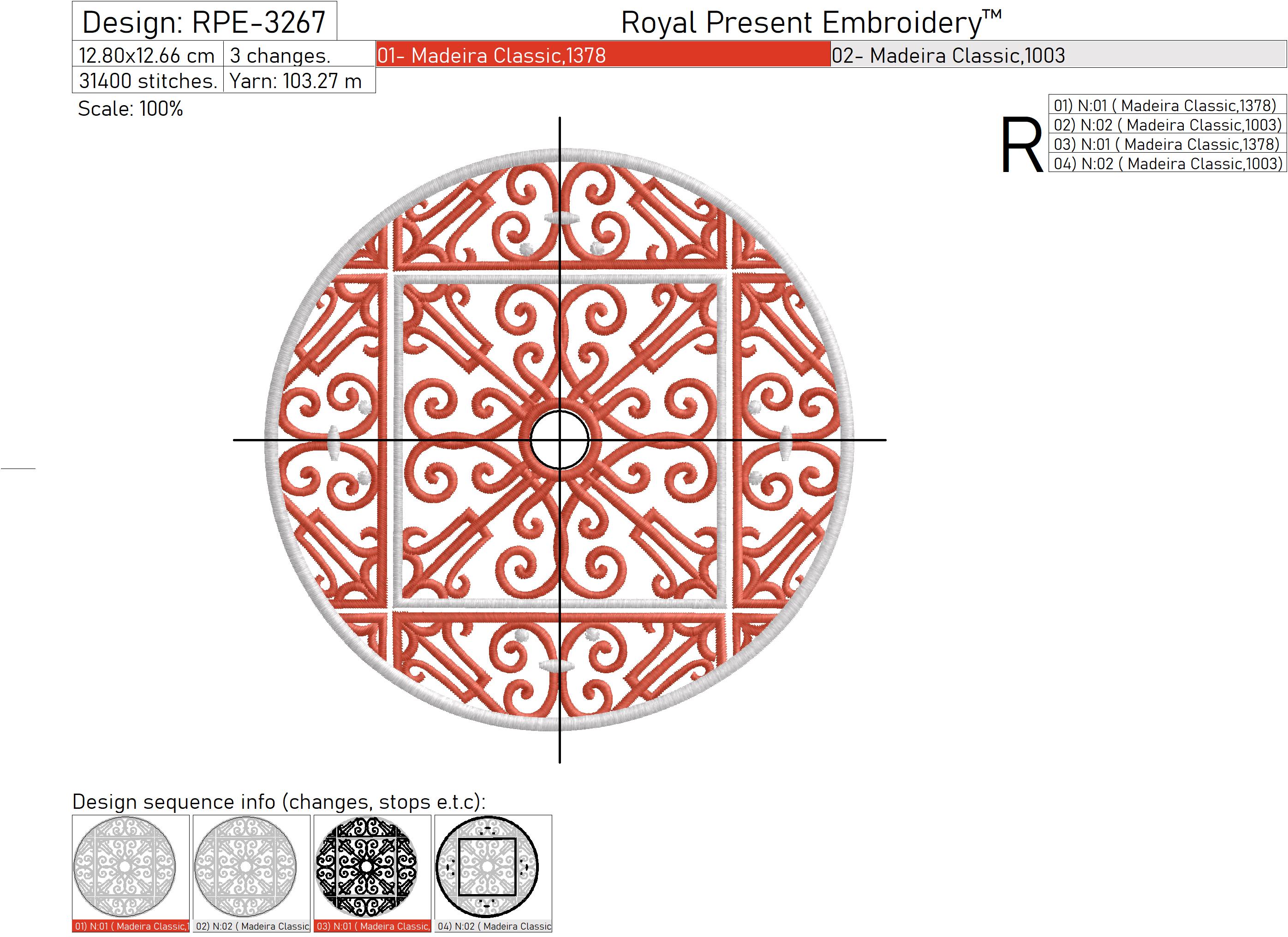
| Original color chart | 2 Madeira Classic 40 colors, 4 color blocks and 3 thread changes |
| Technique | Placement line, tackdown, in-hoop trimming and embroidered finish |
| Style | Andalusian ironwork, Moorish arabesque and radial medallion |
Applique embroidery inspired by tableware and architecture
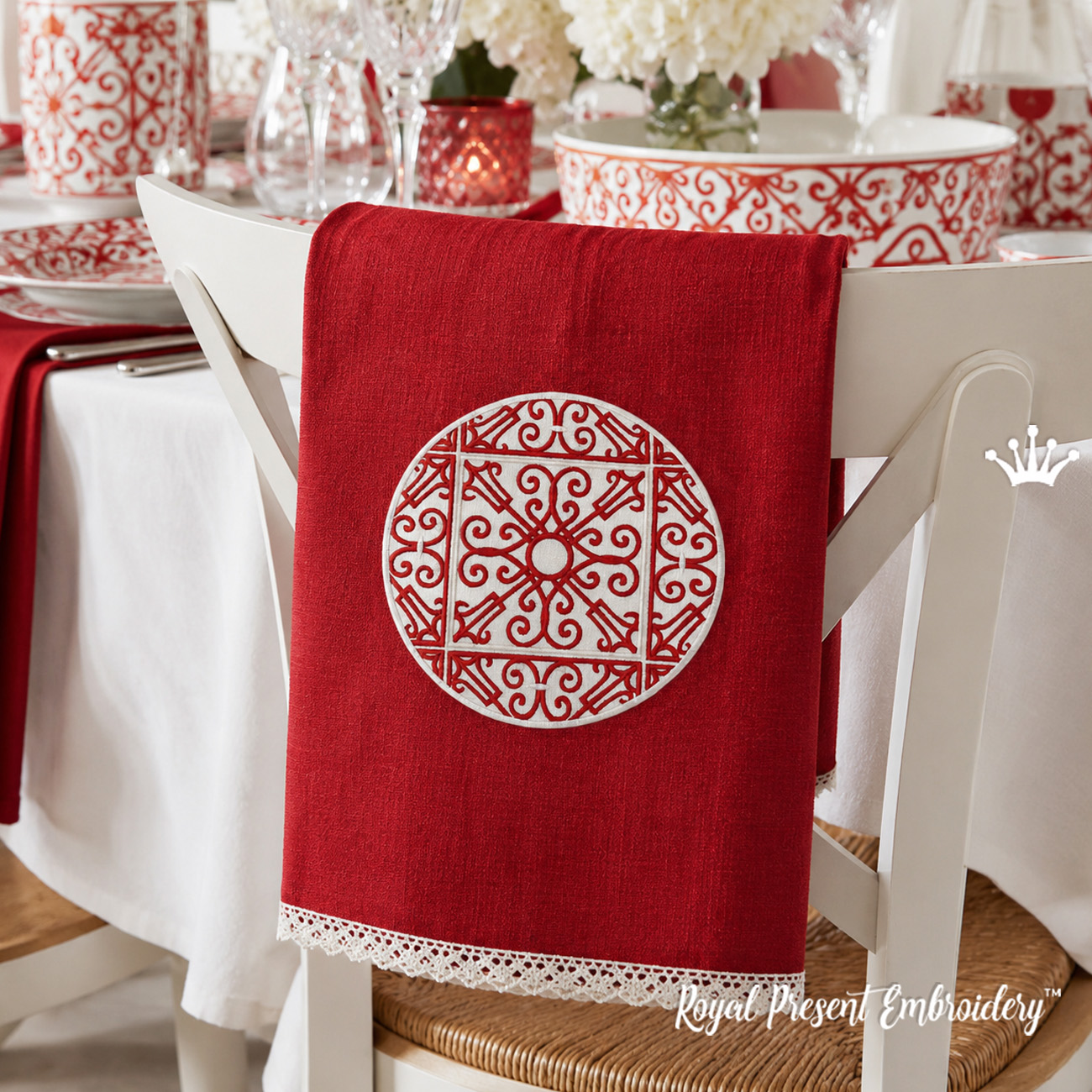
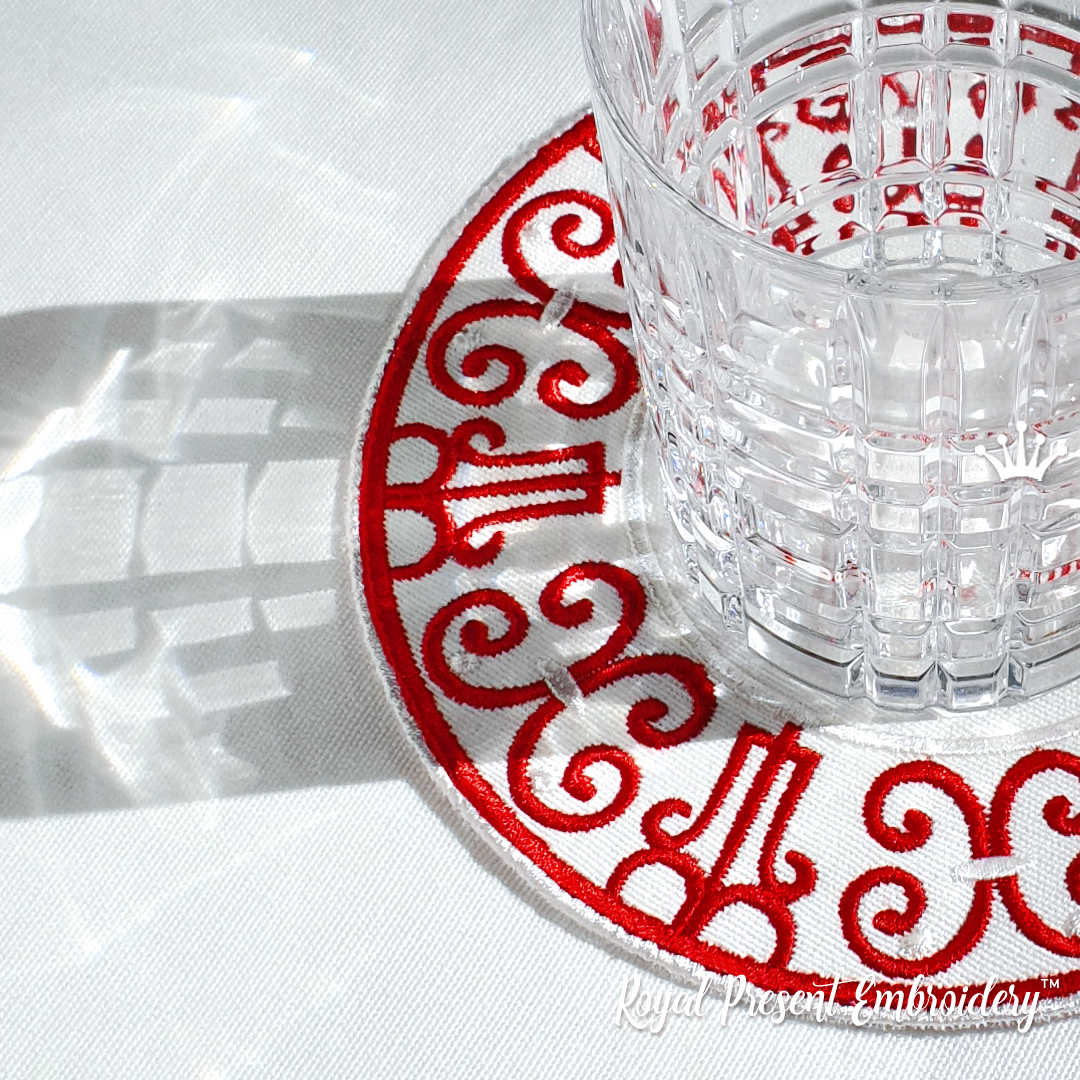
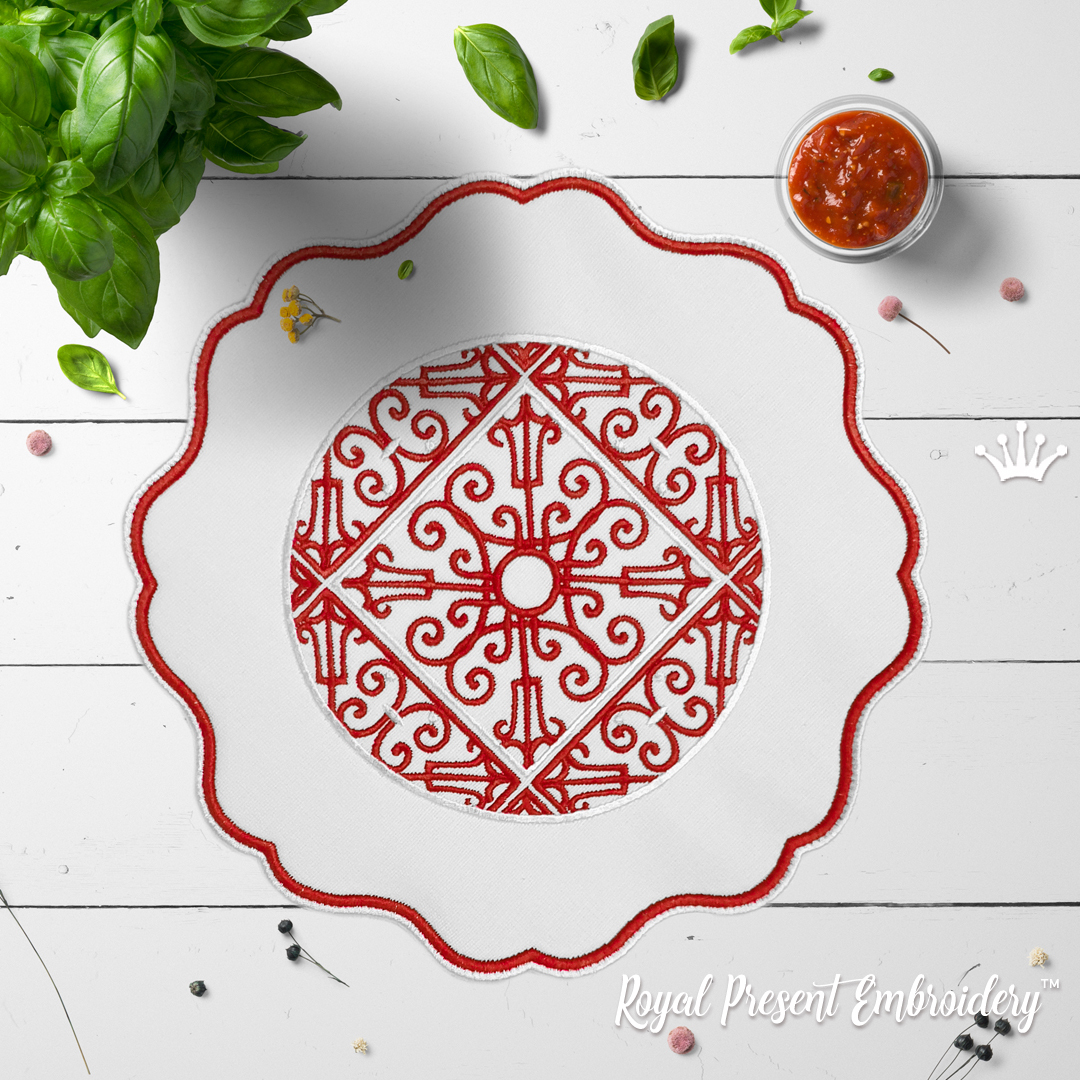
This design is for customers searching for embroidery inspired by Hermès tableware, red and white applique for luxury home décor or machine embroidery to match Balcon du Guadalquivir. The round composition works as a textile medallion rather than a miniature dinner-plate print: the applique fabric forms a broad color field, while the embroidered lattice gives it depth and structure.
Hermès Balcon du Guadalquivir and the Royal Present Andalusian collection refer to the same visual world of southern Spain: wrought-iron balconies, scrolling metalwork and disciplined radial geometry. The shared red-and-white palette lets the embroidery sit naturally beside this porcelain, but the stitch composition is an independent Royal Present Embroidery design. It does not reproduce the dinnerware decoration and is not a Hermès product, licensed file or collaboration.
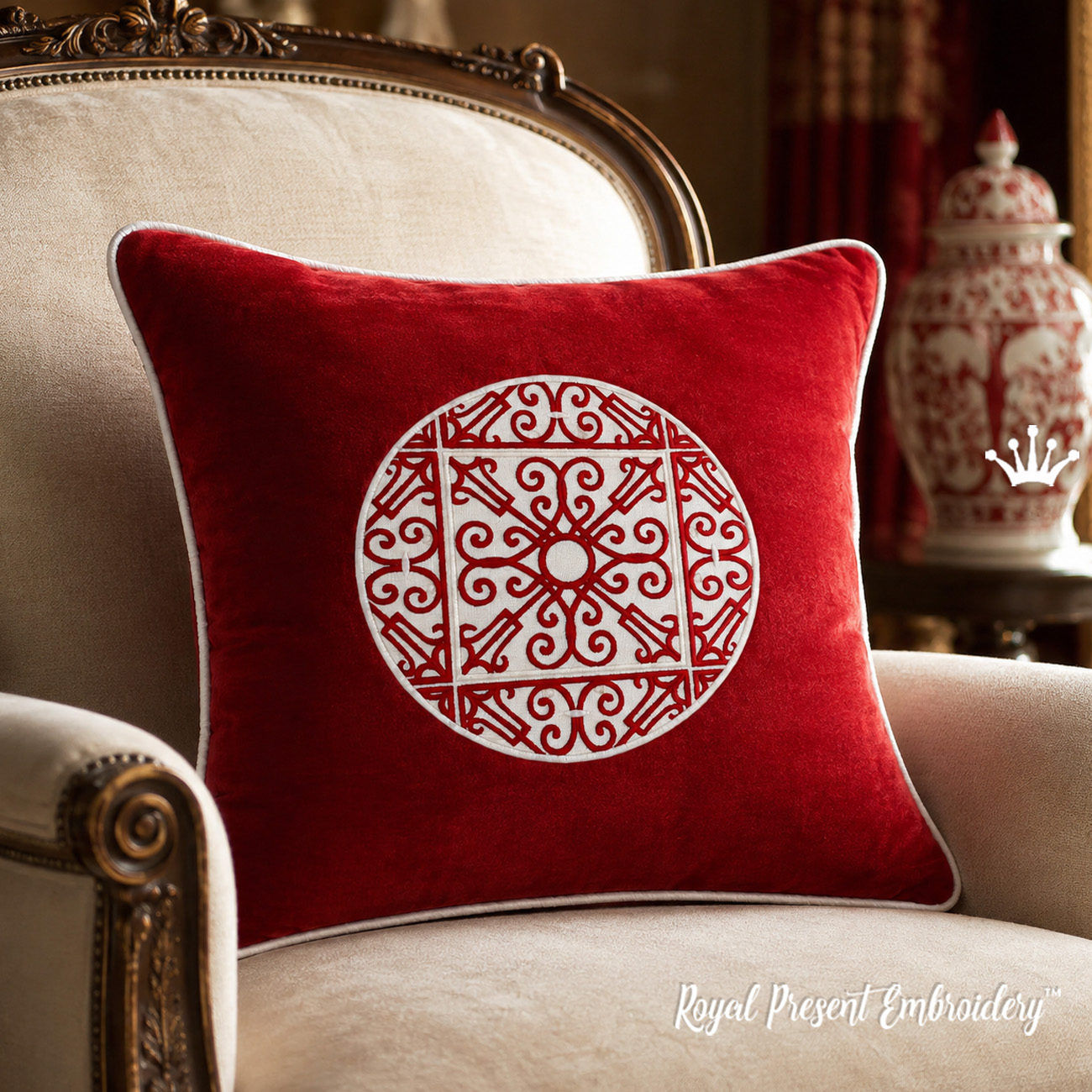
For the strongest tableware connection, combine paprika-red thread with a cream applique insert on white or natural linen. For a quieter interior, use burgundy with champagne; for a graphic contemporary result, reverse the contrast and place a red applique on an ivory ground. The architecture remains readable even when the palette changes because the design is carried by symmetry, not by one prescribed color scheme.
Complete the Andalusian embroidery collection

Madeira thread palette from the RPE-3267 color chart
The original chart uses two Madeira Classic 40 colors. The large swatches below show the intended color family; select thread by number because screens cannot reproduce rayon thread exactly.
| Madeira Classic 40 No. 1378 – Paprika Main red for the ornamental structure |
|
| Madeira Classic 40 No. 1003 – Cream White Cream finish for the frame and light details |
Color-planning tip: choose the applique fabric before selecting the pale thread. A cream insert beside optical white thread may appear yellow, while Madeira 1003 keeps the transition warmer. Compare the fabric, thread spool and dinnerware together in daylight before stitching the full-size version.
Fabric weights that keep the medallion flat
For the ground fabric, use prewashed table linen or a stable linen-cotton blend around 180–240 g/m² (5.3–7.1 oz/yd²). A close, even weave supports the dense lattice without allowing the curves to pull open. Avoid very loose rustic linen with large slubs: the tackdown can land between widely spaced yarns and leave an unstable cut edge.
For the applique insert, smooth cotton, linen or a linen-cotton blend around 140–200 g/m² (4.1–5.9 oz/yd²) gives a cleaner result than bulky upholstery fabric. Prewash the ground and applique fabrics together if the finished item will be laundered. Unequal shrinkage can create a bubble inside the large circle after the first wash even when the embroidery itself is perfectly aligned.
Medium-weight tear-away stabilizer is a practical choice for stable woven fabric, following the product sequence. On velvet, soft furnishing fabric or any material that shifts under 31,177–60,815 stitches, use a stable cut-away backing. Hoop the stabilizer, secure the velvet on top and add a thin water-soluble topping so the decorative stitches remain above the pile.
Applique sequence
- Print the template at 100% scale and transfer the center and axis marks with an air-erase or washable fabric marker.
- Fuse or temporarily secure tear-away stabilizer to the wrong side, then hoop the project fabric and stabilizer together without distortion.
- Stitch the first placement line. After the machine stops, cover it with applique fabric extending about 15–20 mm (0.6–0.8 in) beyond the line.
- Stitch the tackdown line. Remove the hoop from the machine without releasing the fabric from the hoop.
- Trim the excess applique fabric close to the tackdown, leaving only about 0.5–1 mm (0.02–0.04 in) at the edge.
- Return the hoop to the machine and complete the ornamental embroidery. Remove the excess stabilizer after stitching.
Five practical applique tips
- Use duckbill or curved applique scissors. Their shape keeps the base fabric away from the blade while you trim close to the tackdown.
- Do not unhoop the project for trimming. A small shift is enough to misalign the circular frame with the inner lattice.
- Apply temporary adhesive to the applique fabric, not inside the hoop. A light, even layer prevents a fold; overspray can collect on the needle and thread path.
- Stabilize a fraying insert before cutting. A very light fusible web on the wrong side holds loose yarns together and helps the final embroidered edge remain clean.
- Test the smallest file in the chosen materials first. The test reveals thread tension, edge coverage and color interaction while using less fabric and fewer stitches than the largest medallion.
Where to use the eight sizes
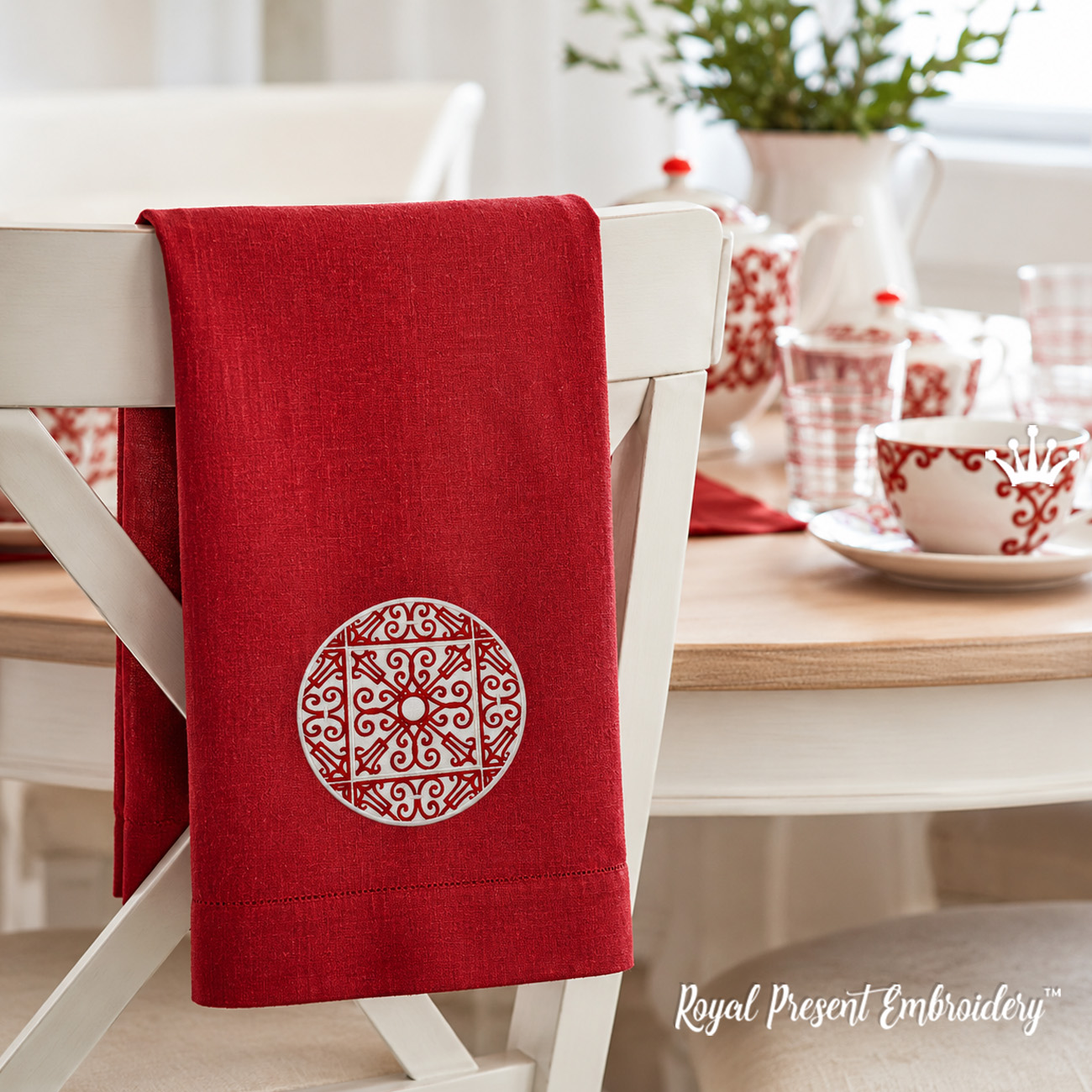
The smaller versions create a centered motif on a table napkin, decorative panel or tote. Sizes around 158.0x156.3mm (6.22x6.15") to 198.0x195.8mm (7.80x7.71") suit 40x40 cm (15.75x15.75 in) pillow covers. The 217.9x215.5mm (8.58x8.48") and 240.7x238.0 mm (9.48x9.37") files make a strong central medallion on 45x45 cm (17.72x17.72 in) pillows, chair backs, quilts and framed textile art.
For a coordinated room, use one large medallion on the main pillow and smaller versions on a table runner or chair textiles. Repeating the palette instead of repeating one identical size keeps the collection connected without making every object look duplicated.
Frequently asked questions
What fabric works best for the applique insert?
Use smooth, prewashed cotton, linen or a linen-cotton blend around 140–200 g/m² (4.1–5.9 oz/yd²). A close weave trims cleanly and creates less bulk under the final embroidered edge.
Can I embroider this design on velvet?
Yes. Hoop a stable cut-away backing, secure the velvet on top without crushing the pile and add thin water-soluble topping. Test the chosen velvet first because very soft pile can hide fine decorative stitches.
How do I stop the applique edge from fraying?
Pre-stabilize a loose insert with lightweight fusible web, then trim with curved or duckbill scissors about 0.5–1 mm (0.02–0.04 in) from the tackdown. Do not pull individual yarns after trimming because this can loosen the fabric behind the securing line.
How should the finished embroidery be washed?
Follow the care limit of the most delicate fabric and thread used. For washable linen or cotton, use a gentle cycle, mild detergent and low spin; reshape while damp and press from the wrong side over a soft towel so the raised embroidery is not flattened.
Is this a Hermès Balcon du Guadalquivir design?
No. It is an independent Royal Present Embroidery design based on Andalusian ironwork and Moorish ornament. The red-and-white palette is intended to coordinate visually with Hermès tableware, but the file does not copy the porcelain decoration and is not an official Hermès product or collaboration.
Andalusian Applique Machine Embroidery Design – 8 Sizes
I ordered this as a gift for my sister and she absolutely loves it! It's even cooler in person than it is in the picture - the embroidery is perfect and the overall style is very chic. She's had a lot of compliments on it already, and I'm sure she'll be showing it off for years to come. Thank you for such a beautiful and unique design!

 Get Sign-In Link
 Login with Google
 Login with Facebook
 Login with Amazon
 Login with Paypal