Baroque Quilt Block Machine Embroidery Design - 7 sizes
By knowing the speed of your embroidery machine, you can find out how long it will take to embroider a design.
To use the embroidery calculator, click on the number of stitches in the product description.
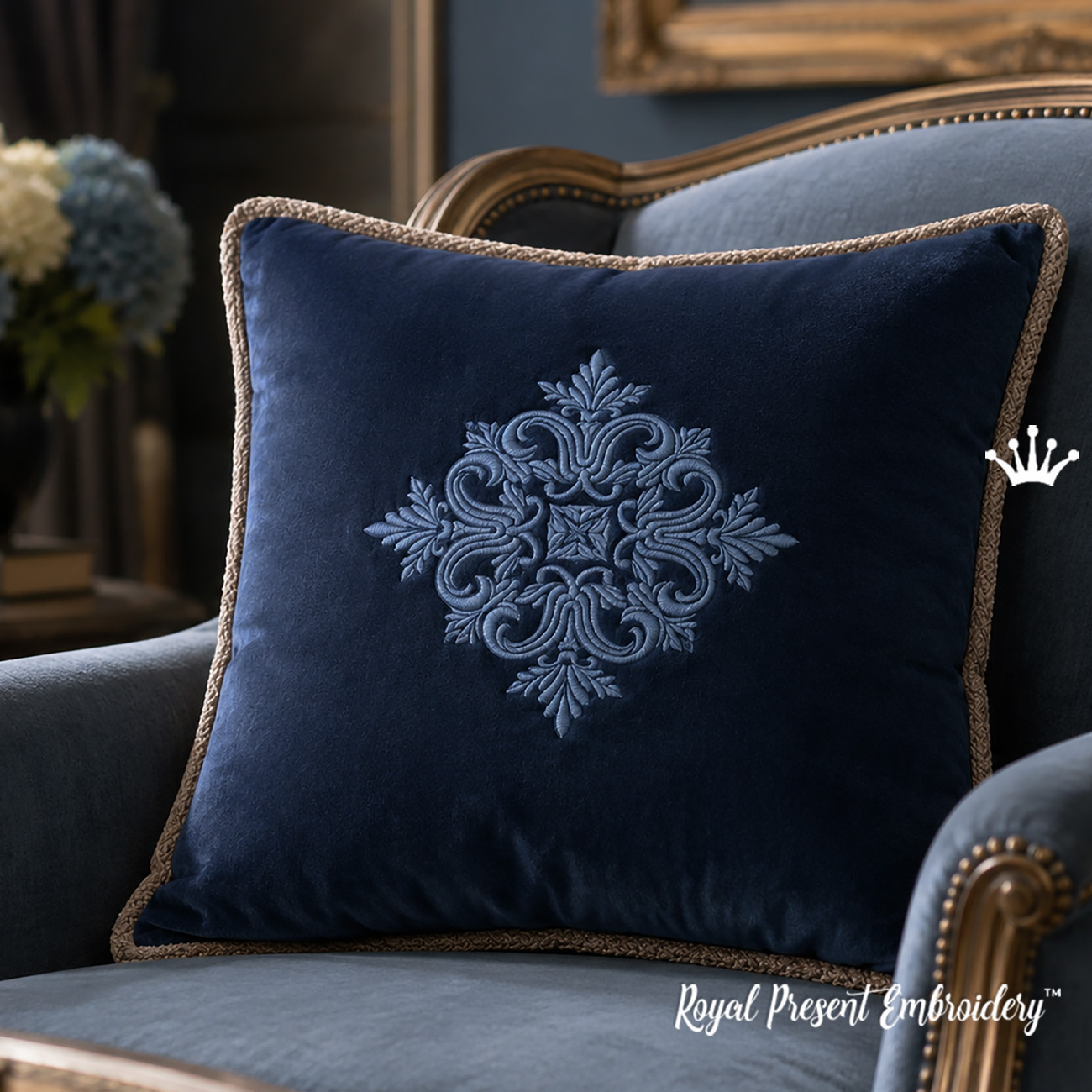
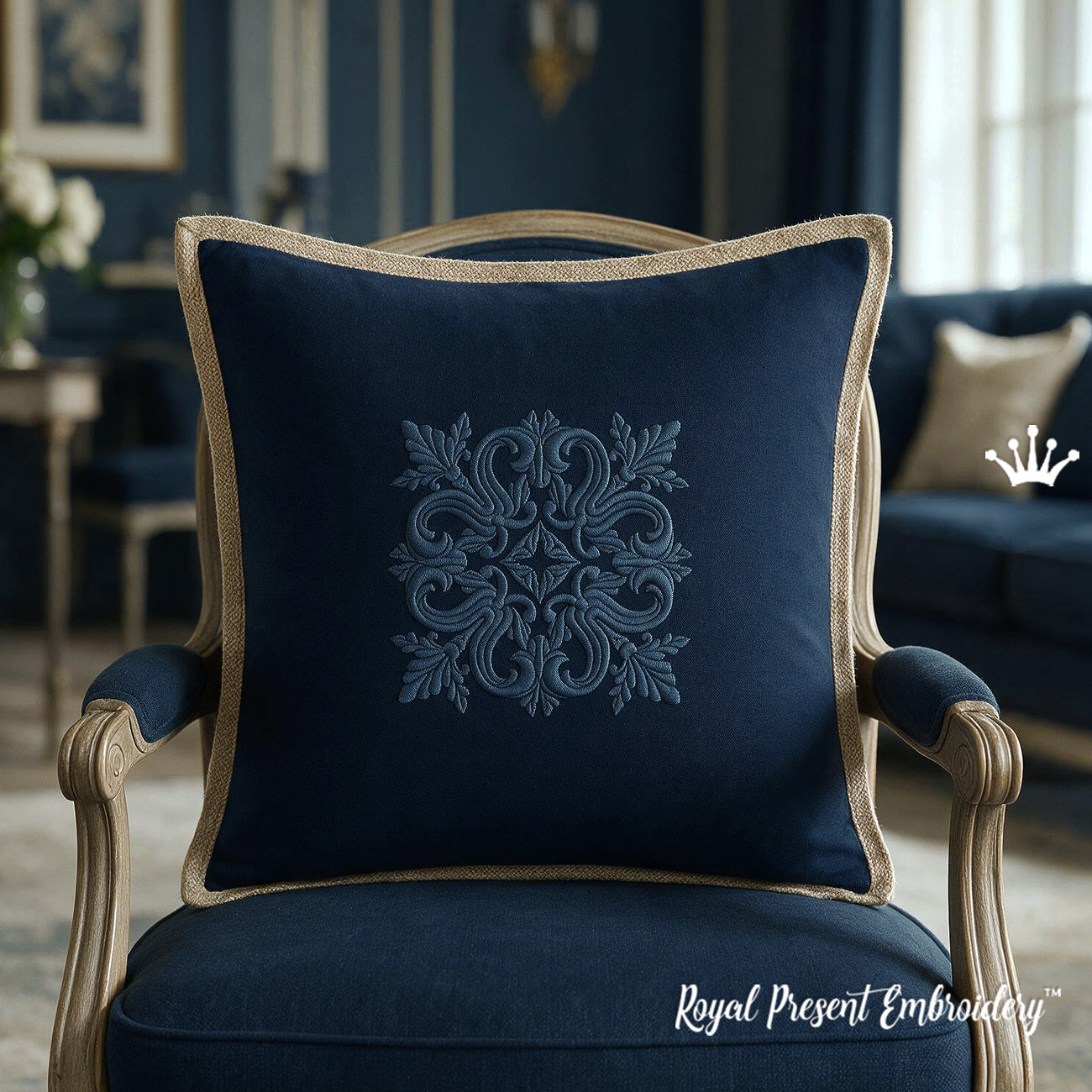
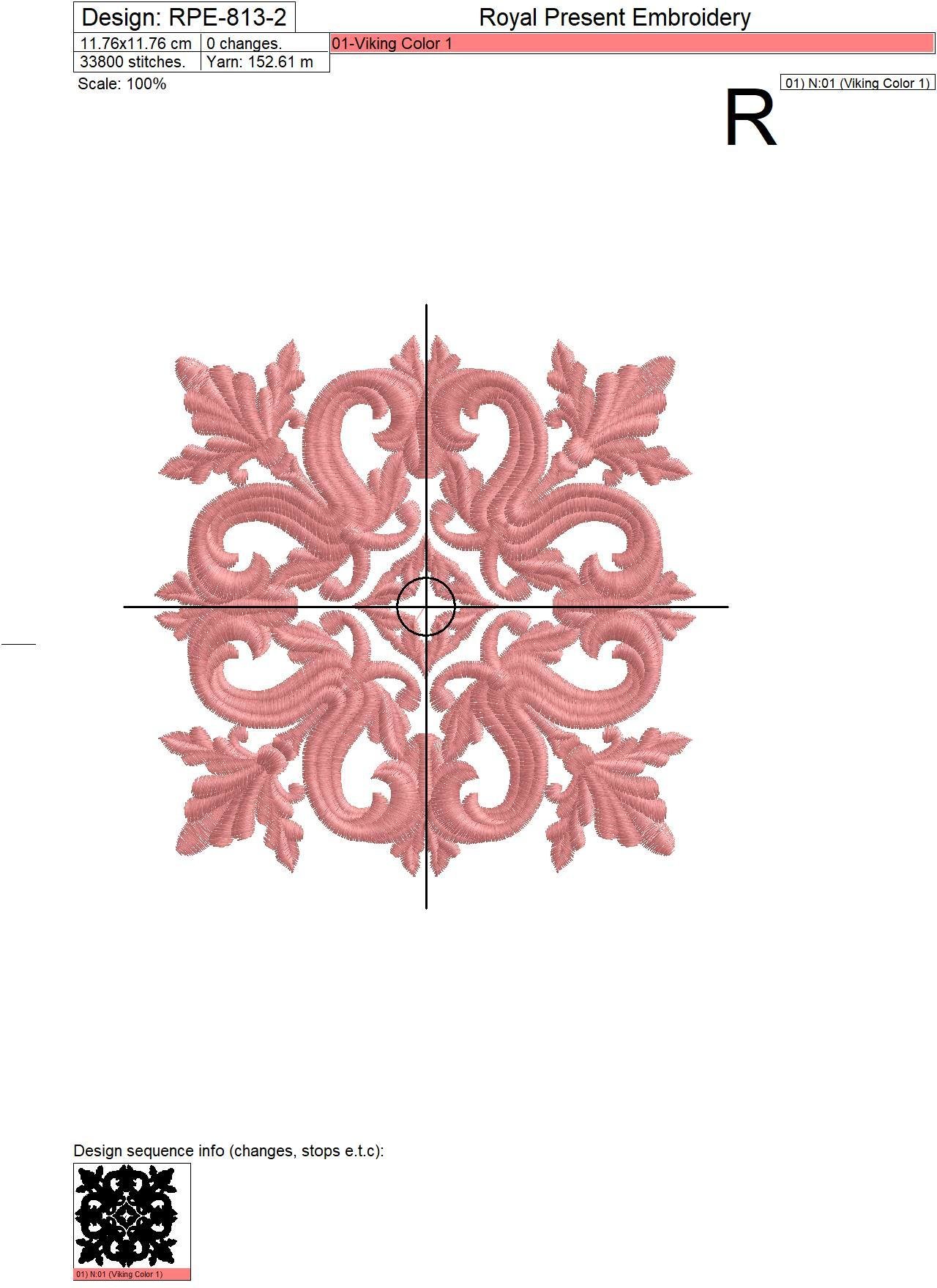
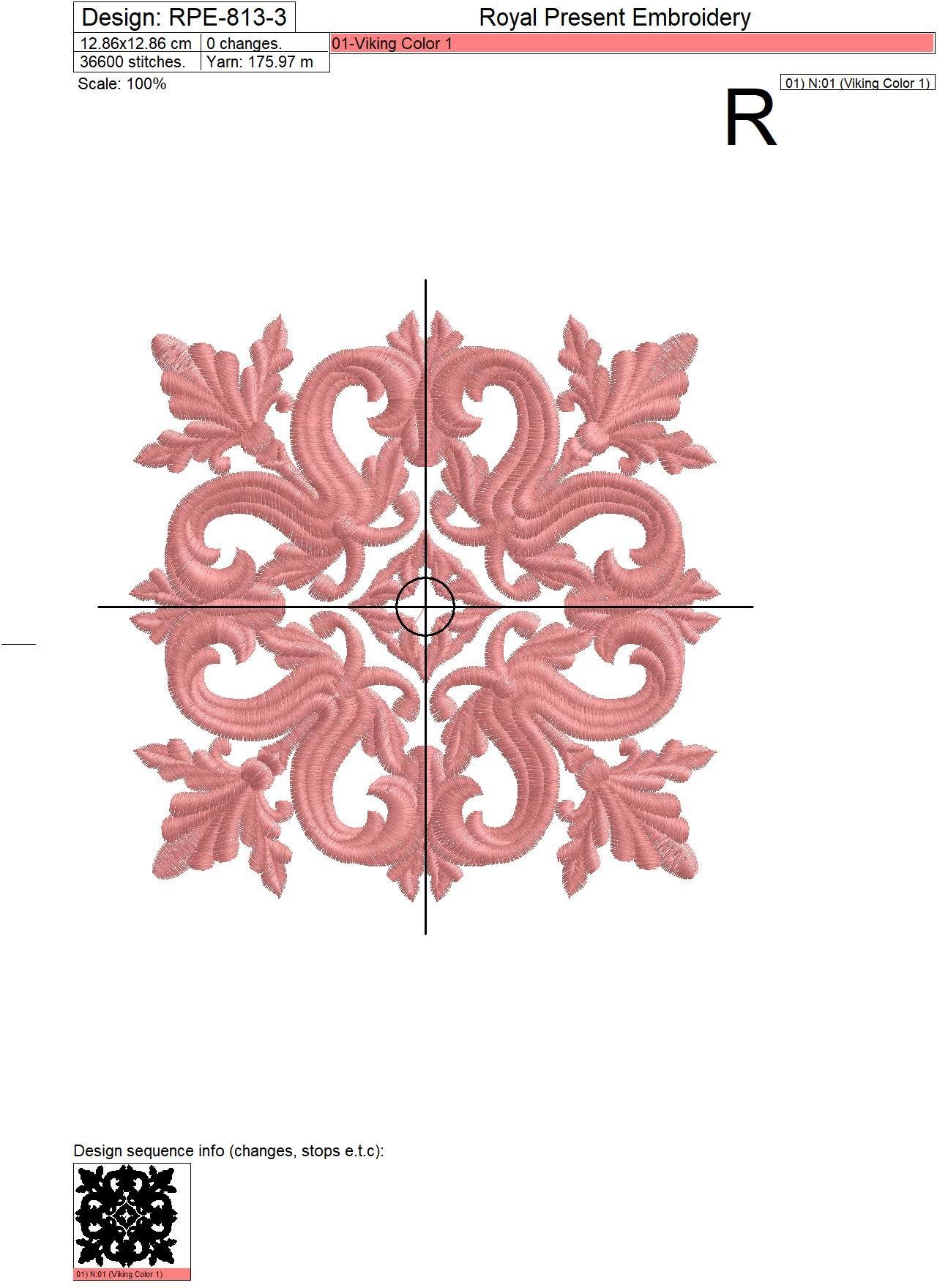
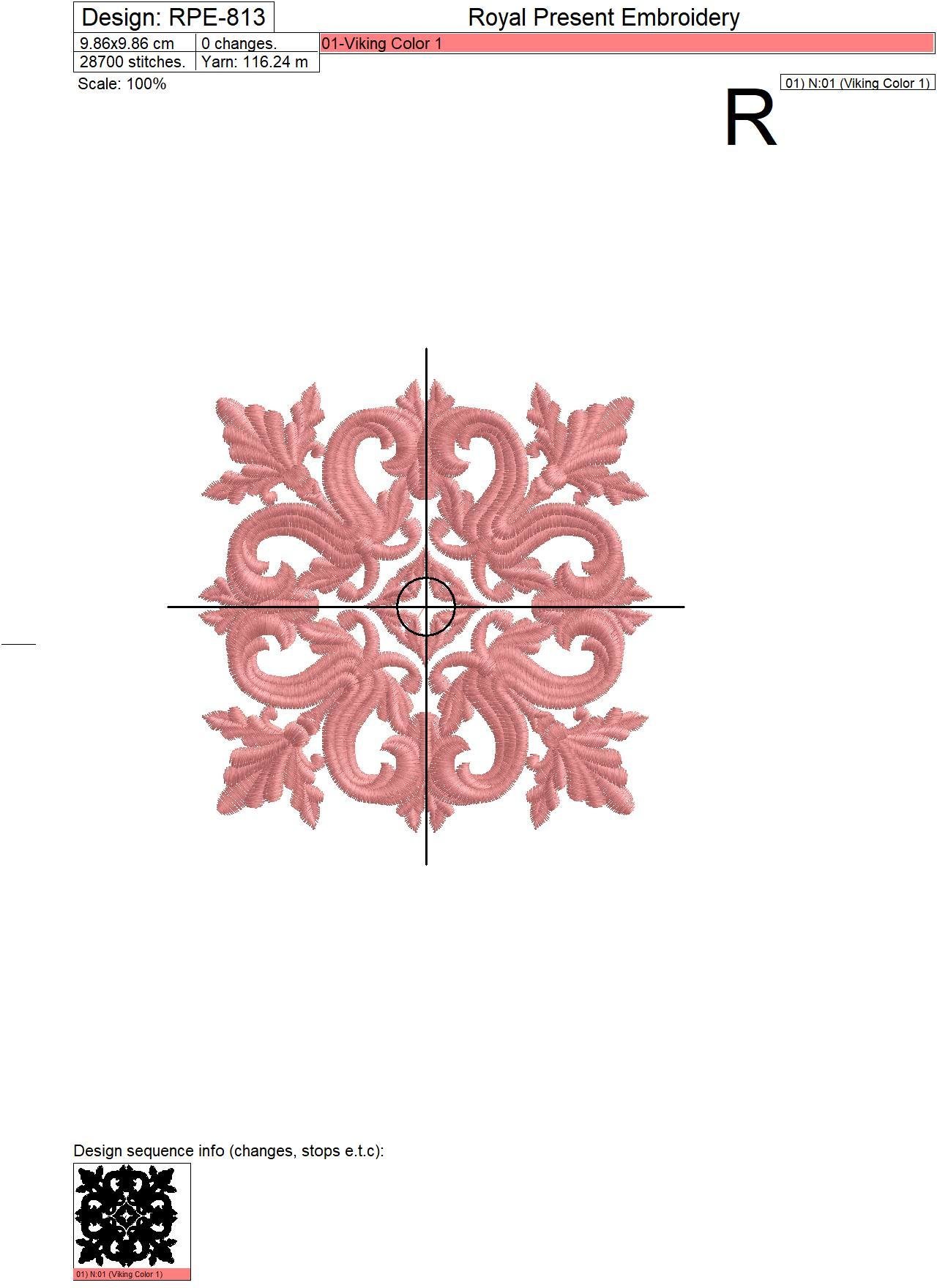
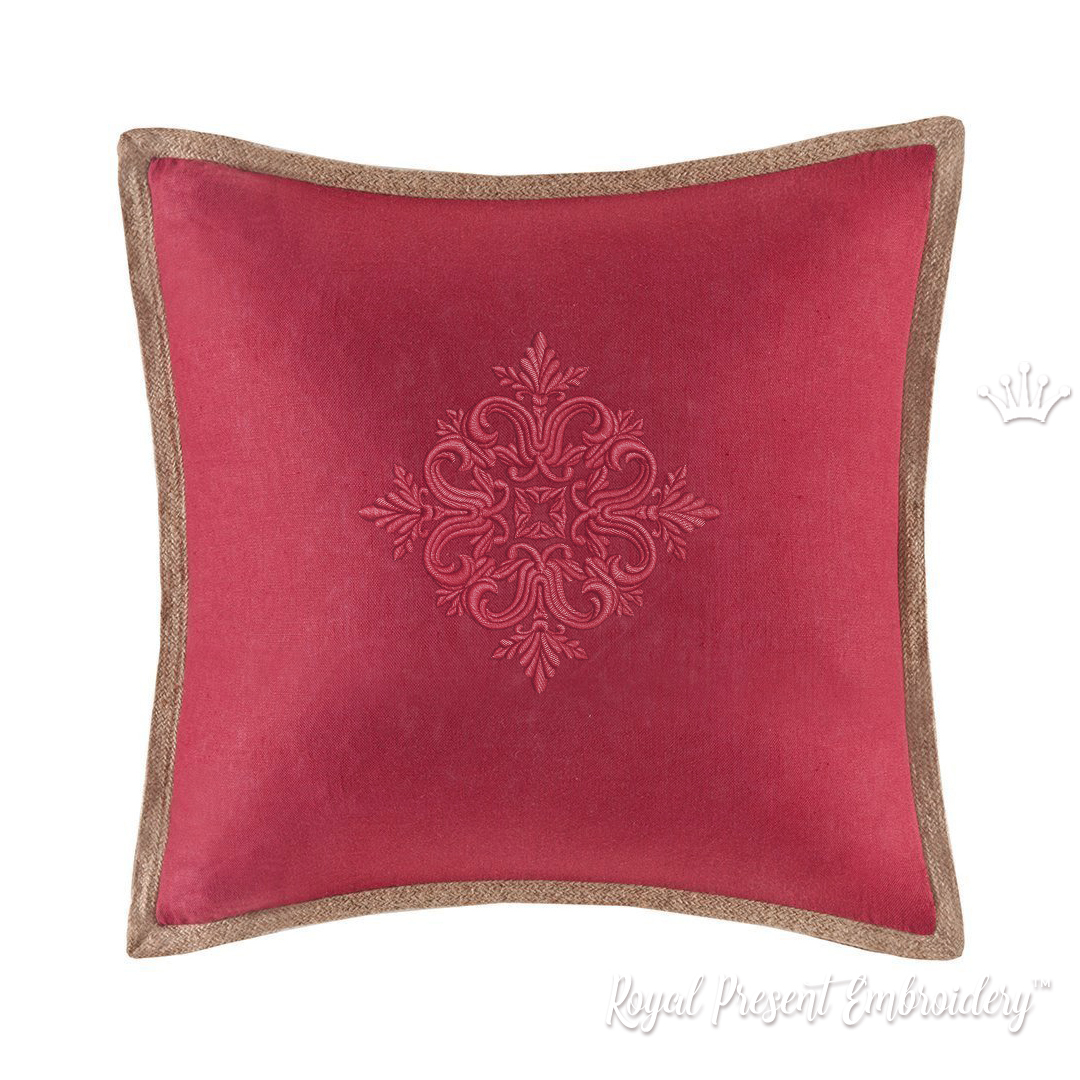
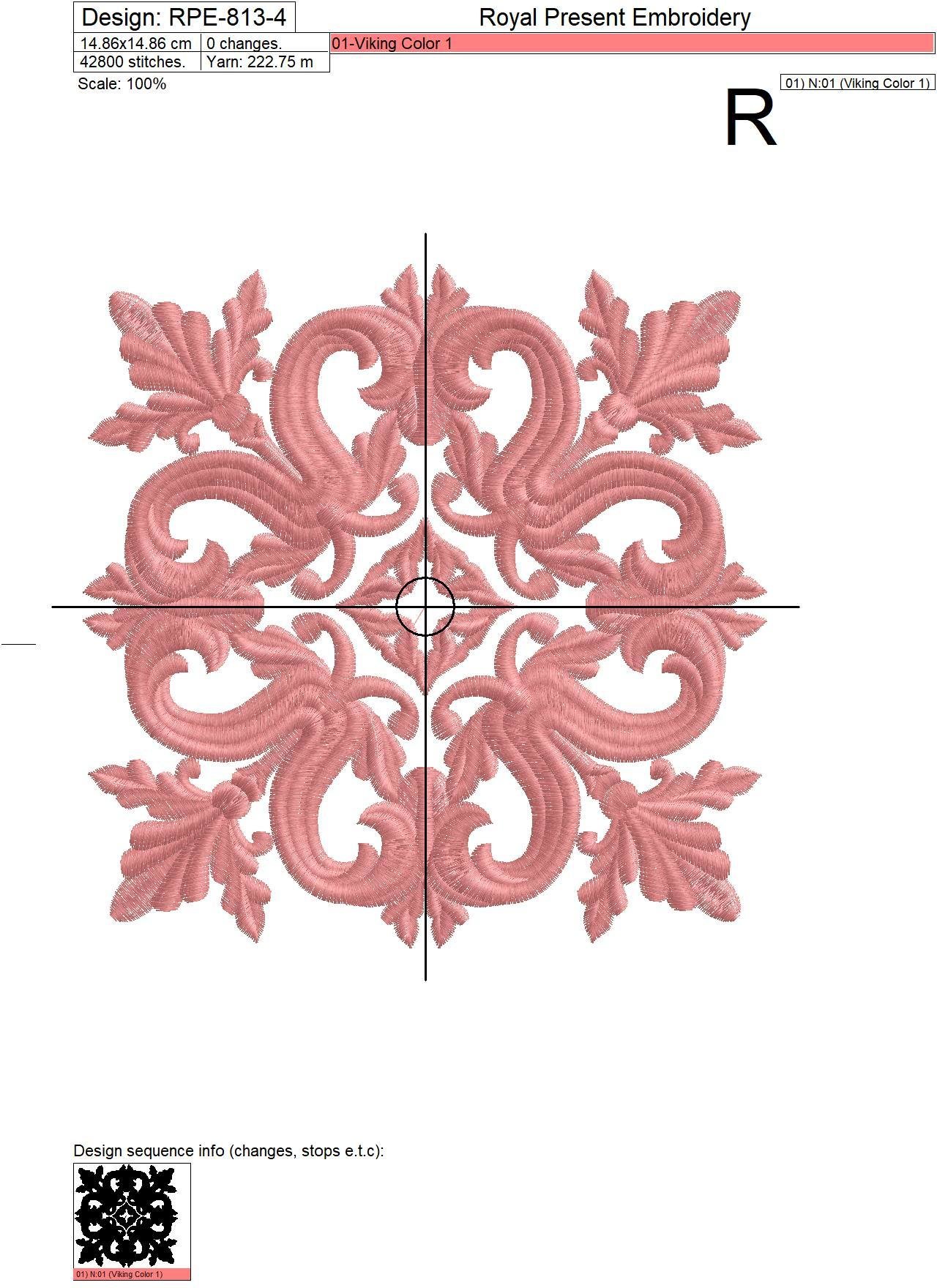
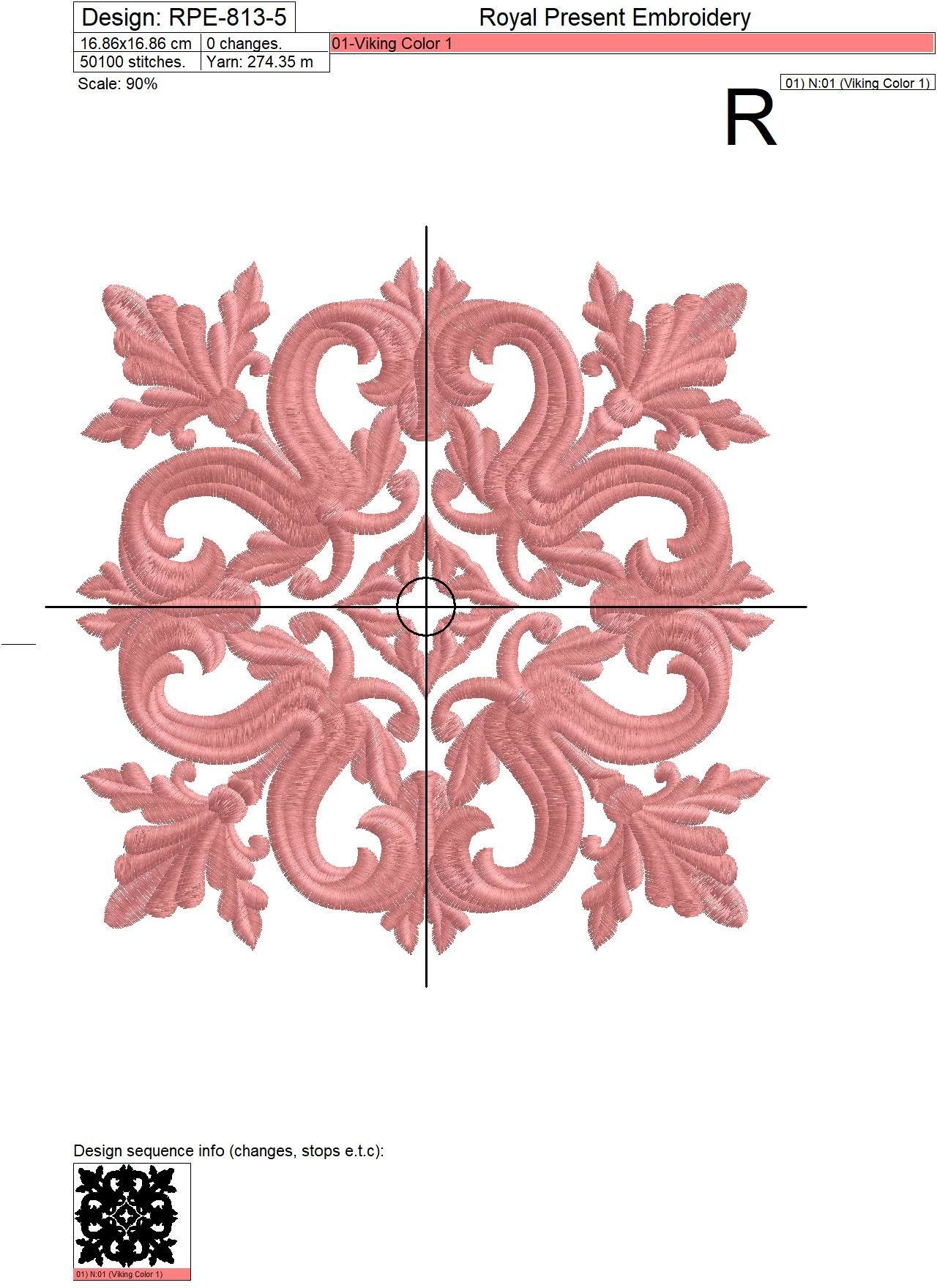
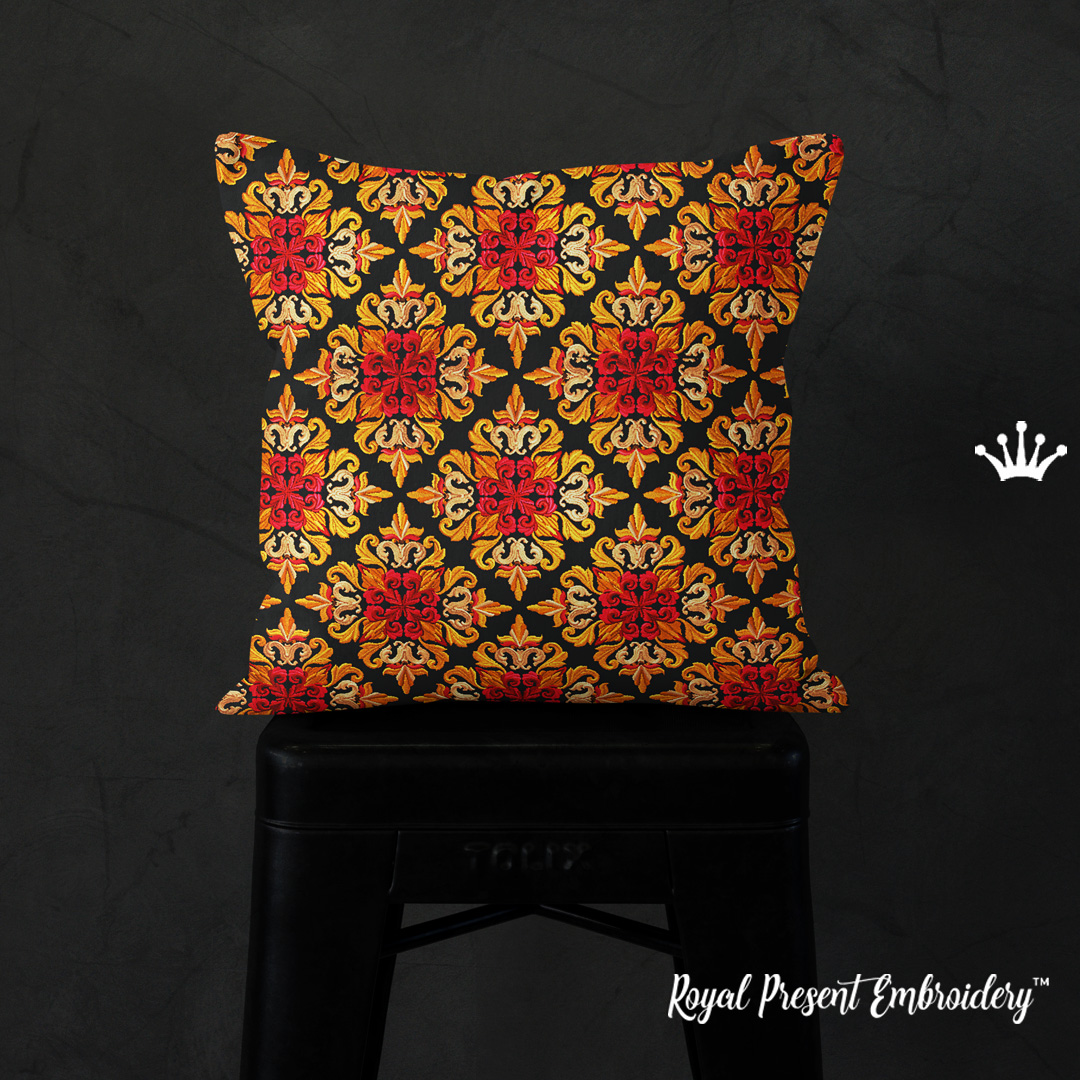
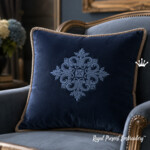
This download includes one dense, square baroque quilt block machine embroidery design in seven separately prepared sizes. Use the ornamental motif on quilt blocks, pillow panels, table runners, placemats, bags and textile wall art; this is a digital embroidery file, not a finished block or physical product. The source color chart shows a red-pink palette, while the blue stitched sample demonstrates how elegant the same design looks recolored tone-on-tone.
Sizes, Stitches and Formats
Size: 98.6x98.6 mm (3.88x3.88 "), Stitches: 28634
Size: 117.6x117.6 mm (4.63x4.63 "), Stitches: 33735
Size: 128.6x128.6 mm (5.06x5.06 "), Stitches: 36527
Size: 148.6x148.6 mm (5.85x5.85 "), Stitches: 42787
Size: 168.6x168.6 mm (6.64x6.64 "), Stitches: 50023
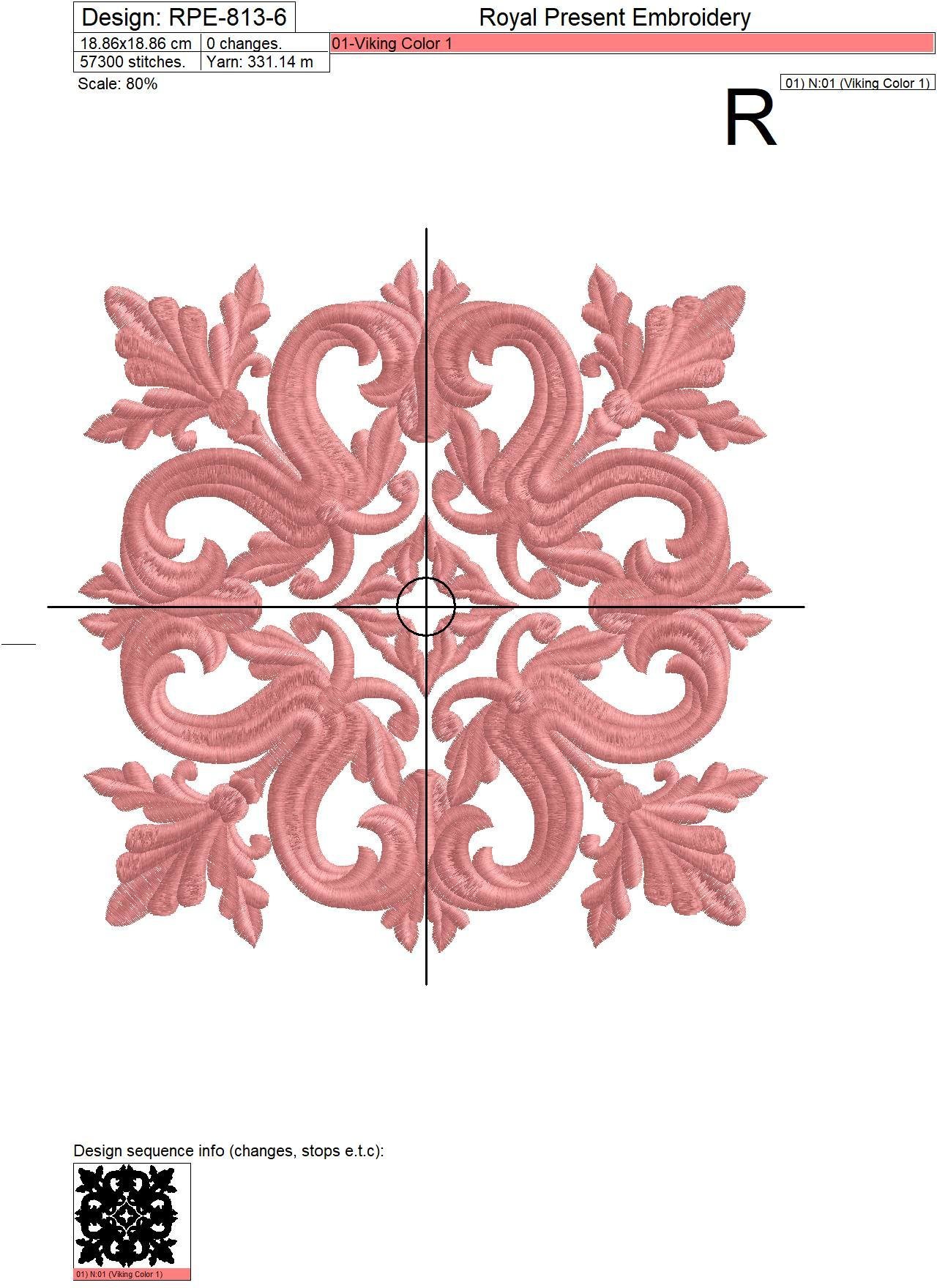
Size: 188.6x188.6 mm (7.43x7.43 "), Stitches: 57244
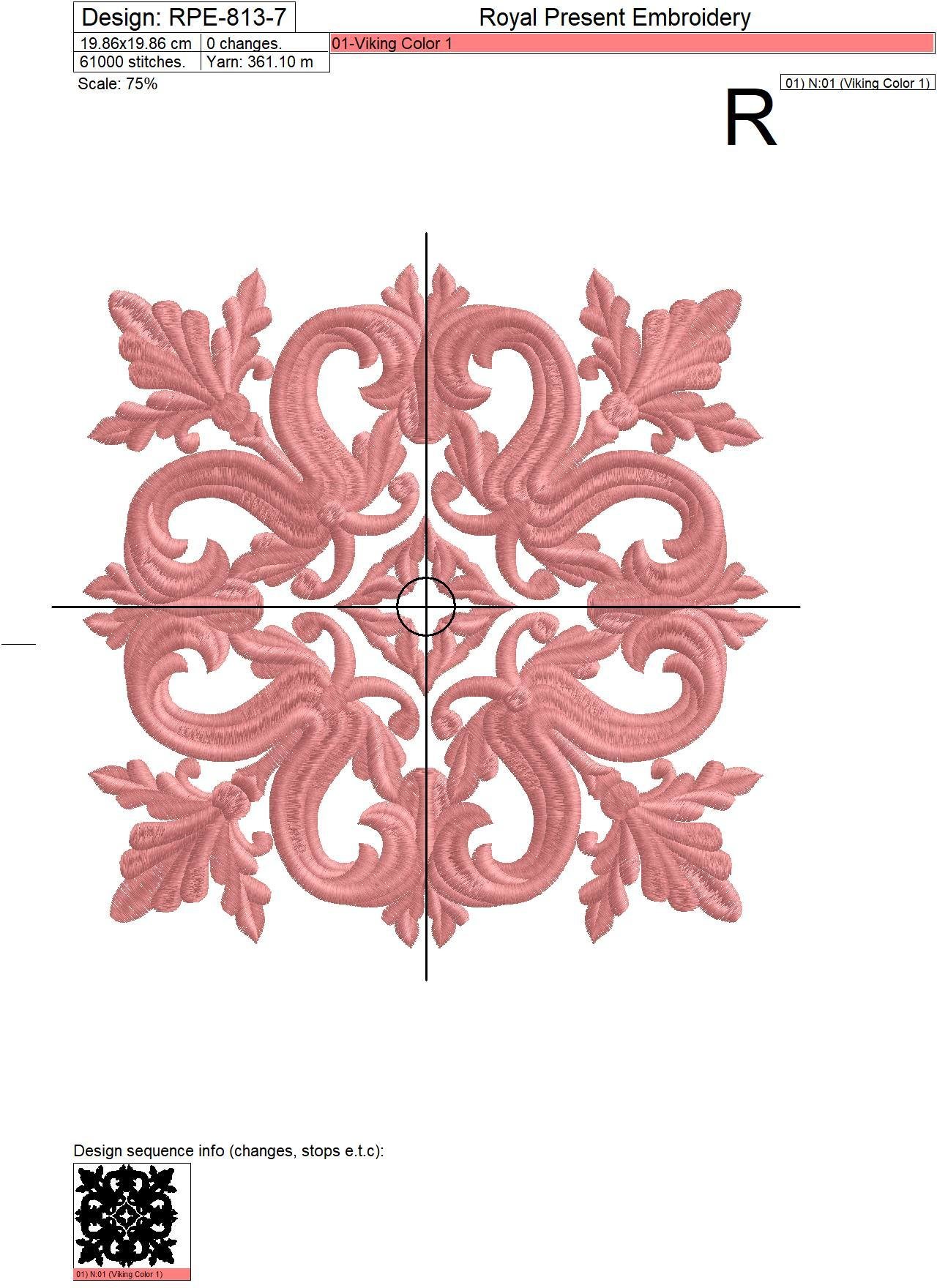
Size: 198.6x198.6 mm (7.82x7.82 "), Stitches: 60975
Formats: .dst, .jef, .pec, .vip, .hus, .pes, .exp, .sew, .dat, .vp3. xxx
Hoop compatibility at a glance: the 98.6x98.6 mm (3.88x3.88 ") file fits a machine with a true 100 × 100 mm (3.94 × 3.94 ") field, commonly called a 4 × 4-inch hoop. A standard 130 × 180 mm (5.12 × 7.09 ") field, commonly called a 5 × 7-inch hoop, accepts the first three files through 128.6x128.6 mm (5.06x5.06 "). A 150 × 240 mm (5.91 × 9.45 ") field, commonly called a 6 × 10-inch hoop, accepts the first four files through 148.6x148.6 mm (5.85x5.85 "). Always compare both file dimensions with the machine’s actual usable field rather than relying only on the hoop name.
Design Specifications
| Included | 1 digital machine embroidery design in 7 prepared sizes |
|---|---|
| Composition | A symmetrical square ornament with a central floral medallion and radiating baroque-style scrollwork |
| Colorway | The source color chart shows red-pink shades; the product photography also shows a blue tone-on-tone version. Thread colors may be changed while the supplied stitching sequence is retained |
| Technique | Standard filled decorative machine embroidery; not appliqué, foundation piecing, edge-to-edge quilting or an ITH block |
| Hooping | Each selected size stitches in one hooping; no split-file alignment is required |
| Stitch range | 28,634–60,975 stitches, depending on the selected size |
| Best fabric type | Stable woven cotton, cotton sateen, medium-weight linen, twill or another fabric capable of supporting dense fill embroidery |
| Delivery | Instant digital download supplied as a ZIP archive with machine files and color information; no physical item is mailed |
Suitable Hoops for All 7 Sizes
| Design size | Suitable hoops | Typical project scale |
|---|---|---|
| 98.6x98.6 mm (3.88x3.88 ") | 4 × 4 inches or larger | Small quilt square, bag panel, placemat detail or compact wall block |
| 117.6x117.6 mm (4.63x4.63 ") | 5 × 5 or 5 × 7 inches or larger | Quilt square, runner block, placemat or tote panel |
| 128.6x128.6 mm (5.06x5.06 ") | 5 × 7 inches or larger | Medium quilt square, cushion insert or table runner block |
| 148.6x148.6 mm (5.85x5.85 ") | 6 × 6 or 6 × 10 inches or larger | Large quilt block, pillow panel, runner or wall hanging |
| 168.6x168.6 mm (6.64x6.64 ") | 7 × 7 or 8 × 8 inches or larger | Large quilt or cushion block and framed textile panel |
| 188.6x188.6 mm (7.43x7.43 ") | 8 × 8 inches or larger | Statement quilt block, 40–45 cm (16–18 ") pillow or wall panel |
| 198.6x198.6 mm (7.82x7.82 ") | 8 × 8 inches or larger | Large pillow center, quilt medallion or textile wall art |
The 198.6x198.6 mm (7.82x7.82 ") file leaves only 1.4 mm (0.06 ") total clearance inside a true 200 × 200 mm (7.87 × 7.87 ") field. Load the file before cutting the final fabric, confirm that the machine accepts it and run the perimeter Trace function; a hoop sold as 8 × 8 inches may have a different usable sewing field.
How to Calculate the Quilt Block Size
The embroidery dimensions are not the dimensions of a finished pieced block. Choose the visible fabric margin first, then add the seam allowance on every side. Use this formula:
Unfinished block width = embroidery width + 2 × visible margin + 2 × seam allowance.
For example, the 98.6x98.6 mm (3.88x3.88 ") motif with a 12.7 mm (1/2-inch) visible border and a 6.35 mm (1/4-inch) seam allowance needs an unfinished square of at least 136.7 × 136.7 mm (5.38 × 5.38 inches). With the same margins, the 198.6x198.6 mm (7.82x7.82 ") motif needs at least 236.7 × 236.7 mm (9.32 × 9.32 inches). Cut the fabric slightly larger again, embroider first, and square the block to its exact unfinished size afterward.
Where to Use the Baroque Quilt Block
| Project | Useful supplied sizes | Planning note |
|---|---|---|
| Patchwork quilt or bedspread | Any supplied size | Embroider separate oversized squares, square every block from the design center, then assemble with identical seam allowances |
| Decorative pillow | 148.6x148.6 to 198.6x198.6 mm (5.85x5.85 to 7.82x7.82 ") | Center the paper template on the unfinished pillow front before adding piping, a zipper or side seams |
| Table runner | 98.6x98.6 to 148.6x148.6 mm (3.88x3.88 to 5.85x5.85 ") | Use one centered block or repeat blocks with a measured gap; complete the full paper layout before the first hooping |
| Placemat | 98.6x98.6 or 117.6x117.6 mm (3.88x3.88 or 4.63x4.63 ") | Place the motif away from the plate and cutlery area and embroider the top panel before adding batting and backing |
| Tote or handbag panel | 98.6x98.6 to 128.6x128.6 mm (3.88x3.88 to 5.06x5.06 ") | Keep the outermost stitches clear of seam lines, handles, pockets and hardware |
| Framed textile art | Any supplied size | Match the paper template to the visible frame opening and leave an even border around the square ornament |
Fabric, Stabilizer and Needle Guide
This design contains 28,634–60,975 stitches and behaves as dense decorative embroidery. A verified buyer specifically reported puckering when the fabric was not firm enough, so the receiving fabric and stabilizer must be selected for the stitch load rather than only for the project type.
| Fabric or project | Recommended support | Practical notes |
|---|---|---|
| Quilting cotton or cotton sateen | One layer of medium-weight cut-away, approximately 50–60 g/m² (1.5–1.8 oz/yd²); add light fusible woven interfacing to very soft cotton before hooping | Hoop fabric and stabilizer together without stretching and use a fresh 75/11 embroidery or sharp needle with 40-weight embroidery thread |
| Medium-weight linen or cotton-linen | Medium cut-away; for an open weave, test two lighter layers placed in different directions | Keep the grain square in the hoop and do not pull the fabric drum-tight to hide slack |
| Twill, canvas or firm furnishing fabric | Medium cut-away or a strong medium tear-away after a complete test stitch | Support the unused fabric at machine-bed height so its weight cannot drag the hoop during long stitch runs |
| Finished quilt sandwich | Not the preferred construction method for this file | Embroider the quilt top block first, then add batting and backing and quilt the layers separately; this decorative motif does not replace structural quilting |
| Light silk, chiffon, organza or stretchy knit | Not recommended without specialist sampling and construction changes | The dense filled square can overpower, perforate or permanently stiffen a light or unstable fabric |
Start around 500–650 stitches per minute and test the complete selected size on the same fabric, thread and stabilizer planned for the finished project. If the fabric begins drawing inward, stop and increase support; tightening or stretching the fabric in the hoop does not correct insufficient stabilization. See the machine embroidery puckering guide.
How to Embroider and Square the Block
- Prewash and press washable fabric so later shrinkage cannot distort the centered ornament.
- Cut the block larger than the final unfinished measurement. Mark its center, horizontal axis, vertical axis and grain direction.
- Print the supplied template at Actual Size or 100% scale. Confirm its stitched width against the selected file dimensions before marking the final fabric.
- Hoop the fabric and stabilizer together without stretching. Match the marked center and axes to the hoop template, then run the machine’s perimeter Trace function.
- Stitch a complete sample first. Use the same fabric, backing, needle, thread and machine settings intended for the project.
- After embroidery, trim the cut-away smoothly without pulling the block, press from the wrong side over a thick towel, then square the block from the embroidery center and add the planned seam allowance.
When making several blocks, use the same size file for every repeat and square each piece from the design center rather than from the original raw fabric edges. This prevents small hooping differences from accumulating across the quilt layout.
Tone-on-Tone and Interior Color Variations
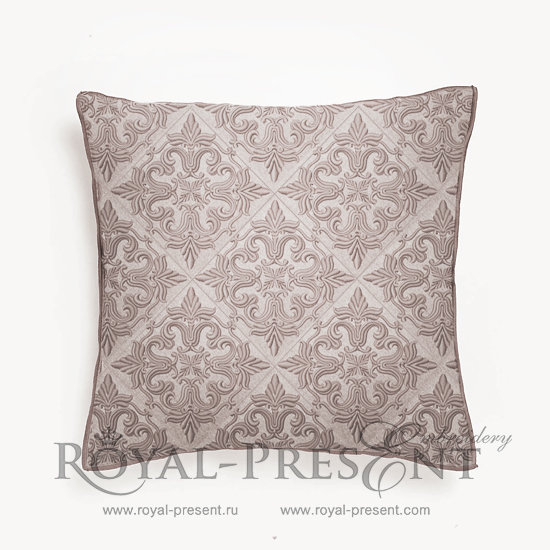
The source color chart shows the design in red-pink shades, but the blue sample on the product page proves that recoloring is part of the design’s decorative potential. For a sophisticated tone-on-tone result, use thread one or two value steps lighter than a dark fabric, or one or two value steps darker than a light fabric. On beige, ivory or gray fabric, the embroidery can instead repeat an accent color already used elsewhere in the room, such as blue from the china, curtains, upholstery or cushions.
Keep every supplied color stop in its original order even when you use one spool for the whole design. The stops may separate overlapping stitched layers, and merging them can change the way the ornament builds. Test the complete selected size on the final fabric because rayon sheen, pile direction and room lighting change the apparent contrast.
Five Interior-Friendly Fabric and Thread Combinations
| Interior palette | Fabric color | Embroidery thread | Why it works | ||
|---|---|---|---|---|---|
| Beige and muted blue |
|
|
A quiet neutral ground lets the embroidery repeat a blue accent from china, curtains or upholstery without making the textile look busy. | ||
| Ivory and warm taupe |
|
|
The thread is several value steps darker than the fabric, so the baroque drawing remains legible while the palette stays soft and classical. | ||
| Pale sage and deep sage |
|
|
This same-hue, darker-thread combination suits botanical, English-country and calm natural interiors. | ||
| Dusty rose and burgundy |
|
|
The darker wine shade gives the pink family depth and works especially well with walnut wood, antique brass and cream textiles. | ||
| Navy and pale blue |
|
|
A lighter thread keeps the ornament visible on dark fabric while preserving the refined monochrome effect shown in the blue product sample. |
The fabric and thread squares are approximate screen references, not color-matching standards. Confirm the Madeira number against a physical Madeira Classic shade card, then stitch a sample on the actual fabric before beginning the finished project.
Coordinating Quilt Block Designs
These square ornamental designs coordinate with the baroque character of this block. The images below use the styled product photographs from their product pages rather than technical color-chart previews.
 Acanthus Quilt Block Peacock Color – 7 sizes Acanthus Quilt Block Peacock Color – 7 sizes |
 Medieval Acanthus Quilt Block – 7 sizes Medieval Acanthus Quilt Block – 7 sizes |
 Medieval Acanthus Renaissance Style – 7 sizes Medieval Acanthus Renaissance Style – 7 sizes |
 Acanthus Quilt Block – 3 sizes Acanthus Quilt Block – 3 sizes |
Browse all machine embroidery designs for quilt blocks.
Frequently Asked Questions
Which sizes fit 4 × 4 and 5 × 7-inch hoops?
A 4 × 4-inch hoop with a true 100 × 100 mm (3.94 × 3.94 ") field accepts only the 98.6x98.6 mm (3.88x3.88 ") file. A 5 × 7-inch hoop with a true 130 × 180 mm (5.12 × 7.09 ") field accepts the 98.6x98.6, 117.6x117.6 and 128.6x128.6 mm files (3.88x3.88, 4.63x4.63 and 5.06x5.06 "). The next size, 148.6x148.6 mm (5.85x5.85 "), does not fit because both sides exceed the 130 mm (5.12 ") width.
How do I prevent puckering in this dense quilt block design?
Use stable woven fabric with medium-weight cut-away support, hoop the fabric and stabilizer together without stretching, and test the complete selected size. Begin around 500–650 stitches per minute with a fresh 75/11 needle. If the fabric draws inward, add support rather than tightening the fabric more aggressively in the hoop.
Is this an in-the-hoop, appliqué or quilting design?
No. It is a dense decorative embroidery motif stitched onto a prepared fabric square. The files do not piece fabric, secure batting, create seam allowances or quilt the top, batting and backing together. Embroider and square the top block first, then assemble and quilt the project separately.
Can I embroider this design in one color or tone-on-tone?
Yes. Leave the same spool in the machine but keep every supplied color stop in its original order. For a tone-on-tone interior look, choose thread one or two value steps lighter than dark fabric or one or two steps darker than light fabric. The blue product sample is an example of recoloring the red-pink source palette without changing the digitized design.
Can I resize the design to another quilt block measurement?
Use one of the seven separately prepared sizes whenever possible. Simple coordinate scaling can change fill density, stitch length, satin width and underlay, especially in the 28,634–60,975-stitch files. If another size is essential, request an assessment through the professional design resizing service; not every reduction or enlargement is technically safe.
Baroque Quilt Block Machine Embroidery Design - 7 sizes
Baroque Quilt Block Machine Embroidery Design - 7 sizes
Your designs are beautiful but I am inexperienced with such a dense design and my stitching out was very puckered but I emailed you and received a reply with suggestions which I am grateful for and will have another go which I am sure will be more successful. In our embroidery class a similar design was purchased by another lady, stitched out on very firm fabric and looks magnificent. Tutorials for members would be great. Regards
Royal P.

 Get Sign-In Link
 Login with Google
 Login with Facebook
 Login with Amazon
 Login with Paypal